Minipg: Packaging PostgreSQL into a Single Executable File
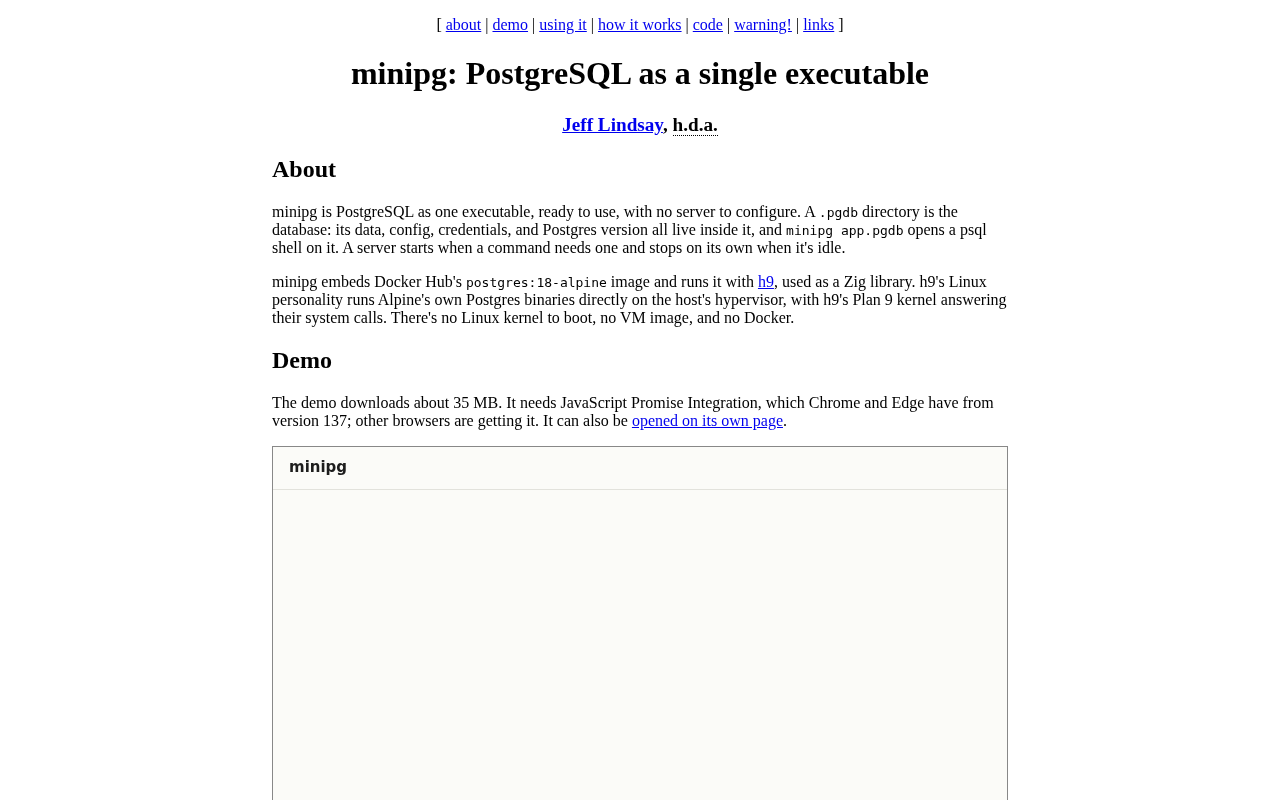
Minipg packages PostgreSQL into a single executable, simplifying deployment but not changing its resource requirements.
The Minipg project attempts to encapsulate PostgreSQL and its runtime dependencies into a single executable that self-extracts and launches the database service at runtime, eliminating the installation packages, dependency libraries, and configuration steps of traditional deployment. The article analyzes the value of this approach: environment consistency, fast startup, and lower barrier to entry, making it suitable for development/testing, CI/CD, and edge computing scenarios. It also notes that single-file packaging only addresses distribution convenience, not PostgreSQL's resource requirements or operational complexity; production environments still need standard operations systems, and the self-extracting mode brings security auditing and upgrade path considerations. The project has received significant attention on Hacker News, reflecting genuine community demand for simplified database deployment.
Why Cram a Database into a Single File?
Turning PostgreSQL into a single executable file sounds like a geeky obsession with tidiness, but it actually points to a long-standing pain point in database deployment. The Minipg project is trying to solve exactly this: letting this powerful relational database run anywhere with zero dependencies.
Traditionally, deploying PostgreSQL involves handling installation packages, dependency libraries, configuration files, data directory permissions, and a whole series of steps. For development environment setup, CI/CD pipelines, edge computing, or embedded scenarios, this complexity often becomes a barrier. Minipg's approach is straightforward—pack all necessary components into a single binary file that self-extracts and starts at runtime, thereby eliminating the friction of environment configuration.
On Hacker News, this project received 259 points and 39 comments, indicating genuine community interest in "single-file databases."
Minipg's Technical Approach
According to the project page, Minipg encapsulates PostgreSQL and its runtime dependencies into a single executable file. Users can download and run it directly to get a usable database instance without pre-installing PostgreSQL or any system libraries.
This packaging approach typically involves embedding the database binaries, necessary shared libraries, initialization scripts, and default configurations into a self-extracting archive. On startup, the executable extracts the contents to a temporary directory (or a user-specified location) and then launches the PostgreSQL service as a subprocess.
From a practical standpoint, this brings several direct benefits:
- Environment consistency: Development, testing, and production environments can use exactly the same binary, reducing "works on my machine" issues.
- Fast startup: Eliminates installation steps, suitable for temporary scenarios that require frequent creation and destruction of databases.
- Lower barrier to entry: More friendly to developers unfamiliar with PostgreSQL system administration—a single command yields a usable instance.
However, single-file packaging also means bloated size and decompression overhead at startup, which needs to be weighed in resource-constrained environments.
A self-extracting archive is a technique that combines compressed data with a decompression program into a single executable file. At runtime, the file first executes the embedded decompression logic, extracts the contents to a specified directory, and then executes the target program. In database packaging scenarios, this approach needs to handle the choice of extraction target path (temporary directories may be cleaned up, persistent paths require permissions), distinguishing first startup from subsequent startups (whether the data directory has been initialized), and port and file lock conflicts when multiple instances run concurrently. Additionally, the startup delay and disk usage caused by self-extraction are direct costs, typically mitigated by caching extraction results or on-demand extraction.
Applicable Scenarios and Limitations
Minipg's most natural landing spot is development and testing environments. Quickly spinning up a database locally, providing a real PostgreSQL instance for integration tests in CI, or avoiding complex installation instructions in demo environments—these are all its use cases.
Edge computing and embedded computing are also potential directions. When devices cannot easily install system packages, a database executable that bundles all dependencies can significantly simplify deployment.
But it's important to recognize clearly that single-file packaging does not change PostgreSQL's own resource requirements. It solves distribution and deployment convenience, not performance or size optimization. For production environments requiring high availability, backup and recovery, monitoring, etc., a standard operations system is still needed. Additionally, the self-extracting mode may bring extra considerations for security auditing—the contents inside the executable need to be trusted.
PostgreSQL uses a multi-process architecture, where each client connection corresponds to a backend process and relies on shared memory for inter-process communication. This means that even when packaged as a single file, the runtime still requires the operating system to provide shared memory, semaphores, and sufficient process count limits. In containers or restricted environments, the size of /dev/shm and kernel parameters (such as semaphore limits related to max_connections) may become hidden constraints. Understanding this helps assess Minipg's practical feasibility on edge devices: single-file solves the distribution problem, while PostgreSQL's architecture determines that it still has specific requirements for the runtime environment.
The Bigger Picture of Single-File Databases
Minipg is not an isolated phenomenon. In recent years, the trend of packaging complex services as single binaries or container images has become increasingly prominent, driven by "reducing operational cognitive load." SQLite has long been known as a single-file database, but it has clear boundaries in concurrency and functionality. Minipg represents another approach: preserving full PostgreSQL capabilities while compressing deployment complexity as much as possible.
According to the project page and Hacker News discussions, community interest in such tools centers on the balance between ease of use and production readiness. Some commenters are concerned about whether this packaging approach affects upgrade paths and the extension ecosystem—these are questions the project will need to answer going forward.
For developers who work with PostgreSQL daily, Minipg offers a noteworthy new option. It won't replace standard installation methods, but in specific scenarios it can save considerable time and hassle.
SQLite is the typical representative of embedded databases—it stores the entire database as a single file, linked into the application process as a library, without a separate service process. Its boundary lies in write concurrency being limited by file locks, and lacking a network access protocol and fine-grained permission system. Minipg differs from SQLite in positioning: the former preserves PostgreSQL's client-server model, full SQL capabilities, and extension ecosystem, only compressing the distribution form; the latter trades in-process embedding for minimalist deployment. The two are not substitutes but correspond to different concurrency requirements and operational assumptions.
Related articles

Garmin Forerunner 265S Drops to Lowest Price of the Year: A Balanced Choice for Small-Wristed Runners
Garmin Forerunner 265S drops to $300, its lowest price of the year. This small-wrist-friendly running watch features an OLED touchscreen, good battery life, and was called a balanced choice in testing.

Will AI End Our Careers?
Hacker News buzzes over 'AI may end our careers.' This article analyzes the real basis of this anxiety, the difference between task replacement and occupational reshaping, and response strategies for tech professionals.
DeepSeekMath: An Open-Source Model Pushing the Limits of Mathematical Reasoning
DeepSeekMath is the math-reasoning-focused direction in the DeepSeek series, aiming to push the boundaries of LLM mathematical derivation. This article explains its positioning, community concerns, and practical implications for developers.