Mistral Large 4 Hands-On: How Good Is This Trillion-Parameter MoE Model at Coding?

Mistral Large 4 hands-on: benchmarks lead peers, coding is usable but flawed—a pragmatic Western open model.
Mistral AI released Mistral Large 4, codenamed "LeChonk," a 1T-parameter MoE model activating 49B parameters, supporting text and image input with a 1M-token context, with weights due by end of October. It scores 62% on DeepSwee (above GLM 5.3), 28% on TerminalBench (beating larger Kimi K3 and QN 3.8 Max), and 15% on the Harvey legal agent benchmark. Hands-on tests produced a working Three.js 3D island game and a website (main flaw: emoji instead of icons). Available via Mistral API and OpenRouter at 50% off ($0.68 input / $2.09 output per million tokens). The verdict: not the best open-weight model at its size, but among the better open models from Western labs.
Mistral AI recently released Mistral Large 4, codenamed "LeChonk." It's a 1-trillion-parameter Mixture-of-Experts (MoE) model that activates 49 billion parameters per pass, supports text and image input, and has a context window of 1 million tokens. Mistral plans to release the model weights by the end of October. Based on a hands-on YouTube video, this article evaluates the model's real-world performance from two angles: benchmark tests and practical coding tasks.
Benchmarks: Leading Its Peers on Multiple Metrics
The published benchmark data shows that Mistral Large 4 performs notably well. It scores 62% on DeepSwee, slightly above GLM 5.3's 61%. On TerminalBench it scores 28%, surpassing Kimi K3 and QN 3.8 Max—interestingly, both of those models are larger than Mistral Large 4. On the Harvey legal agent benchmark, it achieves 15%, the highest among the models shown in the chart.
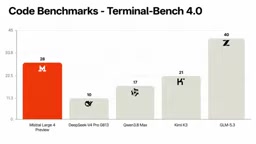
These figures suggest that Mistral Large 4 is competitive on reasoning and domain-specific tasks, particularly in terms of parameter efficiency. That said, benchmarks are idealized environments; real-world performance still needs to be verified through actual tasks.
Mixture-of-Experts (MoE) architecture: An MoE model consists of multiple "expert" sub-networks plus a gating router network. Each token is routed to only a few experts for computation, so the total parameter count (here 1 trillion) far exceeds the number of parameters actually activated per token (here 49 billion). This design lets the model store a large amount of knowledge while keeping the computational cost of a single inference pass relatively small—which is the technical source of the "parameter efficiency" highlighted in the original. The trade-off is that VRAM must still hold all expert weights, and uneven routing can affect training stability.
Context window and long context: The context window is the upper limit on the number of tokens a model can process in a single call; 1 million tokens is roughly equivalent to hundreds of thousands of Chinese characters or hundreds of pages of documentation. Long-context capability relies on techniques such as positional encoding extrapolation, attention sparsification, or chunked processing—it's not simply a matter of increasing the window size. The effective length is often shorter than the nominal value, and evaluations frequently require "needle-in-a-haystack" tests to verify it.
Hands-On Coding: 3D Games and Website Building
The video creator called Mistral Large 4 through a custom paid endpoint in VS Code and ran three coding tests.
3D Island Exploration Game
The first test was building a 3D island exploration game with Three.js. After receiving the prompt, the model entered a thinking state, then generated an HTML file and ran a syntax check. The final product ran well in the browser: the island, trees, rocks, and character visuals were well coordinated, and movement and camera controls worked properly. For a single-shot generation, the level of completion was satisfying.

Website Build
The second test was building a website with a hero section, pricing cards, an FAQ, and micro-interactions. The model generated all the requested sections, the layout was normal, and the page structure matched expectations. One obvious flaw: in some places it used emoji instead of proper icons. Aside from that, the website's functionality met the prompt's requirements.
Another Game
The author also tested another game; movement controls, the scoring system, and visuals all worked properly.

Three.js: A JavaScript 3D graphics library based on WebGL that lets developers build 3D scenes, models, lighting, and camera controls in the browser without directly writing low-level shaders and rendering pipelines. In the original tests, the islands, trees, characters, and movement/camera logic generated by the model were all implemented through Three.js objects such as Scene, Mesh, and Camera. What it tests in a model is whether it can correctly organize the scene graph structure and handle the render loop and input events—not just output syntactically correct code.
TerminalBench and the Harvey benchmark: TerminalBench targets agent tasks in command-line terminal environments, evaluating a model's completion rate on real shell operations and multi-step tool calls; a low score usually indicates that agent capabilities remain a weak spot. The Harvey benchmark targets legal domain tasks, assessing model performance in scenarios such as contract analysis and legal reasoning. These domain benchmarks complement general code benchmarks and more precisely reflect a model's usability in vertical scenarios.
Availability and Pricing
Mistral Large 4 is currently available through the Mistral API and OpenRouter. On OpenRouter there's currently a 50% discount: $0.68 per million input tokens and $2.09 per million output tokens. Since the weights haven't been released yet, there's no free way to use it for now. For developers who want to try it at low cost, OpenRouter's discounted price is a reasonable entry point.
OpenRouter and API pricing: OpenRouter is a unified API gateway that aggregates multiple model providers; developers can switch between vendors' models using the same interface and key, with billing per token. The "$0.68 per million input tokens, $2.09 per million output tokens" in the article is a typical pay-as-you-go model—output usually costs more than input because the generation phase is more compute-intensive. The 50% discount is a limited-time promotion; actual costs vary with traffic, cache hits, and context length, and the real bill for long-context tasks can be significantly higher than the nominal unit price.
Overall Assessment: A Pragmatic Choice Among Western Labs
The author's conclusion is notably measured: Mistral Large 4 is not the best open-weight model at its size, but among the products of Western labs it still ranks among the better open models. Based on the hands-on tests, it's "pretty good"—not perfect, but not bad either.
This assessment reflects the current competitive landscape for open models: Chinese labs are pushing aggressively in the open-weight space, while Mistral, as Europe's representative, has maintained its own strengths in parameter efficiency and multimodal capability. For teams that need text + image input, long context, and prefer a Western vendor, Mistral Large 4 deserves a place on the evaluation shortlist.
Once the weights are open, the model's accessibility and community ecosystem will face their real test. At that point, broader developer feedback will provide the final answer.
One-line Summary
Mistral Large 4 hands-on: benchmarks lead its peers, coding is usable but flawed—a pragmatic open-source choice in the Western camp.
Paragraph Summary
Mistral AI released Mistral Large 4, codenamed "LeChonk," a 1-trillion-parameter MoE architecture activating 49 billion parameters per pass, supporting text and image input with a 1-million-token context window, with weights planned for release by the end of October. In benchmarks, it scores 62% on DeepSwee, slightly above GLM 5.3; 28% on TerminalBench, beating the larger Kimi K3 and QN 3.8 Max; and tops the displayed models on the Harvey legal agent benchmark with 15%. In hands-on coding, it successfully generated a working Three.js 3D island exploration game and a website with a hero section, pricing cards, and an FAQ in one shot; the main flaw was using emoji instead of proper icons on the website. It's currently offered via the Mistral API and OpenRouter, with OpenRouter's 50%-off pricing at $0.68 input and $2.09 output per million tokens. The author's assessment is measured: it isn't the best open-weight model at its size, but it remains one of the better open models among Western labs.
Related articles

Malicious Claude Code Extension Infiltrates Cursor: Version 2.1.313 Self-Check and Cleanup Guide
A malicious Claude Code build 2.1.313 appeared in the Cursor extension marketplace for about 11 hours, affecting up to 5,000 users. StepSecurity disclosed that it stole system information, git email, and environment variable names, and attempted to implant SSH keys and reverse tunnels. This article covers the incident, malicious behavior, and complete self-check and cleanup steps.

15 Essential Prompts for Vibe Coding: Keep AI from Wrecking Your Code
Vibe Coding often tempts AI to break your code. These 15 prompts—from PRD, architecture, and database to testing and debugging—chain each output as the source of truth, turning AI coding from casual chat into a controllable engineering process.

Cursor vs Windsurf: Code Review or Direct Apply — Which Fits You Better?
Cursor shows a diff for review before changing code; Windsurf applies changes directly. We analyze how each mode affects your workflow and cover Cursor 2.0's multi-agent mode.