Mistral Open-Sources Trillion-Parameter Large 4 Weights—Can Your Computer Handle It?

Mistral open-sources trillion-parameter Large 4 weights, with MoE architecture activating only 49 billion parameters per pass.
French AI company Mistral has open-sourced the weights of its trillion-parameter Large 4 (nicknamed LeChunk) model, free for individuals, schools, and normal commercial use, with authorization required only for reselling as a cloud service. The model uses a Mixture of Experts architecture with 128 experts per layer, activating only about 49 billion parameters at a time, and supports million-token context with up to 2048 indexed selections. It scores 48% on the programming agent leaderboard, essentially tied with GLM5.3 but with 47% fewer tokens per task; it scores 41% on TerminalBench 4.0. Even the two-bit compressed version still requires an Apple Ultra computer with 512G of unified memory to run, making it difficult for ordinary laptops to handle. It scores 82% on cybersecurity tasks and has a 96.6% refusal rate for malicious requests, the highest among open-source models.
French AI company Mistral recently did something that sent shockwaves through the open-source community: it released the weights of its trillion-parameter Large 4 model for direct public download. The first reaction for many was "download first, think later," but on reflection, a model of this size is far from friendly to ordinary users' hardware. This article uses the "128-person class of top students" analogy from the original material to explain this giant clearly.
What the Model Is: Large 4 and "LeChunk"
Mistral is a French AI company, and the model released this time is called Large 4, nicknamed "LeChunk," an internet meme that roughly means "chunky pile." According to a Bilibili video introduction, the model first launched a preview version earlier this month, then underwent three more weeks of extra training, with an improved version of the weights released on October 29. It has image understanding capabilities and extremely long document reading capabilities.
So-called "open weights" can be understood as packaging the entire trained "brain" and giving it to users, who can download it and use it however they like at home—modify it or continue training it. It's free for individuals, schools, and normal business use, with only one restriction: if a cloud platform resells it as a service, it needs to obtain authorization from Mistral first.
One Trillion Parameters, but Only 49 Billion Active During Work
What does one trillion parameters actually mean? To use an analogy, this model is like a class of 128 top students, each with their own area of expertise. More precisely, it has such a "class" in every layer, and all their brains combined equal one trillion parameters. But during work, only about 49 billion are activated at a time—less than one-twentieth.
What are the rest doing? Dozing off. Who calls the roll? The class monitor. For every character that comes in, the monitor takes a look at what kind of problem it is and picks four of the most relevant people from the 128; there's also a "study committee member" who is present no matter what the problem is. Four plus one—five people take the stage, and the other 123 keep sleeping. This approach has a name: Mixture of Experts (MoE).
It has a second labor-saving trick: the model can hold one million tokens at a time, like a big stack of notes on the desk, but it won't flip through the entire stack from beginning to end—instead, there's a dedicated index manager that picks out the most relevant spots, up to 2048 of them, and only looks at those. One picks people, the other picks pages—both forms of "laziness" save compute.
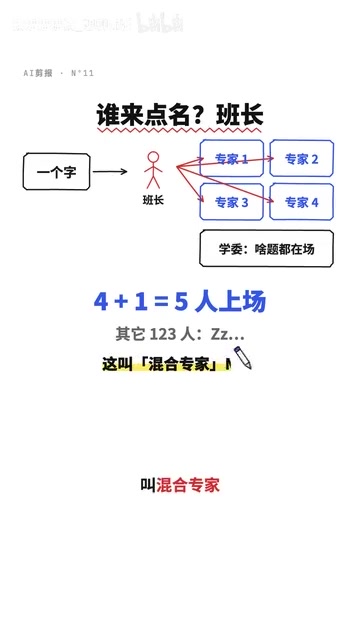
The core idea of the Mixture of Experts (MoE) architecture is "many parameters, little computation": the total parameter scale of the model can be enormous, but each forward pass only activates a small portion of it. A typical implementation places several "expert" subnetworks in each layer, and then a lightweight router (gating network) selects the top-k experts with the highest scores based on the current token's representation to participate in computation, while the remaining experts do not participate in this forward or backward pass. Therefore, MoE's memory footprint depends on the total parameter count (all experts must reside in memory), while compute consumption depends on the activated parameter count. This also explains the "only 5 people called from a class of 128" analogy in the article: you need to reserve 128 beds, but only wake up 5 to work at a time. In addition, the "study committee member" can be understood as a shared expert, which is activated for all tokens and carries general knowledge and stabilizes router training. The difficulty of MoE lies in load balancing: if the router always favors a few experts, it causes insufficient training and wasted memory/compute, typically requiring an auxiliary load-balancing loss as a constraint.
Tokens and context windows: A token is the basic unit of text processed by a model, roughly corresponding to a word or part of a word; in Chinese it's often about one to two characters. The phrase "can hold one million tokens at a time" in the article refers to the model's context window reaching the million level, meaning it can read extremely long documents, code repositories, or multi-turn conversation histories in one go. However, the computation and memory overhead of attention mechanisms grow rapidly with context length, so long-context models generally adopt sparse attention/retrieval-based attention: instead of comparing all historical tokens pairwise, they first use indexing or retrieval to pick out the positions most relevant to the current token (up to 2048 in the article) and then compute attention. This and MoE's "picking experts" are two different types of sparsification: one saves parameter activation, the other saves attention computation—only by combining both can costs be brought down to an acceptable range under million-token contexts.
Report Card: Programming and Terminal Task Performance
On the Artificial Analysis programming agent leaderboard, Large 4 scored 48%, essentially tied with the open-source leader GLM5.3, but used 47% fewer tokens per task on average. Put simply, for the same score, others use a whole stack of scratch paper while it uses half a stack; fewer tokens means a cheaper bill.
The official price is $0.7 per million input tokens and $2.1 per million output tokens.

On TerminalBench 4.0, which involves writing code in the terminal, it improved 13 percentage points over the preview version from three weeks earlier to reach 41%, and Mistral claims it ranks first among open-source models.
Can You Take It Home and Run It? 512G of Memory Is the Threshold
Hugging Face helped run tests: compressing the model to a two-bit version requires an Apple Ultra computer with 512G of unified memory to fit it. Common laptops have only 16G or 32G of memory, and running it produces about 15 tokens per second.
Why does it take up so much space when only 49 billion are active at a time? Because the 123 sleeping people still need their beds reserved.
There are also several points that need to be viewed calmly. First, two-bit is compressed—like condensing a top student's notes into shorthand; the more aggressively you compress, the more likely details are lost. Second, its "thinking" can't be turned off; as long as it's a machine with only low, medium, and high defaults where high is the default, even simple questions require drafting first. Third, most of the scores above come from Mistral's own release article, and whether it's actually good in practice still awaits more people trying it out.

Quantization and "two-bit": Model weights are typically stored as 16-bit floats by default, with each parameter taking 2 bytes; quantization uses lower bit widths (such as 8-bit, 4-bit, 2-bit) to approximately represent weights, thereby compressing memory requirements multiplicatively. A rough calculation: one trillion parameters at 16-bit requires about 2TB, and compressing to 2-bit is theoretically on the order of 250GB, plus inference caches, routing, and runtime overhead, which lands at the "512G unified memory" tier mentioned in the article. Unified memory refers to Apple M-series chips' CPU and GPU sharing the same memory pool, so models far exceeding discrete GPU memory can be placed on the machine, at the cost of limited memory bandwidth and slower generation speed (about 15 tokens per second in the article). The lower the bit width, the greater the rounding error of weights, and the more likely the model is to "lose details" in complex reasoning and long-tail knowledge—this is also why the article reminds us that "two-bit is compressed."
The Card It Most Wants to Play: Cybersecurity
The capability Large 4 most wants to emphasize is actually cybersecurity. One test has the model first reproduce a real vulnerability in open-source software, then patch it. Mistral claims several open-source large models score near zero on this task because they directly refuse to do it; Large 4 scored 82%. When encountering malicious attack requests, it refuses an average of 96.6%, the highest among open-source models. "The plumber has to first find where the leak is."
For ordinary people, in the short term they will most likely still use it through web pages and APIs. But the real change is this: trillion-level models can be moved into a company's own data center, with data never leaving and modifications made as desired. The class of top students doesn't have to borrow from someone else's school every time—the whole class can be invited home, provided there are 512G of "beds" at home.
What about you? If you really had such a machine, what's the first thing you'd have it help you do?
Evaluations such as vulnerability reproduction and patching test the model's agent capabilities: the model needs to autonomously execute commands in a terminal or code environment, read source code, construct trigger conditions, verify vulnerabilities, then provide patches and test their effectiveness. The difference from single-turn Q&A is that it requires multi-step planning, tool calling, and error correction based on environment feedback, so benchmarks like TerminalBench for "real terminal tasks" are commonly used to measure it. Refusal rate measures the degree of safety alignment of the model against malicious requests: too high and it harms legitimate security research (such as penetration testing and vulnerability discovery), too low and there is a risk of abuse. The line "the plumber has to first find where the leak is" in the article highlights this trade-off—for defensive security scenarios, the model needs the ability to identify and reproduce vulnerabilities while maintaining a high refusal rate for other clearly offensive requests. This boundary of "knowing when to do it and when to refuse" is precisely the difficulty of safety alignment in real products.
One-line Summary
Mistral open-sources trillion-parameter Large 4 weights, with MoE architecture activating only 49 billion parameters per pass.
Paragraph Summary
French AI company Mistral has open-sourced the weights of its trillion-parameter Large 4 (nicknamed LeChunk) model, free for individuals, schools, and normal commercial use, with authorization required only for reselling as a cloud service. The model uses a Mixture of Experts architecture with 128 experts per layer, activating only about 49 billion parameters at a time, and supports million-token context with up to 2048 indexed selections. It scores 48% on the programming agent leaderboard, essentially tied with GLM5.3 but with 47% fewer tokens per task; it scores 41% on TerminalBench 4.0. Even the two-bit compressed version still requires an Apple Ultra computer with 512G of unified memory to run, making it difficult for ordinary laptops to handle. It scores 82% on cybersecurity tasks and has a 96.6% refusal rate for malicious requests, the highest among open-source models.
Related articles
DeepSeek Open-Sources DeepInfer: What Is an Inference Framework Actually For?
DeepSeek open-sources its inference framework DeepInfer under Apache 2.0, supporting DeepSeek V4.1 Flash offline inference. This article explains its request scheduling, FlashMLA/DeepGEMM compute optimization, DSPark speculative verification acceleration, and what it means for developers and ordinary users.
Open-Source AI Learning Agent: A Full Workflow Experience from Topology Graphs to Exam Generation
Explore an open-source AI learning agent: built on DeepSeek API, it constructs knowledge systems via topology graphs, with automatic document generation, notes, super documents, and exams. Learn about its Agent workflow and design highlights.

DeepSeek Whale Girl Open-Source MV Meme: AI Industry Coded Slang About Pivoting to Closed Source
Bilibili's DeepSeek Whale Girl rap MV uses fictional memes to tease the AI open-source vs. closed-source debate, with lyrics full of industry slang. This article explains the meme culture, the Whale Girl symbol, and the open/closed tension.