MIT Launches Dear Dreamer: A Free Platform for Youth Entrepreneurship Education

MIT's Martin Trust Center launches Dear Dreamer, a free platform bringing entrepreneurship education to middle and high school students.
MIT's Martin Trust Center recently launched Dear Dreamer, a free entrepreneurship learning platform for middle and high school students, led by Managing Director Bill Aulet. The platform aims to fill the gap in youth entrepreneurship education resources, guiding students to take their first entrepreneurial step as an entry-point tool, with content designed around topics they can understand and act on, reflecting MIT's philosophy of promoting the "democratization of entrepreneurship." The article notes that entrepreneurship education is extending from universities to K-12, similar to the spread of coding education; meanwhile, generative AI tools lower the practical barrier for youth to go from idea to prototype and can complement entrepreneurship education. The platform's success hinges on "simplifying without distorting," and its long-term sustainability depends on continued investment from MIT and related foundations.
A New Entry Point for Entrepreneurship Education
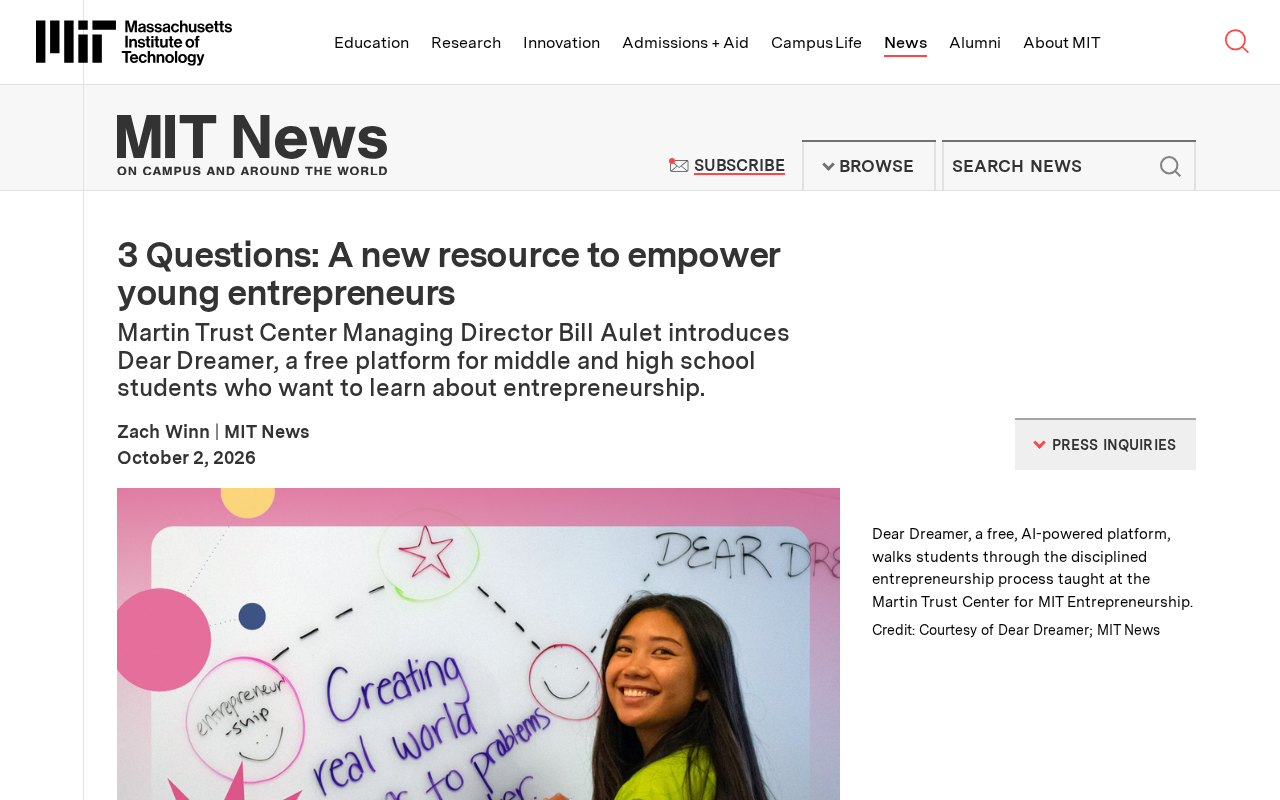
MIT's Martin Trust Center recently launched a free platform called Dear Dreamer, open to middle and high school students to help them explore and learn about entrepreneurship. The project is led by Bill Aulet, the center's managing director, who explained the resource's positioning and goals in an interview.
According to the official introduction, Dear Dreamer is not a traditional course platform, but rather an entry-point tool that guides young people to take their first step into entrepreneurship. It carries on MIT's long-standing accumulation in entrepreneurship education—the Martin Trust Center itself is the core hub of MIT's entrepreneurial ecosystem, having incubated a large number of hard-tech and software startups. Bringing this experience down to the middle and high school level is what makes the platform most noteworthy.
The Martin Trust Center for MIT Entrepreneurship is an entrepreneurship education and incubation institution under the MIT Sloan School of Management, founded in the 1990s. It has long provided entrepreneurship courses, mentor guidance, office space, and seed funding connections for MIT students, alumni, and faculty. It is not an ordinary university entrepreneurship club, but the core node of MIT's entire entrepreneurial ecosystem: according to MIT's official statistics, there are more than 30,000 active companies founded by MIT alumni, with combined annual revenue of approximately $1.9 trillion, many of which received early support from the center. Courses offered by the center, such as "Entrepreneurship and Innovation" and the famous "Disciplined Entrepreneurship" methodology, were developed under the leadership of Bill Aulet and others, and have since been adopted by universities and incubators worldwide. Understanding this background helps clarify that Dear Dreamer is not an isolated product, but an attempt by MIT to export decades of entrepreneurship education experience to a younger demographic.
What Problem Does Dear Dreamer Solve
In the interview, Bill Aulet mentioned a core contradiction: young people's interest in entrepreneurship is growing, but systematic resources truly suited to their age group are scarce. Most entrepreneurship content on the market is aimed at college students or adults, and the language, case studies, and tools are too advanced for middle and high school students.
Dear Dreamer attempts to fill this gap. The platform is offered free of charge, lowering the economic barrier, while its content is designed around topics that middle and high school students can understand and act on. This aligns with MIT's recent push for the "democratization of entrepreneurship"—entrepreneurship should not belong only to students at a few elite schools, but should become a way of thinking accessible to a broader population.
For young people in the AI era, this platform has an additional layer of significance: generative AI tools are dramatically shortening the path from "idea to prototype." A middle or high school student can now use AI to assist with market research, copywriting, and even simple product demos. If Dear Dreamer can work in tandem with these tools, it will significantly boost young people's practical efficiency.
"Democratization of entrepreneurship" is a concept Bill Aulet has repeatedly emphasized in recent years. Its core proposition is that entrepreneurship should not be viewed as the exclusive domain of a few exceptionally talented individuals or top business school students, but rather as a set of thinking and action methods that can be systematically learned and mastered by ordinary people. Traditional views often portray entrepreneurs as "lone heroes," emphasizing inspiration and a spirit of adventure, but Aulet believes entrepreneurship is more like a discipline that can be broken down, requiring a series of trainable steps such as identifying problems, assessing markets, designing business models, and building teams. Based on this philosophy, he shifted the goal of entrepreneurship education from "cultivating a few successful entrepreneurs" to "equipping more people with an entrepreneurial mindset." This approach is consistent with MIT's recent push for open courses, free textbooks, and online resources. Dear Dreamer, offered free of charge to middle and high school students, is precisely an extension of this philosophy into the K-12 stage: lowering economic and cognitive barriers so that entrepreneurship education is no longer determined by family background or school resources.
Implications for the Entrepreneurship Education Ecosystem
From a broader perspective, Dear Dreamer reflects a trend: entrepreneurship education is extending into the K-12 stage. Over the past decade, coding education has completed its penetration from universities to primary and secondary schools, and entrepreneurship education is likely to follow a similar path.
However, this path also has challenges. The cognitive development stage of young people means they struggle to handle complex business models and financial models, so the key to success for such platforms lies in "simplifying without distorting"—making content easy enough to understand while not reducing entrepreneurship to formulaic slogans. The emphasis on "actionability" that Aulet stressed in the interview is precisely aimed at this point.
Dear Dreamer currently offers free resources, which means its long-term sustainability depends on continued investment from MIT and related foundations. Whether it can grow from "a nice resource" into "a widely adopted youth entrepreneurship curriculum system" remains to be seen.
The K-12 stage refers to the basic education stage from kindergarten to 12th grade (equivalent to the senior year of high school in China). In the U.S. education system, this stage covers students from about age 5 to 18. Over the past few decades, many types of skills education have gone through a process of "sinking from universities to K-12": coding education is the most typical example, gradually evolving from university computer science courses into Scratch, Python, and AP Computer Science courses in primary and secondary schools; design thinking, financial literacy, and media literacy have followed similar paths. This downward extension typically requires three conditions: first, social demand is broad enough; second, teaching content can be simplified without losing its core; third, a replicable curriculum and teacher training system emerges. Entrepreneurship education is currently between the first and second stages: demand is growing, but systematic curricula and assessment standards suited to young people remain scarce. Whether Dear Dreamer can drive the third stage will determine whether it is merely "another resource" or can become a curriculum system widely adopted by schools.
One-line Summary
MIT's Martin Trust Center launches Dear Dreamer, a free platform bringing entrepreneurship education to middle and high school students.
Paragraph Summary
MIT's Martin Trust Center recently launched Dear Dreamer, a free entrepreneurship learning platform open to middle and high school students and led by managing director Bill Aulet. The platform aims to fill the gap in youth entrepreneurship education resources, using an entry-point tool approach to guide students in taking their first entrepreneurial step. Its content is designed around topics they can understand and act on, embodying MIT's philosophy of promoting the "democratization of entrepreneurship." The article notes that entrepreneurship education is extending from universities to the K-12 stage, following a path similar to the spread of coding education. At the same time, generative AI tools have lowered the practical barrier for young people to go from idea to prototype, complementing entrepreneurship education. The key to the platform's success lies in "simplifying without distorting," while its long-term sustainability depends on continued investment from MIT and related foundations.
Related articles

iPhone Duo Review Controversy: Why Apple's First Foldable Is Said to 'Should Be Called an iPad'
The Vergecast debates the iPhone Duo review controversy: is a 7 fair? Why are apps struggling? Why critics say it 'should be called an iPad'? We unpack Apple's first foldable's positioning mismatch and first-gen compromises, plus AI security flaws and agentic shopping.

Meta vs. Publishers: The AI Data Battle Over Terms of Service Changes and the Future of the Internet
Meta changed its business account terms to allow AI training on linked website data, sparking backlash from publishers and creators. Industry groups demanded negotiations, forcing Meta to remove 'training' wording and delay the effective date. The dispute reveals the deeper battle over data authorization and the future of the internet in the AI era.

When Outside Xbox Meets Blood on the Clocktower: A Legion Match in Minecraft
Outside Xbox guests Ellen and Mike play Minecraft Blood on the Clocktower in a Legion game. How can three good players fight an evil majority amid information noise? This article breaks down Legion mechanics, information-role mind games, and the endgame reversal.