MIT Technology Review's 35 Innovators Under 35: A Climate Tech Edition Explained
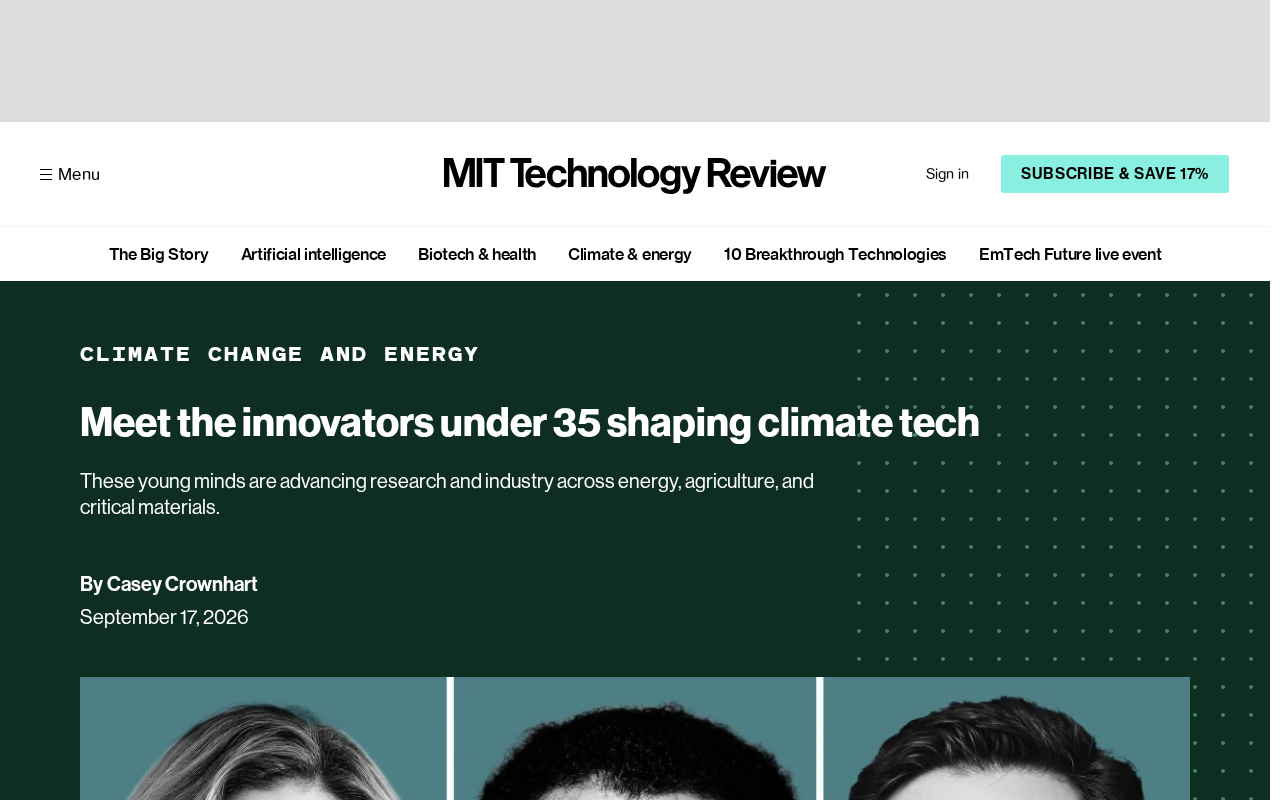
MIT Technology Review's 35 Innovators Under 35 spotlights nine young global climate tech innovators.
MIT Technology Review has released a climate tech-focused edition of its annual 35 Innovators Under 35 list, selecting nine young researchers and inventors from around the world. The list, now over two decades old, is widely seen as a technology bellwether that prioritizes potential impact over current fame. This edition's climate focus reflects both the urgency of the issue and the reality that innovation is emerging simultaneously across multiple regions. For readers tracking sustainability and tech trends, the list offers a valuable lens for identifying frontier directions in climate technology and assessing which pathways may prove most consequential.
MIT Technology Review's Annual Innovators List Turns the Spotlight on Climate Tech
Every year, the editorial team at MIT Technology Review publishes one of the most closely watched lists in the technology world — the 35 Innovators Under 35. This roster brings together young researchers, inventors, and original thinkers from around the globe who are worth keeping an eye on. After months of vetting and deliberation, the latest edition zeroes in on climate tech, recognizing nine outstanding individuals from countries across the world.
At a time when climate change has become one of the defining global challenges of our era, a list dedicated to climate tech carries special weight. It is not merely an acknowledgment of individual achievement — it is also a forward-looking statement about the direction of technology itself. The work these honorees are doing may well shape the technical pathways humanity takes to address the climate crisis over the coming decades.
Why This List Deserves Your Attention
MIT Technology Review's innovators list has long served as a bellwether for the broader tech industry. Past honorees include people who went on to make lasting impacts in their respective fields. The selection criteria are not primarily about present-day fame; they emphasize the potential influence and originality of a candidate's work.
Choosing climate as this edition's focus reflects the editorial team's conviction about the urgency of the issue. Climate tech is a remarkably broad domain, spanning clean energy, carbon capture, sustainable materials, agricultural technology, and climate adaptation solutions. The nine honorees come from various parts of the world — a reminder that the climate challenge is inherently global, and that the power of innovation is emerging simultaneously across many regions.
The 35 Innovators Under 35 list was founded in 1999 and has now run for more than two decades. It is widely regarded in the industry as an important reference for identifying "early-stage potential." Past honorees include Demis Hassabis, who later co-founded DeepMind; pioneering researchers in CRISPR gene editing; and multiple scholars who subsequently received major scientific prizes. The list is organized by category — typically Inventors, Entrepreneurs, Visionaries, Humanists, and Pioneers — and the selection process involves the editorial team working alongside external expert nominations, with a strong emphasis on real-world deployment potential rather than sheer publication volume. Climate tech has received significantly greater weight in recent years, reflecting the editors' read that both capital and talent are converging on the sector.
The Value of Young Innovators
Shining a light on people under 35 is itself a statement of intent. Climate change is a long game that demands sustained commitment over decades, and the younger generation will be the most consequential technological force during that period. These researchers and inventors tend to challenge conventional thinking and are willing to invest their energy in technological directions that have yet to fully mature.
For readers who track technology trends, this list offers a window into the frontier of climate tech. By understanding what problems these young people are working to solve, we can better grasp where the field is headed — which technical approaches are receiving early validation, and which application areas are likely to reach commercial viability first.
Climate tech as an investment and research category expanded rapidly in the early 2020s. According to data from PitchBook and similar institutions, global climate tech venture investment peaked historically in 2021–2022, and while it has pulled back somewhat since, it remains at an elevated level. The technical pathways in this space are extraordinarily diverse: on the hardware side, they include next-generation solar cells, long-duration energy storage, direct air carbon capture (DAC), and green hydrogen production; on the software and data side, they encompass climate risk modeling, grid optimization, and carbon accounting platforms. Precisely because technical approaches have yet to converge and business models are still being explored, the non-linear thinking of young researchers often generates differentiated breakthroughs in niche segments — rather than being constrained by the path dependencies of established technological paradigms.
Closing Thoughts
MIT Technology Review's climate tech edition of the 35 Innovators Under 35 is both a tribute to nine young individuals and a structured survey of an entire industry. On the long road toward addressing climate change — humanity's shared challenge — the spirit of innovation and the technical breakthroughs these young faces represent are well worth following closely for anyone invested in a sustainable future.
(Note: Due to the limited source material available, this article provides only a contextual overview of the list's background and significance. For the full roster of honorees and technical details on their work, please refer to the official publication by MIT Technology Review.)
Related articles

vLLM v0.30.0rc1 Released: Isolates FlashInfer BF16 Autotuning Logic
vLLM v0.30.0rc1 release candidate fixes FlashInfer BF16 autotuning isolation (PR #57285). Learn the technical background and its impact on inference deployment.

Comp AI Raises $34M Series A, Bets on Agentic Security Compliance
Comp AI raises $34M Series A led by Roo Capital and Grand Ventures, betting on "continuously agentic" AI to transform compliance from periodic audits into real-time monitoring.

Ollama Cloud Deep Dive: One Subscription to Run DeepSeek, GLM, and More Open-Source Models
Ollama Cloud revamped with transparent per-token pricing and no service fees. One subscription runs DeepSeek, GLM, Kimi, Qwen & 20+ open-source models. Great time-zone perks for China users.