MLOps Interview Prep Guide: Distributed Training, GPU Scheduling & System Design Explained

A comprehensive MLOps interview prep guide covering distributed training, GPU scheduling, and system design.
This guide systematically breaks down the core competencies needed for MLOps and ML infrastructure interviews at major tech companies. It covers three key dimensions — ML fundamentals, software engineering skills, and ML infrastructure expertise — with deep dives into distributed training (data/model/pipeline parallelism, ZeRO, AllReduce), GPU resource scheduling (Kubernetes, device plugins), and MLOps toolchains (Triton, vLLM). A practical four-week study plan and paired learning strategies are included.
A Junior Engineer's Job Search Story
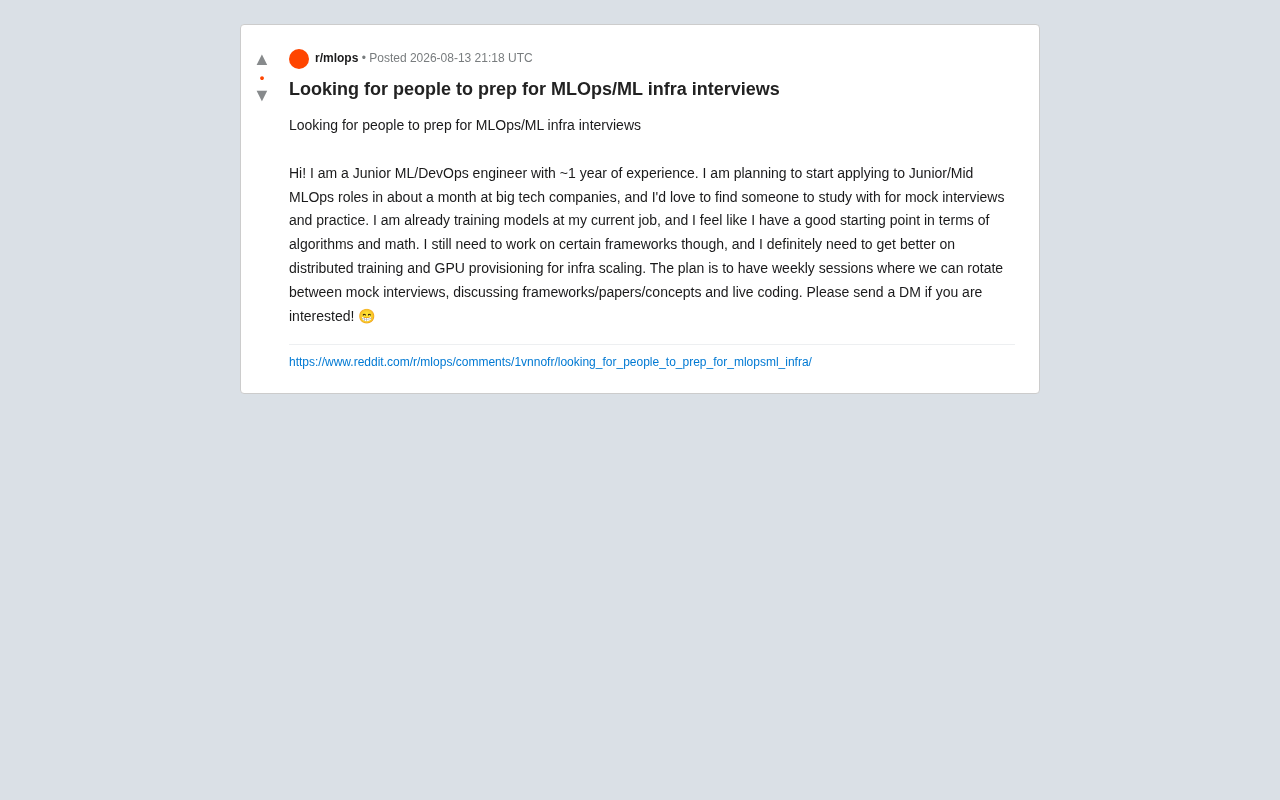
Recently, a junior ML/DevOps engineer posted on Reddit and struck a chord with many peers. This engineer, with about a year of experience, planned to start applying for junior to mid-level MLOps positions at major tech companies in a month and was looking for study partners to do mock interviews and practice together.
He candidly shared that while he had been training models at his current job and had a solid foundation in algorithms and mathematics, he still needed to strengthen his skills in certain frameworks, distributed training, and GPU resource scheduling (for infrastructure scaling). He planned to organize weekly study sessions, rotating between mock interviews, framework/paper/concept discussions, and live coding.
This seemingly simple help-wanted post actually reflects the complexity and breadth of skill requirements for the emerging field of MLOps. This article will use it as a starting point to systematically break down the core competencies needed for MLOps/ML infrastructure interviews and provide an actionable preparation strategy.
Three Key Competency Dimensions in MLOps Interviews
Machine Learning Fundamentals
MLOps (Machine Learning Operations) is essentially an extension of the DevOps philosophy into machine learning workflows, requiring engineers to possess comprehensive, multi-faceted skills. The concept began gaining widespread industry attention around 2018-2019, with its intellectual roots traceable to Google's seminal 2015 paper, Hidden Technical Debt in Machine Learning Systems. This paper was the first to systematically describe the massive "hidden technical debt" in ML systems — the actual ML code often accounts for only a small fraction of the entire system, surrounded by vast amounts of data collection, feature extraction, configuration management, monitoring, and serving infrastructure code. As companies rushed to move ML models from the lab into production, traditional software engineering methodologies couldn't fully address the unique challenges of ML systems such as data drift, model degradation, and training-serving skew — and MLOps emerged to fill this gap. Today, MLOps has become an independent and rapidly growing career path, with related job postings on platforms like LinkedIn growing over 300% in the past three years.
First, machine learning fundamentals. This includes model training, evaluation, feature engineering, and more — requiring an understanding of algorithmic principles and the underlying mathematics. As the original poster mentioned, this is the area where he felt most confident.
Software Engineering & Systems Skills
Second, software engineering and systems skills. This encompasses code quality, CI/CD pipelines, containerization (Docker/Kubernetes), cloud platform usage, and more — the core DNA of DevOps.
ML Infrastructure Skills
Third, machine learning infrastructure (ML Infra). This is what distinguishes MLOps from regular DevOps, involving distributed training, GPU resource scheduling, model serving and deployment, inference optimization, and more. The original poster explicitly identified this as his key weakness that needed focused improvement — a very representative situation.
Why ML Infra Is the Interview Differentiator
For mid-level positions at major tech companies, the ability to handle large-scale training and inference scenarios is often what separates candidate tiers. Almost anyone can train a model on a single machine, but when model parameters reach billions or more, how to implement data parallelism, model parallelism, and pipeline parallelism — how to manage GPU cluster resources and optimize communication overhead — these are what truly demonstrate engineering depth.
Specifically, model parallelism comes in two main forms. Tensor Parallelism splits the computation of a single layer (such as a large matrix multiplication) across multiple GPUs for parallel execution. For example, Megatron-LM splits the weight matrices of Transformer self-attention heads and feed-forward networks by columns or rows across different GPUs. This approach has very high communication frequency and typically requires high-bandwidth interconnects between GPUs (such as NVLink). Pipeline Parallelism splits along the layer dimension, placing different layers of the model on different GPUs, with data flowing through them sequentially like an assembly line. Its main challenge is the "pipeline bubble" — when a preceding stage is computing, subsequent stages sit idle waiting. Frameworks like GPipe and PipeDream use micro-batch techniques to reduce the bubble ratio. Modern large model training typically employs a 3D parallelism strategy, simultaneously using data parallelism, tensor parallelism, and pipeline parallelism to achieve the optimal balance between computational efficiency, communication overhead, and memory utilization.
Core Skills to Build for MLOps Interviews
Distributed Training Techniques
The original poster mentioned needing to strengthen distributed training, which is indeed a high-frequency topic in MLOps interviews. Here's what to study systematically:
-
Data Parallelism: Understand how to split batch data across multiple devices and master gradient synchronization mechanisms like AllReduce. AllReduce is one of the most essential communication primitives in distributed training — in data parallel training, each GPU independently computes gradients on its own data subset, then all GPUs need to aggregate and sum the gradients and broadcast the result back to every GPU. The most commonly used implementation is the Ring AllReduce algorithm, popularized by Baidu in 2017: it arranges N GPUs in a logical ring and completes gradient synchronization through N-1 rounds of send-receive operations. The communication volume is independent of the number of GPUs and proportional only to the model parameter count, giving it excellent scalability. NVIDIA's NCCL (NVIDIA Collective Communications Library) is currently the most widely used AllReduce implementation in industry, deeply optimized for various interconnect topologies including NVLink, PCIe, and InfiniBand.
-
Model Parallelism & Pipeline Parallelism: Splitting strategies for when a single model can't fit in a single GPU's memory.
-
Major Distributed Training Frameworks: Such as PyTorch's DistributedDataParallel (DDP), DeepSpeed, Megatron-LM, etc. Understanding the principles of ZeRO optimizer sharding is particularly valuable. ZeRO (Zero Redundancy Optimizer) is a breakthrough technology proposed by Microsoft's DeepSpeed team in 2019 to address memory bottlenecks in large model training. In traditional data parallel training, every GPU maintains a complete copy of model parameters, gradients, and optimizer states, resulting in massive memory waste. Taking a 1.5-billion-parameter model as an example, using the Adam optimizer requires at least ~24GB of state information per GPU. ZeRO eliminates this redundancy by sharding these states across multiple GPUs instead of replicating them, progressing through three stages: ZeRO-1 shards only optimizer states (~4x memory savings), ZeRO-2 additionally shards gradients (~8x), and ZeRO-3 also shards model parameters, achieving memory efficiency equivalent to model parallelism while retaining the simplicity of data parallelism. This technology enables training models with tens of billions or even trillions of parameters without introducing complex model parallelism code.
GPU Resource Scheduling & Infrastructure Scaling
This section corresponds to resource management capabilities in production environments:
-
Container Orchestration: Kubernetes with GPU device plugins and node affinity configuration. Kubernetes doesn't natively have the ability to detect specialized accelerators like GPUs. GPU device plugins are extension mechanisms provided by vendors like NVIDIA for K8s. They run as DaemonSets on each GPU node, discovering GPU resources and registering them with Kubernetes' resource manager, allowing users to request GPUs in Pod resource specifications using declarations like
nvidia.com/gpu: 1. However, GPU scheduling in production is far more complex than CPU scheduling: GPUs don't support overcommitment — a card is either fully allocated or not (unless virtualization technologies like MIG or MPS are used); the topology between GPUs significantly affects multi-card training communication performance; the vast compute differences between GPU models require fine-grained scheduling control through node affinity and taint/toleration mechanisms. Additionally, schedulers specifically designed for AI workloads, such as Volcano and Run:AI, offer advanced features like Gang Scheduling (ensuring all Pods of a training job are scheduled simultaneously) and fair-share queues. -
Resource Scheduling Strategies: How to efficiently allocate GPUs in multi-task, multi-user environments while avoiding resource fragmentation.
-
Elastic Scaling: Automatically scaling up and down based on load, balancing cost and performance.
MLOps Frameworks & Toolchain
The MLOps tool ecosystem is vast. Commonly asked about in interviews are MLflow (experiment tracking), Kubeflow (pipeline orchestration), DVC (data version control), and various model serving frameworks such as TorchServe and Triton Inference Server. Understanding their design philosophies matters more than memorizing APIs.
Among these, NVIDIA's Triton Inference Server is one of the most popular model serving frameworks in the industry. It supports multiple inference backends including TensorFlow, PyTorch, TensorRT, and ONNX Runtime, and can simultaneously host models from different frameworks. Triton's core advantage lies in its Dynamic Batching capability — it automatically combines multiple inference requests arriving within a short time window into a single batch for GPU computation, dramatically improving throughput. Additionally, Triton supports Model Ensemble, chaining preprocessing, inference, and postprocessing into a directed acyclic graph (DAG) for execution. In the era of large models, another highly regarded inference framework is vLLM, which uses the PagedAttention mechanism to solve KV Cache memory fragmentation issues, achieving throughput far exceeding traditional solutions for large language model inference scenarios. Understanding the design decisions behind these frameworks — how to balance latency and throughput, how to manage GPU memory, how to implement seamless model updates — is key to demonstrating system design depth in MLOps interviews.
Four-Week MLOps Interview Prep Strategy
The Value of Paired Study
The original poster's proposed approach of "rotating weekly between mock interviews, concept discussions, and live coding" is actually a widely validated and highly effective preparation method. The benefits of having a study buddy include:
- Simulating real interview pressure: The tension of answering questions from a real person can't be replicated through self-study.
- Exposing knowledge gaps: Explaining concepts to others is the easiest way to discover what you don't truly understand. This aligns with the "Feynman Technique" — physicist Richard Feynman believed that if you can't explain a concept in simple language to someone else, you haven't truly understood it.
- Maintaining rhythm and discipline: A fixed weekly commitment effectively combats procrastination.
The Science Behind Three Types of Practice
- Mock System Design Interviews: Focus on system design problems, such as "Design a model inference service that supports thousands of requests per second" or "How would you build an end-to-end model training pipeline?" These questions have no standard answers and test a candidate's ability to make reasonable trade-offs across multiple dimensions including latency, throughput, cost, and reliability.
- Concept/Paper Discussions: Stay current with cutting-edge technologies, understand design trade-offs, and prepare for open-ended questions. Recommended focus areas include: parallelism strategy papers for large model training (such as the Megatron-LM series), inference optimization techniques (such as FlashAttention, Speculative Decoding), and engineering blogs on MLOps platform development (such as Uber's Michelangelo, Airbnb's Bighead, etc.).
- Live Coding Practice: Write clean, runnable code under time constraints, covering data processing, algorithm implementation, and more.
Suggested Four-Week Plan
For the goal of "starting to apply in one month," consider dividing the four weeks as follows:
- Week 1: Solidify theoretical foundations of distributed training. Focus on understanding the principles and use cases of data parallelism, model parallelism, and pipeline parallelism. Read technical documentation or papers on DeepSpeed ZeRO and Megatron-LM.
- Week 2: Get hands-on with GPU scheduling and containerized deployment. Set up a multi-node GPU training environment on a cloud platform (such as AWS or GCP) and experience the full workflow of Kubernetes scheduling GPU tasks.
- Week 3: Focus on MLOps system design problems. Reference case studies from books like Designing Machine Learning Systems by Chip Huyen, and practice the complete thought process from requirements analysis to architecture design.
- Week 4: Conduct intensive mock interviews and comprehensive review. Do at least one complete mock interview per day (covering coding, system design, and behavioral questions), and make targeted improvements on weak areas.
Core Advice for MLOps Job Seekers
MLOps is a cross-disciplinary role that demands breadth — very few people are strong across every dimension. Like the original poster, clearly identifying your strengths (algorithms and math) and weaknesses (distributed systems and infra), and proactively seeking study partners, is itself a very mature job search strategy.
For readers preparing for similar roles, the core advice is: Don't try to cover everything. Instead, while maintaining a solid ML foundation, focus your efforts on strengthening infrastructure skills — the area that truly sets candidates apart. At the same time, finding a reliable study partner can often double your preparation efficiency.
It's worth noting that MLOps interview styles vary significantly across companies. Some traditional big tech companies (like Google and Meta) emphasize general algorithmic coding and system design abilities, while AI-native companies (like OpenAI, Anthropic, and Scale AI) place more value on hands-on experience with large-scale ML systems and deep understanding of cutting-edge technologies. Therefore, during your preparation, understanding your target company's tech stack and interview style to tailor your approach accordingly is equally crucial.
Key Takeaways
Related articles

From Photons to Production: An Open-Source Computer Vision Engineering Reading Path
Reddit user open-sources a computer vision engineering reading path with 16 chapters from image formation to production deployment, emphasizing primary sources, dependency order, and reproducible benchmarks to help engineers understand why models fail and build reliable vision systems.

Prompt Failures? The Truth About Why AI Agents Struggle in Production—and How to Fix It
A Reddit developer built Agents with Copilot and Gemini but faced unstable behavior. This article analyzes three gaps in prompt engineering for Agent scenarios and offers three practical paths to reliable Agent deployment, including structured prompts, workflow-first approaches, and building an evaluation loop.

Tesla Robotaxi to Open Private Vehicle Access Next Year: Promise or Pipe Dream?
At its Q3 earnings call, Tesla said owners can add their cars to the Robotaxi fleet next year. We analyze the technical basis, Musk's missed deadlines, business logic, and competition.