MMMem: Letting AI Agents Self-Evolve from Tasks

MMMem distills completed tasks into reusable experience with four complementary strategies, making multimodal agents better the more they're used.
The article introduces MMMem, a multimodal memory framework addressing the flaw that existing memory systems emphasize storage and retrieval but neglect experience learning. It proposes four complementary strategies: source-linked multi-view memory for what to remember, source-generated tasks with dual-layer knowledge alignment for how to learn, experience distillation that turns completed tasks into structured experience entries, and task-aware retrieval and reuse for how to use. Experiments show it outperforms eight baselines across three memory benchmarks and two vision-language readers, improving 36.9%, 17.6%, and 15.2% over the best baseline with Qwen3.5-9B, with ablations confirming training and memory warm-up are each effective and stackable. The article argues this turns memory from a passive storage bucket into an active learning loop, though large-scale real deployment cost and latency remain to be seen.
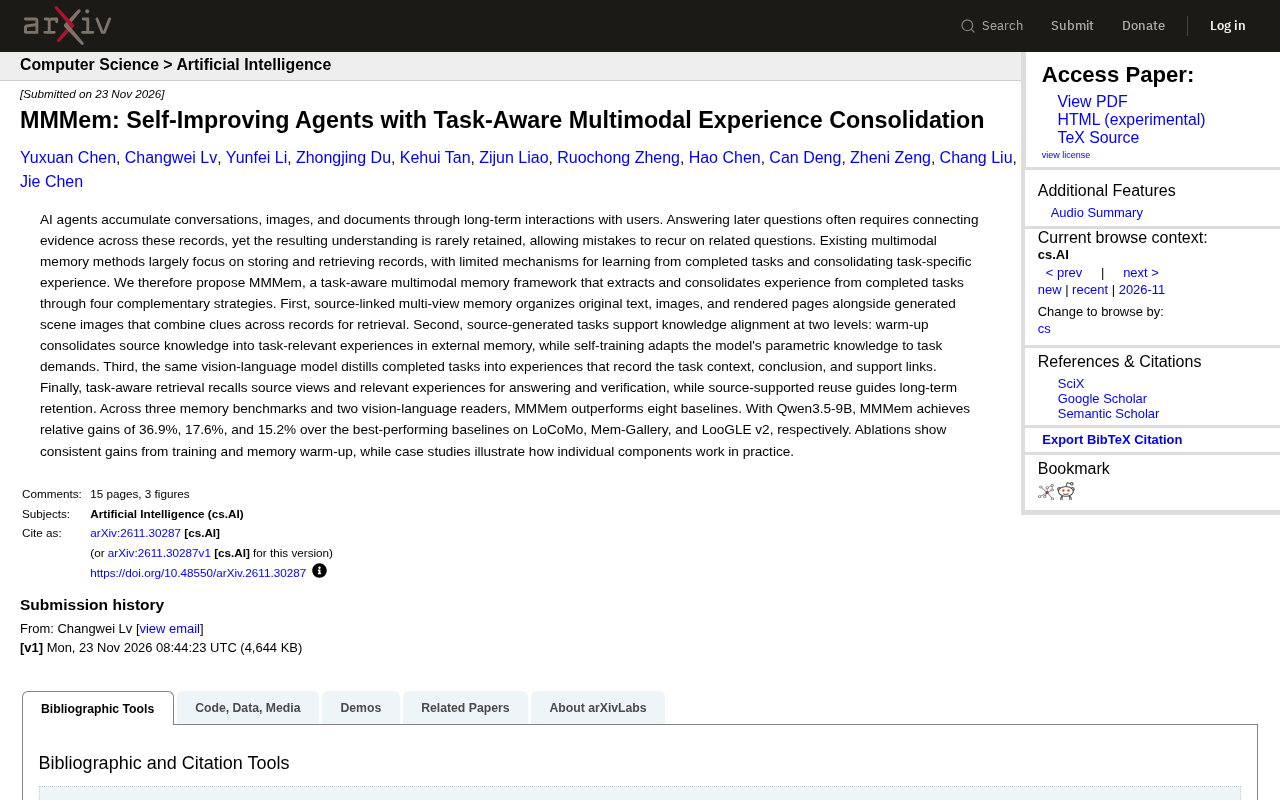
Multimodal AI agents accumulate a large amount of conversations, images, and documents during long-term interactions with users. But answering follow-up questions often requires connecting evidence across these records. Yet the understanding gained from this is rarely retained, causing errors to recur on related problems. Most existing methods focus on storing and retrieving records, lacking a mechanism to learn from completed tasks and consolidate task experience. To address this pain point, researchers propose MMMem—a task-aware multimodal memory framework that extracts and consolidates experience from completed tasks through four complementary strategies.
Limitations of Existing Memory Systems
Current multimodal memory methods mainly solve the problem of "what to store and how to retrieve it," while ignoring "what has been learned." After an agent completes a complex task, the reasoning paths, key clues, and conclusions often dissipate as the conversation ends. The next time it encounters a similar problem, the model has to start from scratch—inefficient and prone to repeating mistakes.
This is precisely the starting point of MMMem: treating completed tasks themselves as training signals, allowing the agent to continuously self-improve through interaction.
The distinction between retrieval-augmented generation (RAG) and parametric memory is key background for understanding this paper. RAG-style methods encode external documents or historical records as vectors and store them in a database; at inference time, relevant fragments are recalled by similarity and assembled into the context. Their advantages are that knowledge can be updated at any time and is traceable, but the drawback is that they do not change the model's own weights—the model's "digestion" of experience is limited. In contrast, parametric memory writes information into model parameters through fine-tuning or self-training, requiring no retrieval at use time and responding faster, but updates are costly and old knowledge is easily forgotten. MMMem's dual-layer knowledge alignment essentially complements these two routes: the warm-up stage places experience into external memory for explicit retrieval, while the self-training stage internalizes task-relevant capabilities into parameters, thereby achieving both traceability and generalization.
Building Task-Aware Memory with a Four-Layer Strategy
MMMem's core consists of four complementary strategies, covering the complete pipeline from storage to training to consolidation.
Source-Linked Multi-View Memory
The first layer addresses "what to remember." The system not only retains original text, images, and rendered pages but also generates scene images that combine clues across records for use in subsequent retrieval. This multi-view approach allows the same piece of evidence to be recalled from different angles, avoiding the blind spots of single-modality retrieval.
Source-Generated Tasks and Dual-Layer Knowledge Alignment
The second layer addresses "how to learn." The system generates tasks from source data and performs knowledge alignment at two levels: the warm-up stage consolidates source knowledge into task-relevant experience in external memory; the self-training stage adjusts the model's parametric knowledge to fit task requirements. This dual-track design of "external memory + parameter internalization" allows experience to be both explicitly retrievable and sedimented into the model itself.
Self-training is a semi-supervised learning paradigm: the model first generates pseudo-labels or task samples from existing data, then continues training itself on these self-produced samples. In the agent memory scenario, its value lies in converting interaction history into training signals without manual annotation—the system automatically constructs tasks and reference answers from source records, the model attempts to complete them and then verifies against source evidence, reinforcing correct reasoning paths and correcting erroneous ones. This process requires attention to the risk of "error accumulation": if the pseudo-labels themselves are wrong, repeated self-training may amplify bias. MMMem constrains this risk through source-linked multi-view evidence and dual-layer alignment, keeping self-training samples always anchored to verifiable original records rather than products of the model's free imagination.
Experience Distillation
The third layer is performed by the same vision-language model: completed tasks are distilled into experience entries, each recording task context, conclusions, and supporting links. As a result, what remains after a task is completed is not a pile of raw records but structured, reusable experience.
Knowledge distillation originally refers to training a small model with the output distribution of a large teacher model, enabling it to approximate the teacher's capability with fewer parameters. This paper borrows the metaphor of "distillation" but extends its meaning: here the "teacher" is the trajectory the agent itself produces during a complete task, and the "student" is the compressed experience entry being stored. An experience entry contains task context, conclusions, and supporting links, effectively compressing a lengthy multi-step reasoning process into a directly reusable knowledge unit—saving context length during retrieval while preserving the path to trace back to original evidence. The key to this approach lies in choosing the level of abstraction—too specific and it cannot transfer to new problems; too general and it loses guiding value.
Task-Aware Retrieval and Reuse
The fourth layer addresses "how to use." When answering and verifying, the system recalls source views and related experience; meanwhile, a source-supported reuse mechanism guides long-term retention, so valuable experience is not diluted over time.
Experimental Results: Leading Across Multiple Benchmarks
According to the paper, MMMem outperforms eight baseline methods across three memory benchmarks and two vision-language readers. With Qwen3.5-9B as the backbone, MMMem achieves improvements of 36.9%, 17.6%, and 15.2% over the best baseline on LoCoMo, Mem-Gallery, and LooGLE v2, respectively.
Ablation experiments show that both training and memory warm-up bring consistent gains, indicating that the two paths are each effective and can be stacked. Case studies further demonstrate how each component operates in actual tasks.
Why It's Worth Attention
MMMem's significance lies in turning "memory" from a passive storage bucket into an active learning loop. Traditional memory systems are static databases, whereas MMMem makes every completed task an opportunity for fine-tuning, with experience sedimented in structured form and precisely recalled when needed.
For agents that need to accompany users long-term and handle multimodal information, this task-aware memory consolidation mechanism may be a key step from "usable" to "better the more it's used." However, the paper has not yet disclosed deployment cost and latency in large-scale real-world scenarios, which remains a direction worth watching.
Related articles

A 19-Year-Old's Rental Horror Story: Ceiling Collapse, Bug Infestation, and the Lessons It Taught Me
At 19, my first off-campus rental brought bug infestations, no heat, a collapsed ceiling, and a ruined laptop with no renter's insurance. Here are the hard-won lessons for first-time student renters.

Veda Nurse's Cranial Nerve Exam: Why ASMR Role-Play Is Going Viral
Bilibili creator Veda's cranial nerve exam ASMR video goes viral, blending humor and sensory triggers through nurse role-play. This article analyzes its unique appeal and the audience psychology behind ASMR role-play.

LG Cinebeam AI Review: 120-Inch Giant Screen + 3000 Lumens, a New Choice for the Living Room Theater
LG Cinebeam AI projector review: 3000 ANSI lumens, 4K, 100 inches from about 8 cm and 120 inches from about 18 cm. Built-in webOS, AI Concierge voice recommendations, AI Sound Pro 11.1.2 virtual surround, and Game Optimizer—positioned for fixed living room installation, complementing the portable Cinebeam S.