mod_wsgi Creator Builds Rust Server with AI: Muru Takes the Pain Out of Python Deployment
The mod_wsgi creator writes a new Rust server, Muru—AI-assisted but vetted by twenty years of experience.
Muru is a new project launched by Graham Dumpleton twenty years after starting mod_wsgi. Written in Rust, it aims to provide an integrated runtime for both ASGI and WSGI applications in development and production. The project uses AI-assisted development, but Dumpleton stresses that "what counts as acceptable" is still judged by his twenty years of hard-won experience. Public design notes show Muru covers import once/fork many, dev HTTPS, zero-downtime releases, canaries without a service mesh, K8s affinity, per-worker scaling, scale-to-zero, and page toolbar with tracing, aiming to replace the "nginx/gunicorn + glue scripts + observability add-ons" stack. It is still in the polishing stage—better as a direction to track than an immediate replacement.
A Veteran Sets Out Again After Twenty Years
Twenty years ago, Graham Dumpleton started the mod_wsgi project—an Apache module for Python that was once the default choice for countless Python web applications in production. Two decades later, he has been pondering the same question: what is really the best way to run Python web applications in production?
Muru is his answer. It is a new server written in Rust, positioned as the best possible runtime tool for ASGI and WSGI applications in both development and production environments. Unlike many Rust rewrite projects, Dumpleton has not packaged Muru as a revolutionary product meant to "tear everything down and start over," but rather placed it on the extension of his twenty years of hard-won experience.
According to a write-up on Simon Willison's blog, Dumpleton continued the approach from his earlier wrapture project, documenting as he developed, publishing nearly twenty design notes in about three weeks. This extremely transparent development style is itself the best entry point for understanding Muru's design trade-offs.
mod_wsgi is a module for the Apache HTTP Server that embeds Python web applications (primarily WSGI applications) into Apache's process model. From the late 2000s through the 2010s, it was one of the most common deployment methods for Python web applications in production, especially suited to scenarios requiring integration with existing Apache features (such as virtual hosts, authentication, and static file serving). mod_wsgi supports two running modes: embedded mode (running Python inside Apache child processes) and daemon mode (a separate process pool), the latter being better for isolation and resource control. Its long-term maintenance experience gave Dumpleton an extremely deep accumulation of knowledge about low-level details such as the Python process model, preloading, fork behavior, and signal handling—exactly the sources of Muru's design trade-offs.
WSGI (Web Server Gateway Interface, PEP 3333) is Python's earliest synchronous web server gateway interface standard, defining how servers call Python applications. It is simple and mature, but essentially a synchronous blocking model, making it difficult to natively support WebSocket, long connections, and asynchronous I/O. ASGI (Asynchronous Server Gateway Interface) is the successor standard designed for asynchronous scenarios, supporting async/await, WebSocket, HTTP/2, and more, and is adopted by frameworks such as FastAPI, Starlette, and Django Channels. Muru supporting both means it must be compatible with existing synchronous applications while also carrying modern asynchronous applications—a dual requirement on the server's process/event loop model.
AI-Assisted, but Not AI-Driven
Muru is described as an "AI-assisted" Rust server. In the related notes, Dumpleton wrote a piece specifically titled "AI as a lifestyle choice," in which one passage deserves careful reading:
"AI may have ostensibly done a lot of the work, but judging what is not good enough is still up to me. And the mistakes I've made on mod_wsgi over twenty years happen to be useful for that judgment."
This passage makes the actual shape of AI programming very clear. AI can accelerate code output, but the standard for "what counts as acceptable" comes from human domain experience. In an area like Python service deployment, which carries heavy historical baggage, specification details, boundary conditions, and migration compatibility are precisely where AI tends to give superficially correct answers. Dumpleton's value lies in knowing where things will go wrong.
In his notes, he stated his willingness to keep polishing Muru until it becomes something he dares to trust—and others dare to trust too. This statement is plain, but contrasted with the current state of many AI-generated projects where "it runs, and that's enough," it seems rare.
The Technical Outline of Muru, as Seen from the Public Notes
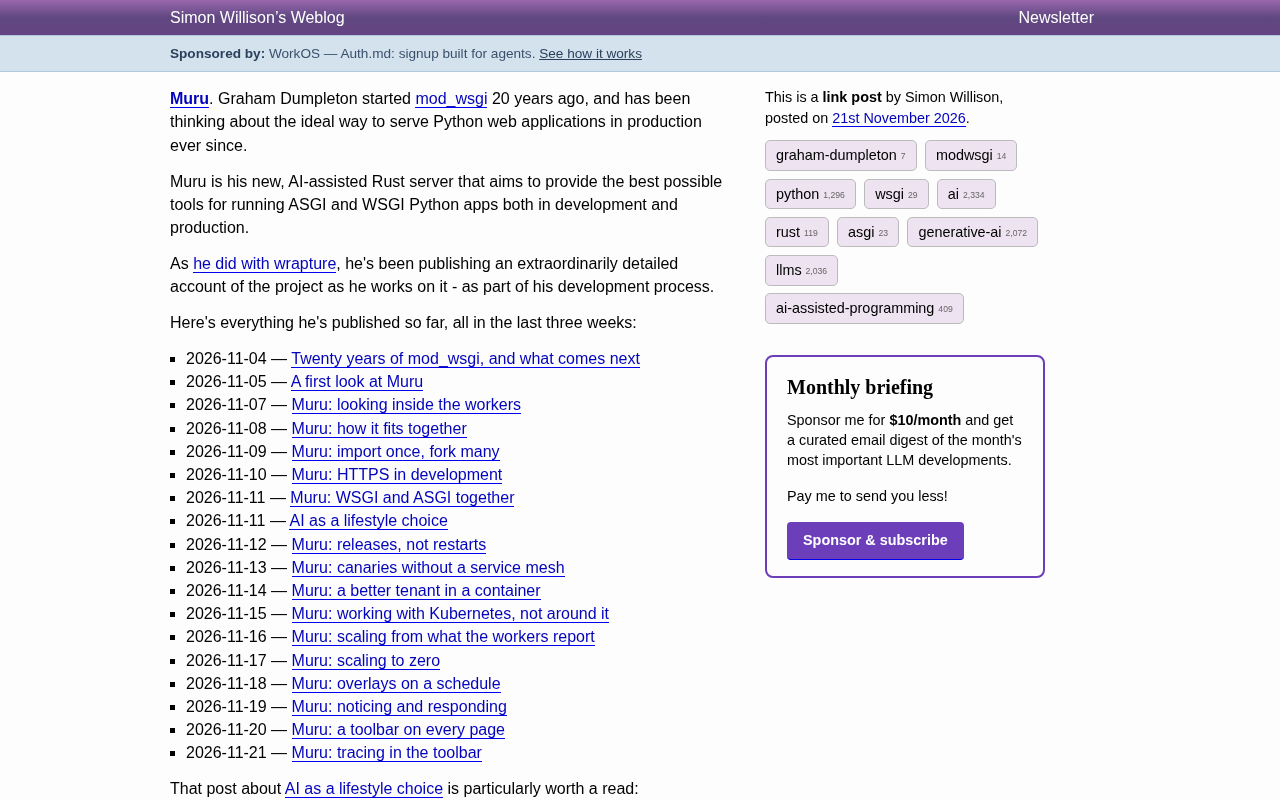
The series of notes Dumpleton published covers the main design surfaces of Muru, and the titles themselves form a feature map:
- Internal structure of workers: how processes and work units are organized
- import once, fork many: import once, fork many times—clearly targeting the classic pain points of the Python preloading model
- HTTPS in the development environment: local development directly supports HTTPS, eliminating the hassle of self-signed certificates and extra proxies
- WSGI and ASGI coexisting: the same server carries both generations of Python web interfaces
- releases, not restarts: replacing crude restarts with release actions, pointing toward zero-downtime updates
- canaries without a service mesh: canary releases without relying on a service mesh, lowering the infrastructure barrier
- Container and Kubernetes affinity: Dumpleton's phrasing is "working with Kubernetes, not around it," that is, following K8s mechanisms rather than building a separate system
- Scaling based on per-worker reporting: scaling decisions come from data actually reported by workers
- scale to zero: support for scaling to zero
- Scheduled overlays: switching configuration layers on a schedule
- Page toolbar and tracing: a toolbar attached to each page, with distributed tracing integrated
Individually, these items are all common requirements; combined, they reveal a clear product judgment: what Muru wants to replace is the existing assembled solution of "nginx/gunicorn + a bunch of glue scripts + observability add-ons," bringing development experience and production operations into a single binary.
import once, fork many refers to the Python preload pattern: the server first imports the application code, then forks multiple worker processes, using the operating system's copy-on-write to share memory, reducing each worker's startup time and memory footprint. This pattern appears in Gunicorn's --preload and mod_wsgi's daemon mode. Its classic pain points include: after forking, certain libraries (such as database connection pools, background threads, and random number generators) end up in inconsistent states, and side effects produced at import time are copied to all workers. Muru listing this as a separate design note indicates it has more detailed considerations regarding fork safety and import timing.
canaries without a service mesh—canary release means directing a small amount of traffic to a new version first, observing metrics, and then gradually expanding. The traditional approach relies on a service mesh (such as Istio or Linkerd) for traffic splitting. Muru attempts to build in the ability to split traffic by worker or by release batch at the server layer, thereby achieving canaries without introducing a service mesh and lowering the infrastructure barrier for small and medium-sized teams.
Why It Is Worth Paying Attention To
The toolchain for Python production deployment has long been in a subtle state of stagnation. The combination formed in the WSGI era still works, but new requirements—ASGI, containers, elastic scaling, observability—are often solved by stacking external components layer upon layer. The cost of stacking is configuration complexity and difficulty in diagnosing problems when they arise.
Muru's approach is to consolidate these capabilities into the server layer. Writing it in Rust means a higher ceiling for concurrency and resource efficiency; supporting both WSGI and ASGI ensures that existing applications do not need to be torn down and rebuilt. For teams maintaining existing Python services, whether the migration path is smooth is more convincing than performance numbers.
Another signal worth noting is the degree of openness in the development process. Nearly twenty design notes mean all key decisions can be externally scrutinized and questioned, which is not common in infrastructure software. For users, these notes themselves are material for evaluating whether Muru is reliable.
What Attitude to Maintain for Now
It should be noted that the currently public information is mainly design notes, and the project is still in what Dumpleton calls the "continuous polishing" stage. The notes discuss many capabilities, but there is still a distance between design intent and production readiness. Treating it as a direction worth tracking is more appropriate than treating it as a solution that can immediately replace the existing stack.
Dumpleton himself does not treat AI as a quality endorsement. His statement that "judging what is not good enough is still up to me" is, to some extent, also a reminder to users: tools can write code for you, but they cannot bear production incidents for you. The evaluation of Muru will ultimately come back to actual testing and migration costs.
One-line Summary
The mod_wsgi creator writes a new Rust server, Muru—AI-assisted but vetted by twenty years of experience.
Paragraph Summary
Muru is a new project launched by Graham Dumpleton twenty years after starting mod_wsgi. Written in Rust, its goal is to provide an integrated runtime solution for both ASGI and WSGI applications in development and production. The project uses AI-assisted development, but Dumpleton emphasizes that "what counts as acceptable" is still judged by his twenty years of hard-won experience. Nearly twenty public design notes show that Muru covers capabilities such as import once/fork many, HTTPS in the development environment, zero-downtime releases, canaries without a service mesh, K8s affinity, scaling based on per-worker reporting, scale to zero, and page toolbar with tracing, with the intent of replacing the assembled solution of "nginx/gunicorn + glue scripts + observability add-ons." The project is still in the polishing stage and is suitable as a direction to track rather than an immediate replacement for the existing stack.
Related articles

A 19-Year-Old's Rental Horror Story: Ceiling Collapse, Bug Infestation, and the Lessons It Taught Me
At 19, my first off-campus rental brought bug infestations, no heat, a collapsed ceiling, and a ruined laptop with no renter's insurance. Here are the hard-won lessons for first-time student renters.

Veda Nurse's Cranial Nerve Exam: Why ASMR Role-Play Is Going Viral
Bilibili creator Veda's cranial nerve exam ASMR video goes viral, blending humor and sensory triggers through nurse role-play. This article analyzes its unique appeal and the audience psychology behind ASMR role-play.

LG Cinebeam AI Review: 120-Inch Giant Screen + 3000 Lumens, a New Choice for the Living Room Theater
LG Cinebeam AI projector review: 3000 ANSI lumens, 4K, 100 inches from about 8 cm and 120 inches from about 18 cm. Built-in webOS, AI Concierge voice recommendations, AI Sound Pro 11.1.2 virtual surround, and Game Optimizer—positioned for fixed living room installation, complementing the portable Cinebeam S.