Model Composition as the New Intelligence Frontier: Fireworks Nexus Set to Debut
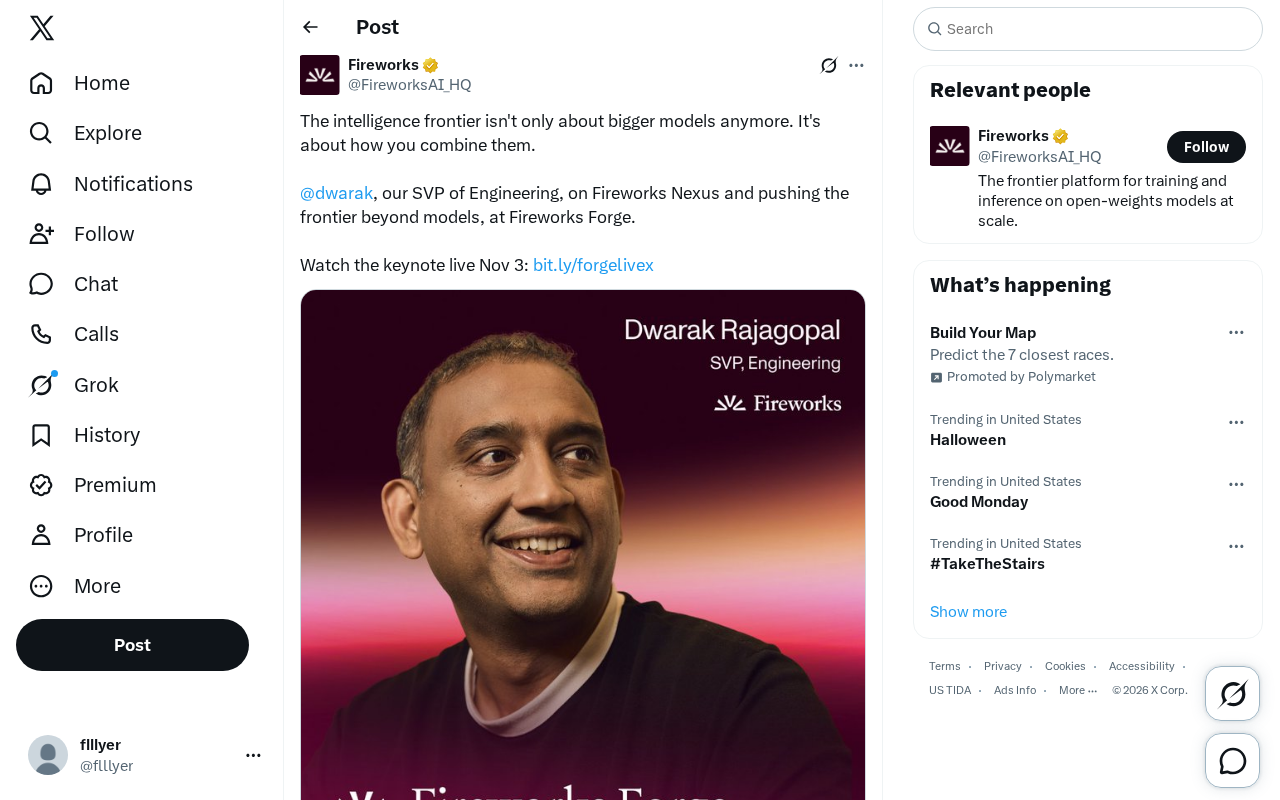
Fireworks executive says the intelligence frontier is shifting toward model composition, with Nexus set to debut on November 3.
The article centers on a claim by @dwarak, Senior VP of Engineering at Fireworks: the frontier of AI intelligence is shifting from "bigger models" to "how to compose models." The author notes that a single model struggles to balance cost, latency, accuracy, and domain fit, making task splitting, chaining, and routing across multiple models more pragmatic—which is also why inference platforms and orchestration layers are drawing attention. The article speculates that Fireworks Nexus may involve multi-model collaboration and a unified access layer, but stresses that official feature details have not been disclosed and that pricing and performance information lacks sources. For developers, models should be treated as replaceable, composable components, with invocation layers abstracted in advance and routing and fallback strategies designed—while remaining alert to new complexities such as cumulative latency, error propagation, and cost accounting.
From "Bigger Models" to "Better Composition"
@dwarak, Senior VP of Engineering at Fireworks, made a thought-provoking claim on social media: the frontier of intelligence is no longer just about bigger models, but about how you compose them. This view points directly at a core shift in the AI industry—as marginal gains from single-model capability begin to slow, system-level composition and orchestration are becoming the new competitive dimension.
According to the tweet, this idea will be realized as Fireworks Nexus and will be elaborated further at the Fireworks Forge event, with the keynote scheduled to livestream on November 3.
Why "Composition" Deserves More Attention Than "Scale"
Over the past few years, industry narratives have been heavily concentrated on the race for parameter scale and benchmark scores. But in real-world deployments, a single model can hardly satisfy multiple requirements at once—cost, latency, accuracy, and domain fit. Splitting tasks across different models, chaining them, or routing between them is often more pragmatic than forcing one large model to cover every scenario.
@dwarak's statement, though brief, pinpoints a real pain point on the engineering side: composition capability determines whether models can be effectively put to use, not merely evaluated. This also explains why inference platforms, orchestration layers, and routing mechanisms have been drawing increasing attention lately.
Model Routing is the most representative engineering mechanism in the "composition" approach: the system decides in real time which model or models to call based on the characteristics of the input request (such as task type, complexity, language, and length). Typical strategies include difficulty-based routing (simple requests go to small models, complex requests escalate to large ones), domain-based routing (code, math, and multilingual tasks each use specialized models), and cascading fallback (start small, escalate when confidence is insufficient). The core benefit of routing is Pareto optimization of cost and latency while retaining the upper-bound capability of large models on hard samples. The cost is the error introduced by the classifier or heuristic itself, which requires continuous calibration with online data.
The Orchestration Layer goes further by organizing multiple model calls into a directed flow: task decomposition, parallel invocation, result aggregation, failure retries, and fallbacks. The difference from routing is that routing focuses on "who to pick," while orchestration focuses on "how to chain them." A common engineering form is a declarative workflow plus a unified invocation abstraction, making models pluggable components. The challenges center on error propagation control, cumulative latency across calls, and per-call cost attribution.
Speculating on Fireworks Nexus's Positioning
The tweet did not disclose specific feature details about Nexus, only tying it to "pushing the frontier beyond the model itself." Given Fireworks' existing background in inference services, it is reasonable to infer that its direction involves multi-model collaboration, invocation orchestration, or a unified access layer, but the specific form will have to wait until the November 3 keynote.
Currently confirmed information is limited: the product name, the event it belongs to (Fireworks Forge), the speaker's identity, and the livestream time. Any descriptions of pricing, performance metrics, or supported model lists lack source support and should not be concluded prematurely.
Fireworks AI is a platform company that started with high-performance inference services. Its core capabilities revolve around low-latency, high-throughput model serving, supporting open-source model hosting, fine-tuning, and custom deployments, and it is known for inference optimization techniques such as Fireworks Attention. Understanding this background helps assess where Nexus might land: it is more likely an orchestration and collaboration layer layered on top of the existing inference foundation rather than yet another standalone model. For an inference platform, extending upward into the orchestration layer is a natural commercial path—it can both deepen usage per customer and keep the traffic generated by multi-model calls settled within the platform. Correspondingly, its competitive landscape will expand from pure inference pricing and throughput to orchestration ease of use, observability, and ecosystem integration.
Practical Implications for Developers
For teams building AI applications, the value of this signal lies in the reminder: when designing architecture, models should be treated as replaceable, composable components rather than a sole dependency. Abstracting a unified invocation layer, preparing alternative models for different tasks, and focusing on routing and fallback strategies—these engineering practices will yield more stable returns than chasing the latest single model.
Of course, composition also brings new complexity—cumulative latency, error propagation, and cost accounting all become harder to control. If Nexus can absorb this complexity at the platform level, that is where its true value lies.
What to Watch For
Three things are worth watching in the November 3 keynote: what composition primitives Nexus actually provides; how it connects with existing inference services; and whether there is verifiable engineering data to support the claim of "beyond the model." Until these details are clear, a stance of cautious optimism is appropriate.
One-line Summary
Fireworks executive says the intelligence frontier is shifting toward model composition, with Nexus set to debut on November 3.
Paragraph Summary
The article centers on a claim by @dwarak, Senior VP of Engineering at Fireworks: the frontier of AI intelligence is shifting from "bigger models" to "how to compose models." The author notes that a single model struggles to balance cost, latency, accuracy, and domain fit, making task splitting, chaining, and routing across multiple models more pragmatic—which is also why inference platforms and orchestration layers are drawing attention. The article speculates that Fireworks Nexus may involve multi-model collaboration and a unified access layer, but stresses that official feature details have not been disclosed and that pricing and performance information lacks sources. For developers, models should be treated as replaceable, composable components, with invocation layers abstracted in advance and routing and fallback strategies designed—while remaining alert to new complexities such as cumulative latency, error propagation, and cost accounting.
Related articles

DSH + Ollama Local LLM Deployment in Practice: Free Chat with Da Fei Yu
Bilibili creator tests DSH + Ollama local LLM deployment end to end: Ollama install, Xunlei-accelerated downloads, ModelScope GGUF model import, DSH custom API address setup, and a comparison of Qwen 3.5 4B, 8B, Gemma, and other models on 8GB VRAM, with advice on choosing local deployment vs. API calls.

Tested: A $899 Mac Mini vs. a $200/Month AI Subscription
Real-world test of whether an M4 Mac mini can replace a $200 AI subscription: 16GB can't fit large models, and both speed and quality fall short—but privacy, no caps, and near-zero running costs make it an ideal host for an always-on agent. Includes buying advice per configuration and money-saving strategies.

RSTGameTranslation: Real-Time OCR Localization + Offline Translation with Local LLMs
RSTGameTranslation is an open-source real-time Windows game translation tool: OCR for English, Japanese, and Korean with Chinese overlays in place, plus Ollama or LM Studio local LLM offline translation and Whisper speech transcription for games, manga, and visual novels.