Model Fingerprint Fiasco: The DeepSeek Distills GPT Rumor and the Open-Source Counterattack

An incomplete model fingerprint tool library caused a false 'distillation' determination; DeepSeek responded by fully open-sourcing its inference framework.
The article begins with a post claiming that DeepSeek distilled closed-source models and reviews the model fingerprint testing process: the same model was judged as different closed-source models in different tests, the earlier-released DeepSeek R1 was identified as a Claude model released 9 months later, and even a random number generator was 'identified' as having distilled GPT and Claude. After checking the tool's GitHub repository, the author found that its built-in fingerprint library contained only GPT and Claude, forcing any input into one of the two and making the conclusions unconvincing. Meanwhile, DeepSeek announced the open-sourcing of DeepInfer and DeepSeek Recipe, compatible with NVIDIA and Huawei Ascend, with daily throughput of 155 trillion tokens per cluster. The article argues that fingerprint testing is not rigorous 'paternity testing,' and open-source engineering details are the real basis for responding to distillation doubts.
Title
Model Fingerprint Fiasco: The DeepSeek Distills GPT Rumor and the Open-Source Counterattack
Meta Description
DeepSeekAd accused of distilling GPT and Claude? Model fingerprint tests produce absurd time-travel results, and the tool's built-in fingerprint library contains only GPT and Claude. Meanwhile, DeepSeek open-sources its inference framework DeepInfer, countering doubts with transparent engineering.
Article Content
Recently, a rather dramatic claim has been circulating in the AI community: the open-source model DeepSeek actually "distilled" closed-source models, and there have even been accusations as temporally confused as "a model released earlier distilling a model released later." This controversy began with a model fingerprint test, but ultimately evolved into questions about the testing tool itself, as well as DeepSeek's response through comprehensive open-sourcing.
The "Distillation" Suspicion Sparked by Model Fingerprint Testing
The starting point was a post. Shortly after the release of DeepSeek V4.1 Flash 1017, someone shared the fingerprint test results for that model, claiming it was identified as GPT-65 AllStar with a probability as high as 90.71%. That number was enough to invite speculation: had DeepSeek really distilled GPT?
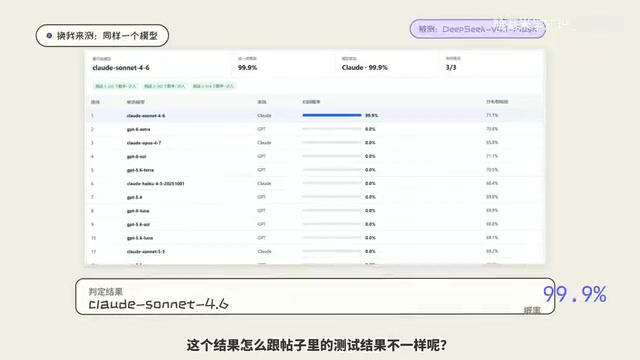
To verify, the video author used the model fingerprint tool Model Trace mentioned in the post for testing. The result was unexpected—DeepSeek V4.1 Flash 1070 was identified as Claude Sonnet 4.6 with a probability of 99.9%. The same model pointed to different closed-source models in different tests, which in itself contradicted the conclusion in the post.
Model distillation is short for Knowledge Distillation, referring to using the outputs of an already trained "teacher model" (such as probability distributions, intermediate features, or generated text) to train another "student model," so that the student model approaches the teacher model's capabilities with fewer parameters or lower cost. Therefore, the accusation that "a certain model distilled a certain closed-source model" centers on suspicion that its training data or supervisory signals came from another model. Determining whether distillation occurred usually requires evidence such as training data provenance and output distribution comparisons; output style similarity or a single fingerprint test alone is rarely sufficient.
Time-Traveling Fingerprints: When the Tool Only Knows Two Model Families
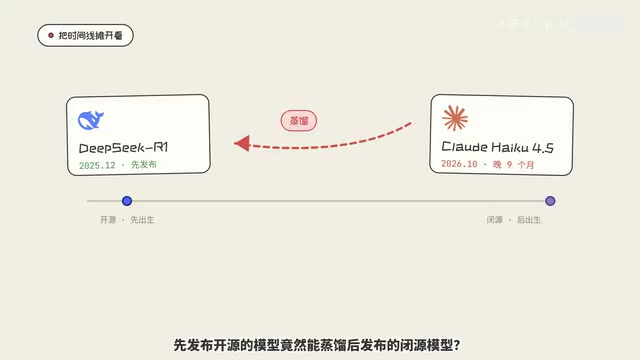
The author then switched to DeepSeek R1 on SiliconFlow for testing, and the result was even more absurd: DeepSeek R1 was identified as Claude Haiku 45 2025 1001, released 9 months later, with a probability of 100%. An open-source model released earlier had supposedly "distilled" a closed-source model released later—this clearly violates basic temporal logic.
What came next was even more ridiculous. In the comments of the original post, someone even used a Python random number generator and successfully "identified" the random numbers as having distilled Claude Sonnet 5.5 and GPT-5 4. At this point the author realized that all test results pointed only to GPT and Claude. After opening the tool's GitHub repository, the truth came to light: the tool's built-in fingerprint library actually contained only the fingerprints of GPT and Claude.
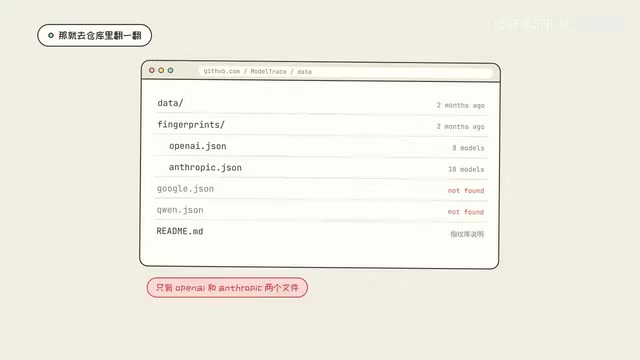
In other words, no matter what model was input, the tool could only "guess" one answer from these two options. The so-called probabilities of 90.71% or 99.9% reflected more the limitations of the tool's built-in library than any real relationship between models. Using such a tool to accuse a model of distillation is clearly unconvincing.
Model fingerprinting is a class of techniques that infer a model's identity or origin by analyzing statistical features of its outputs (such as response style under specific prompts, word frequency distributions, perplexity patterns, etc.). Its basic assumption is that different models leave distinguishable "traces" in training data, alignment strategies, and decoding methods. But fingerprint testing is essentially closed-set classification: the tool can only give the most similar item within its built-in candidate model library, and cannot prove "not in the library" or "truly of the same origin." When the candidate library is incomplete, any input is forcibly assigned to an existing category, producing high-confidence but meaningless determinations—this is exactly the root cause of random numbers also being "identified" as distilling closed-source models in this controversy.
DeepSeek's Open-Source Response: Inference Framework and Production-Grade Components
Just as the community was endlessly debating distillation, DeepSeek announced the full open-sourcing of its internal inference framework DeepInfer, along with the production-grade token codec component DeepSeek Recipe. According to the information in the video, DeepInfer is compatible with both NVIDIA and Huawei Ascend platforms, with a single cluster's daily throughput reaching 155 trillion tokens and each GPU earning $38 per hour.
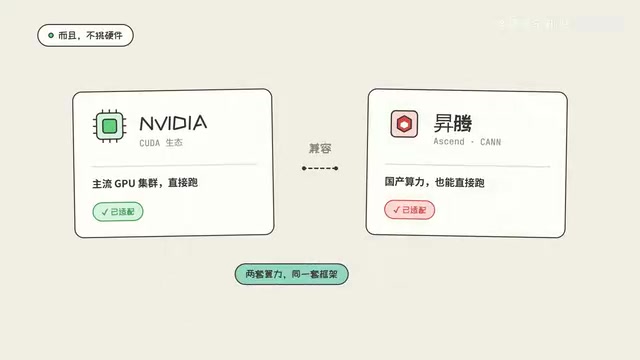
With the same compute, it can handle more requests, spend less money, and consume less power. DeepSeek made public the entire process of how the model is built, deployed, and made cost-effective. This approach of "showing all your cards" stands in sharp contrast to some closed-source models that "try every trick to hide themselves completely."
An inference framework is the engineering layer between a trained model and actual service, responsible for model loading, request scheduling, batching, KV Cache management, quantization and operator optimization, etc., directly determining throughput per unit of compute and inference cost. The value of self-developed frameworks like DeepInfer lies in deep optimization for specific hardware (such as NVIDIA GPUs and Huawei Ascend NPUs), thereby serving more requests on the same cluster and reducing cost per token. The token codec component is responsible for bidirectional conversion between text and token sequences and must strictly align with the model vocabulary; it is a foundational link in the inference service chain that is easily overlooked but affects compatibility and correctness.
The Boundaries of Fingerprint Testing and the Confidence of Open Source
This controversy revealed an easily overlooked problem: model fingerprint testing is not rigorous "paternity testing." If the tool's built-in fingerprint library is incomplete, or the testing method is biased, the results can be seriously misleading. The fact that even random numbers could "distill" closed-source models precisely shows how fragile such tests are when transparent methods are lacking.
On the other hand, DeepSeek's choice to respond to doubts with an open-source inference framework is itself a statement. When technical details, deployment plans, and cost structures are all publicly available for inspection, the accusation of "distillation" naturally loses its footing. Open source is not a slogan; it is laying engineering practice out in the sunlight and letting the community judge for itself.
For those following the AI industry, this incident reminds us: when facing sensitive accusations such as "model distillation," it is worth first checking whether the testing tool itself is reliable before drawing conclusions.
One-line Summary
An incomplete model fingerprint tool library led to a false "distillation" determination, and DeepSeek responded to doubts with a fully open-source inference framework.
Paragraph Summary
The article begins with a post claiming that "DeepSeek distilled closed-source models" and reviews the entire process of model fingerprint testing: the same model was judged to be different closed-source models in different tests, the earlier-released DeepSeek R1 was identified as a Claude model released 9 months later, and even a random number generator was "identified" as having distilled GPT and Claude. After checking the tool's GitHub repository, the author found that its built-in fingerprint library contained only GPT and Claude, causing any input to be forced into one of the two and rendering the test conclusions unconvincing. Meanwhile, DeepSeek announced the open-sourcing of its internal inference framework DeepInfer and the production-grade token codec component DeepSeek Recipe, compatible with NVIDIA and Huawei Ascend, with single-cluster daily throughput reaching 155 trillion tokens. The article argues that fingerprint testing is not rigorous "paternity testing," and that open-source engineering details are the real basis for responding to distillation doubts.
Related articles

Amphibious Transforming Drone: Beyond 100x Power Savings, What Are the Real Needs?
Is the amphibious transforming drone just a gimmick? Starting from the 100x power difference of the M4 Morphobot, explore real application scenarios and thesis topic ideas, analyzing boundary conditions where pure drones and pure ground robots both fail.

Warhound Raises $200 Million: Genetically Engineered "War Dogs" Paired with Anduril Gear
Warhound raises $200M, backed by Ben Lamm and Palmer Luckey, to genetically engineer dogs for military and law enforcement use and equip them with Anduril gear. This article analyzes its technology direction, funding logic, and ethical controversy.

Claude API Comes to Google Cloud: IAM Integration and SDK Access Guide
Anthropic hosts the full Claude API on Google Cloud with IAM-controlled permissions and unified billing. This guide covers the Vertex AI and Anthropic-hosted entry points, IAM role configuration, and SDK access.