Model-Free Bayesian Clustering: Reconstructing Posterior Uncertainty from a Predictive Perspective

Model-free Bayesian clustering via martingale posteriors and Wasserstein summarization for noise-aware uncertainty quantification.
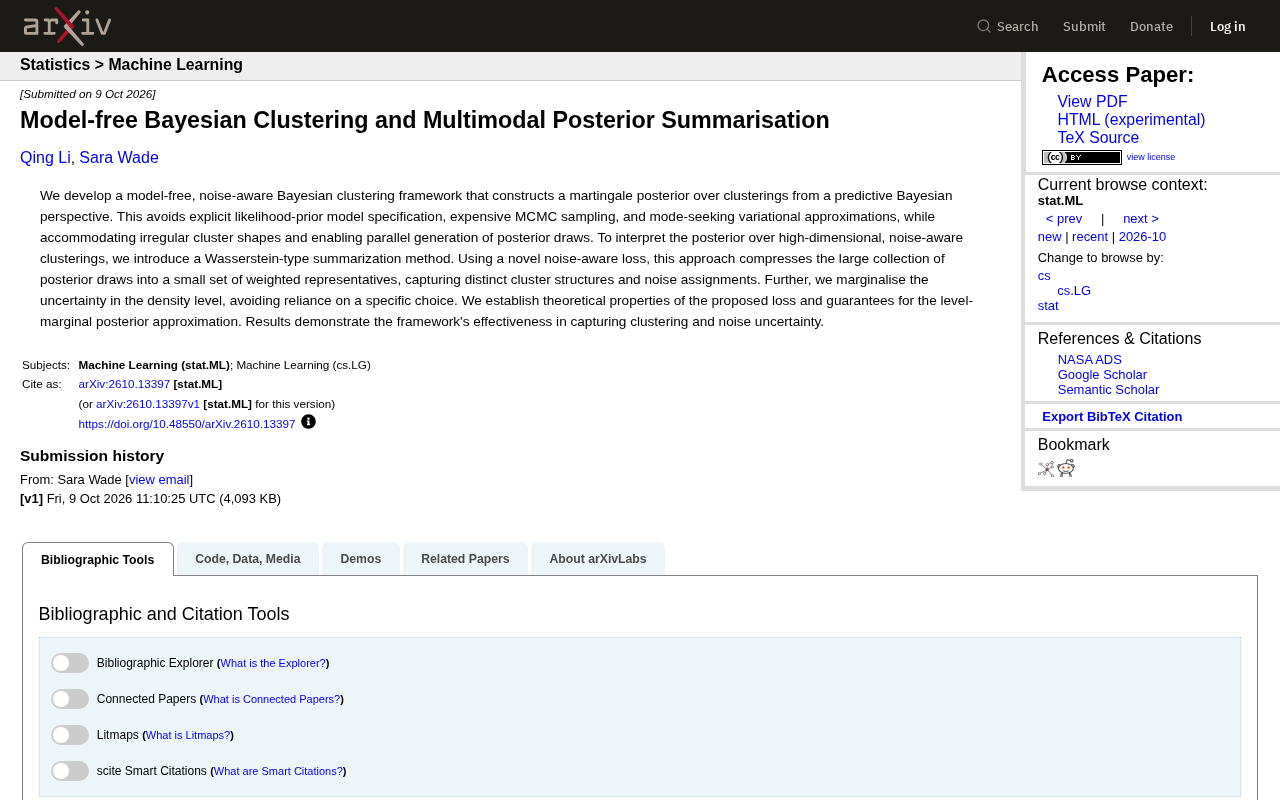
This work addresses three structural bottlenecks in Bayesian clustering — model misspecification, MCMC overhead, and uninterpretable multimodal posteriors — with a model-free, noise-aware framework. Its theoretical core is a martingale posterior constructed from a predictive Bayesian perspective, enabling parallel posterior sampling without specifying a likelihood-prior form. The framework explicitly models noise in the posterior, marginalizes over density thresholds to avoid arbitrary parameter choices, and uses a Wasserstein-type summarization with a novel noise-aware loss function to compress complex posteriors into interpretable weighted representative clusterings.
An Old Problem, A New Approach
Clustering analysis is the starting point for nearly every data science task, yet traditional Bayesian clustering methods have long been constrained by several structural bottlenecks: the need to explicitly specify likelihood-prior models, reliance on computationally expensive MCMC sampling, and the mode-seeking bias introduced by variational approximations. These limitations not only slow down computation but often force researchers to make distributional assumptions that may not hold in practice.
This research proposes a model-free, noise-aware Bayesian clustering framework designed to circumvent these obstacles. Its core idea is to adopt a predictive Bayesian perspective to construct a martingale posterior over clustering structures — enabling uncertainty quantification without ever explicitly specifying a model.
Why Avoid Explicit Models
The pain points of traditional approaches can be summarized in three ways: first, the subjectivity of model specification, where incorrect likelihood assumptions systematically distort results; second, the slow convergence and high computational cost of MCMC in high-dimensional settings; and third, variational methods' tendency to capture only the dominant mode of the posterior while ignoring multimodal structure. This framework addresses all three issues through the construction of a martingale posterior, and naturally supports parallel generation of posterior samples — a critical advantage for large-scale data settings.
The martingale posterior is a central concept in the predictive Bayesian framework and deserves a brief explanation. Traditional Bayesian inference starts from a prior and updates to a posterior via observed data. Predictive Bayesian inference reframes this process as follows: if we make sequential predictions about unseen data, the resulting prediction sequence forms a martingale — a stochastic process whose expected future value equals its current value. The martingale posterior exploits this property to directly generate posterior samples over clustering structures via an exchangeable prediction rule, without specifying a joint likelihood. The key advantage is that as long as the prediction rule satisfies consistency conditions, the posterior is guaranteed to be probabilistically calibrated — without any parametric assumptions on the data distribution. This provides a rigorous theoretical foundation for model-free clustering, and is the fundamental reason the framework can bypass MCMC.
Handling Irregular Shapes and Noise
Clusters in real-world data are rarely neat spheres, and the presence of noise points often interferes with clustering judgment. A notable strength of this framework is its ability to adapt to irregularly shaped clusters while explicitly modeling noise as part of the posterior, rather than simply discarding outliers.
The noise-aware design means the model simultaneously produces a clustering partition and a probabilistic assessment of which observations belong to noise. This approach is closer to the true data-generating mechanism than hard noise removal, and yields more meaningful uncertainty quantification downstream.
Parallel Posterior Sample Generation
By breaking free from MCMC's sequential dependencies, posterior samples can be drawn in parallel. In engineering terms, this is a concrete speedup — in modern multi-core or distributed computing environments, parallel sampling can compress what would otherwise be hours of inference into a practical time frame.
Wasserstein-Style Posterior Summarization
A posterior over high-dimensional clustering is essentially a collection of many different clustering solutions. Distilling interpretable conclusions from thousands of posterior samples is a long-neglected challenge in Bayesian clustering. To address this, the authors introduce a Wasserstein-type summarization method.
The idea is to use a newly designed noise-aware loss function to compress the large posterior sample collection into a small set of weighted representative clusterings. Each representative captures a distinct cluster structure and noise assignment pattern, effectively providing a "summary card" for a complex multimodal posterior.
Why Wasserstein Distance
Wasserstein distance has favorable geometric properties for comparing distributions — including structured objects like clustering partitions — by measuring the minimum cost of "transporting" one clustering solution into another. Compared to simple label-matching metrics, it better reflects substantive differences between clustering structures, making it well-suited for meaningful summarization of multimodal posteriors.
In the context of clustering posterior summarization, Wasserstein distance faces a practical challenge: the labels of two clustering solutions have no natural correspondence (the label switching problem), so computing the distance directly requires solving an optimal label assignment first. Wasserstein distance bypasses this by representing clustering partitions as probability measures and solving an optimal transport problem — measuring the minimum total cost to "move" one partition into another, rather than comparing labels one-to-one. The noise-aware loss function developed in this work extends this further by incorporating the assignment uncertainty of noise points into the distance calculation, so comparisons between clustering solutions reflect both cluster structure differences and noise attribution differences. This allows the posterior summary to not only capture dominant cluster partition patterns, but also distinguish between posterior samples that share similar cluster structures but differ substantially in how they handle noise.
Marginalizing Over Density Levels
Density-based clustering methods typically require the user to manually select a density threshold (level), a choice that is often arbitrary and directly affects the number and shape of resulting clusters. This framework instead marginalizes over the uncertainty in the density level, treating it as a parameter to be integrated out rather than fixed at a specific value.
This step makes results substantially more robust to threshold selection. The authors also provide theoretical guarantees for the level-marginalized posterior approximation along with a formal analysis of the proposed loss function's properties — meaning the method is not only empirically effective but also mathematically grounded.
The practical significance of density level marginalization can be understood through density-based clustering methods such as DBSCAN or hierarchical density estimation. The core operation in these methods is: select a density threshold, define connected regions above that threshold as clusters, and label points below it as noise. The threshold directly determines the number and granularity of clusters — too high, and genuine clusters get fragmented; too low, and noise gets absorbed into clusters. The conventional approach is manual tuning or heuristic selection of a single threshold, but this introduces non-negligible arbitrariness. Marginalization treats the threshold as an uncertain parameter and integrates over all plausible values under a reasonable prior, so the resulting clustering posterior automatically synthesizes results across different threshold settings. Mathematically, this is equivalent to maintaining honest uncertainty about "at what resolution to view the data" rather than forcing a single answer.
Significance and Positioning
Overall, this work integrates several independent technical threads — predictive Bayesian inference, martingale posteriors, Wasserstein summarization, and noise-aware loss functions — into a coherent framework for clustering uncertainty quantification. It targets a longstanding practical weakness of Bayesian clustering: avoiding both model misspecification and computational bottlenecks, while making high-dimensional multimodal posteriors interpretable.
Experimental results demonstrate that the framework effectively captures uncertainty in both cluster structure and noise assignment. For researchers who need reliable clustering analysis on complex, noisy data, this represents a new option that balances theoretical rigor with computational feasibility. That said, as a methodological paper, its performance on real-world large-scale industrial data and its head-to-head comparison with mainstream clustering tools remain subjects for further empirical validation.
Related articles

Random Pruning of the DPO Computation Graph: 1.4x Training Speedup and Lower Peak Memory
DPO training too slow and memory-hungry? This paper proposes a random pruning framework for the DPO computation graph, sampling independently across position, sequence, and branch dimensions; branch pruning achieves a 1.426x step-time speedup and cuts training time by about 30%, with in-depth attribution of memory and time gains.

Why Does JEPA Underperform MLM in Longitudinal EHR Representation Learning?
New study compares JEPA and MLM for longitudinal EHR representation learning on MIMIC-IV: three JEPA variants train stably without collapse but underperform MLM; target size, not heterogeneity, drives prediction error.

Transfer Learning + Visible Light Communication: A New Approach to Energy-Efficient Indoor Positioning
A study proposes a transfer learning-based visible light communication indoor positioning method, achieving 47% accuracy improvement on the BOSCH factory dataset, 67.5% model efficiency under high noise, and introducing the ME composite metric for energy-efficient positioning in energy-constrained industrial IoT scenarios.