Modeling Care Escalation Decisions with POMDP: When Is It Appropriate, and When Is It Overkill?

A pragmatic analysis of when POMDP modeling fits care escalation decisions versus simple threshold rules.
This article examines whether POMDP is the right framework for modeling care escalation decisions—when someone fails to respond to medication reminders. While POMDP elegantly captures hidden states, noisy observations, and asymmetric costs, simple threshold rules may suffice for small projects. The recommended approach is phased: start with interpretable baselines, then upgrade to POMDP once data justifies the complexity.
A Real Modeling Dilemma
Recently in Reddit's reinforcement learning community, a developer who described themselves as an RL beginner posed a highly representative question: how should one model an agent for "care escalation" decisions?
The scenario is specific: when someone fails to respond to a medication reminder in time, the system needs to decide what action to take—remind again (remind), continue waiting (wait), or directly notify the caregiver (notify). The challenge is that the person's true state is hidden: they might simply be "fine but busy," "asleep," "phone is dead," or they might be "experiencing a genuine emergency." The system can only observe noisy signals, such as how much time has elapsed and historical response patterns.
The developer's intuition was to model this as a POMDP (Partially Observable Markov Decision Process): maintain a belief distribution over hidden states (belief state), continuously update it through Bayesian filtering, and then use an escalation policy to map beliefs to specific actions.
POMDP is a generalization of MDP (Markov Decision Process). In a standard MDP, the agent can fully observe the environment state, whereas POMDP acknowledges a fundamental limitation of reality: the agent cannot directly know the true state and can only infer it indirectly through noisy observations. Its mathematical definition includes a seven-tuple (S, A, T, R, Ω, O, γ), corresponding to the state space, action space, state transition function, reward function, observation space, observation function, and discount factor. POMDP's core innovation is introducing the "belief state"—a probability distribution defined over all possible hidden states, where the agent makes decisions based on this distribution rather than a single deterministic state.
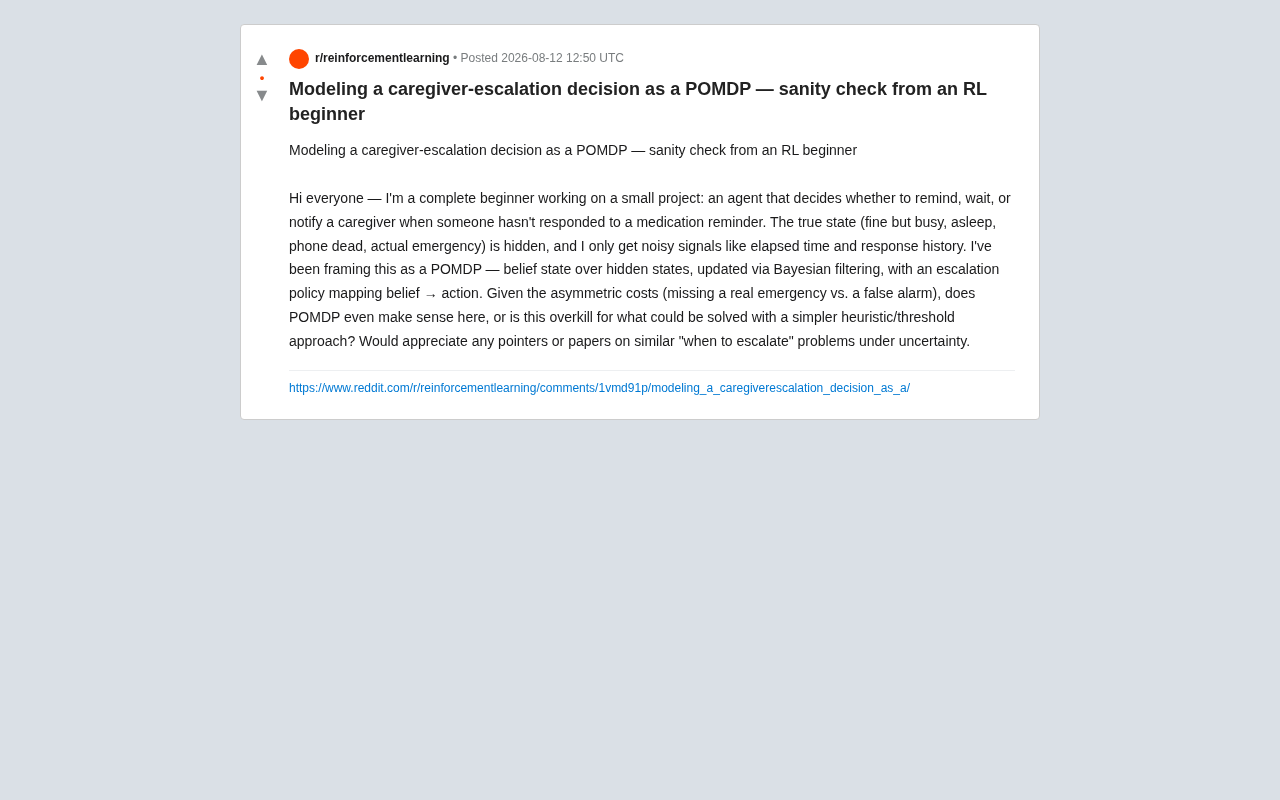
Their real question was: given the highly asymmetric costs involved (missing a real emergency is far worse than a false alarm), is POMDP actually appropriate here? Or is this using a sledgehammer to crack a nut, when a simple threshold/heuristic method would suffice?
Why Care Escalation Is a Good Fit for POMDP Modeling
This question might seem like "a beginner's self-doubt," but it actually touches on one of the most critical judgments in sequential decision-making: when to bring out the heavy artillery, and when to keep things simple.
POMDP Is a Perfect Conceptual Fit
From a formal perspective, this scenario is almost a textbook POMDP case, simultaneously possessing three key elements:
- Hidden states: The true situation cannot be directly observed (busy/asleep/phone dead/emergency);
- Noisy observations: Only indirect signals are available (time elapsed, response history);
- Sequential decision-making: The current choice to "wait" or "remind" affects what information and costs come later.
In other words, the problem inherently has the structure of "making repeated decisions under uncertainty," and using a belief state to express "how confident am I right now that this is an emergency" is natural and appropriate. Bayesian filtering continuously incorporates new observations (another 5 minutes have passed with no response) into the belief—this is exactly the standard approach for such problems.
Bayesian filtering is the core mechanism for maintaining belief states in POMDPs. Every time the agent takes an action and receives a new observation, it updates the belief distribution according to Bayes' rule: first predicting the prior probability of each state at the next time step through the state transition model, then computing the likelihood of the current observation under each state using the observation model, and finally normalizing to obtain the posterior belief. In the care scenario, this means that for every 5 minutes that pass without a response, the system's confidence in the "emergency" hypothesis rises according to mathematical principles rather than relying on arbitrarily set linear growth. Kalman filtering and particle filtering are both specific implementations of Bayesian filtering under different assumptions.
Asymmetric Costs Are Where POMDP's Value Shines
The real key lies in the asymmetric costs the developer themselves mentioned. POMDP's value is precisely demonstrated here: it can explicitly encode "the enormous cost of missing a report" and "the nuisance cost of a false alarm" into the reward function, allowing the policy to mathematically weigh the tradeoff between "waiting a bit longer to gather more information" and "escalating immediately to avoid risk."
The concept of asymmetric costs originates from the expected utility framework in decision theory. In a classic confusion matrix, false positives (false alarms) and false negatives (missed detections) are typically assigned different weights. In medical and safety domains, this asymmetry is especially extreme: missing a stroke episode could cost a life, while making one extra phone call only causes minor disturbance. POMDP explicitly quantifies this asymmetry through the reward function—for example, setting the missed detection reward to -1000 and the false alarm reward to -1, the policy solver will automatically learn to act preemptively when the belief distribution leans toward danger rather than waiting for complete confirmation. This implicit calculation of "Value of Information" is precisely the core advantage of the POMDP framework over static rules.
This is something pure threshold methods cannot handle elegantly—fixed thresholds cannot adaptively adjust escalation timing based on dynamic changes in belief.
Simple Threshold Methods May Already Be Sufficient
However, a pragmatic perspective from the community discussion is: don't underestimate the power of simple methods.
For small projects with only a handful of hidden states and limited observation signals, a carefully designed heuristic rule or threshold policy can likely cover over 90% of practical needs. For example:
If no response for more than T1 minutes → remind again
If no response for more than T2 minutes AND historical response rate is low → notify caregiver
The advantages of such rules are very clear:
- High interpretability: Both caregivers and care recipients can understand "why" the system is alerting at this moment, which is crucial in healthcare scenarios;
- Easy to debug and tune: Problems can be quickly located;
- No training data required: POMDP's transition probabilities, observation model, and reward function all need to come from data or expert estimates, and these parameters are often hard to obtain early in a project.
The Cost Trap of POMDP Modeling
Adopting POMDP means you need to answer a series of thorny questions: What's the probability of transitioning from "asleep" to "emergency"? When observing "10 minutes have passed," what's the likelihood for each hidden state? Is the cost ratio of false alarms to missed detections 1:100 or 1:1000?
If these parameters are poorly estimated, the "optimal policy" solved by the POMDP may actually be less reliable than a conservative threshold rule. For a beginner's small project, this is a very real over-engineering risk. A deeper issue is that exact POMDP solving is itself a PSPACE-complete problem, with computational complexity growing exponentially with the state space—even though this care scenario has a small state space, the engineering investment needed to build a complete modeling-solving-verification pipeline far exceeds writing a few lines of threshold rules.
A Pragmatic Phased Approach
Taking everything into account, the most reliable path is phased progression:
Step 1: Establish a Performance Baseline with Threshold Methods
Use simple rules to quickly build a working prototype, which naturally becomes the performance baseline for any subsequent complex methods. If the baseline already meets requirements, there's no need to add complexity.
Step 2: Upgrade to POMDP After Data Accumulation
When you find that fixed thresholds frequently misjudge between "user is busy but fine" and "genuine emergency," and the losses from asymmetric costs are indeed significant, then introduce belief states and Bayesian updating. At this point, you'll have accumulated some response data to more reliably estimate model parameters.
Related Research Directions Worth Exploring
For readers who want to go deeper, here are several keywords and areas worth following:
- POMDP applications in healthcare management decisions, especially treatment and monitoring timing decisions. This direction has extensive literature—for example, in chronic disease management (diabetes insulin regulation, depression treatment switching) and screening strategy optimization, POMDPs are used to maximize patient outcomes under limited testing resources;
- Optimal stopping problems—"when to escalate" is fundamentally a stopping problem of "when to act." Optimal stopping theory is a classic branch of probability theory and decision theory, studying "when to stop observing and take an irreversible action." The most famous example is the "secretary problem": interviewing n candidates, where after each interview you must immediately decide to hire or pass. In the care escalation scenario, "notifying the caregiver" can be viewed as a semi-irreversible action—once triggered it incurs social costs, but waiting too long may miss the rescue window. Wald's Sequential Probability Ratio Test (SPRT) is a classic tool for such problems, continuously accumulating evidence between two hypotheses until reaching a threshold, which is highly aligned in spirit with POMDP belief updating;
- Cost-sensitive decision making, specifically addressing asymmetric error costs;
- Approximate solving methods like QMDP, POMCP, SARSOP, which make POMDPs computationally tractable in practice. QMDP is the simplest approximation method, assuming uncertainty disappears at the next step, reducing the POMDP to a weighted sum of multiple MDPs—fast to compute but performs poorly in scenarios requiring active information gathering. SARSOP (Successive Approximations of the Reachable Space under Optimal Policies) accelerates exact solving by only exploring the subset of belief space reachable under the policy, suitable for medium-scale problems. POMCP (Partially Observable Monte-Carlo Planning) extends Monte Carlo tree search to partially observable settings, approximating optimal policies through extensive simulation sampling, suitable for scenarios with large state spaces but available online computational resources.
Conclusion: The Art of Modeling Is About Matching
This beginner's "sanity check" was right on point. The answer is not a binary "POMDP is right or wrong":
- From a modeling rigor perspective, POMDP is entirely justified—it precisely captures hidden states, noisy observations, and asymmetric costs;
- But from an engineering practicality perspective, starting with a simple baseline is often the smarter starting point.
The general insight for AI application developers is: the art of modeling lies not in using the most powerful tool, but in using the tool that matches the problem's complexity, data conditions, and interpretability requirements. In life-safety-related care scenarios, a conservative strategy that can be understood and verified by humans is sometimes far more valuable than a theoretically optimal but unexplainable black box. This principle is known in AI safety research as "alignability"—the system's decision logic must be understandable and correctable by human supervisors, especially when decisions involve human welfare. POMDP is worth learning and understanding as a theoretical framework, but when deploying it to real care systems, transparency and auditability should be equally important as optimality.
Key Takeaways
Related articles

JobRunner MCP Server: AI Agents Can Now Fix Failed Java Jobs
JobRunner launches an open-source MCP server enabling AI agents to view cluster status, diagnose failures, and recover Java jobs—incident response from any cloud coding environment or existing agent.

MLAI Digital Launches 9 Security Agents: MCP Server Safeguards the Full Lifecycle of Agentic AI
MLAI Digital launches Security MCP Server with nine built-in specialized security agents covering vulnerability discovery, attack simulation, prompt injection detection, API and infrastructure assessment, and accelerated remediation—embedding security validation across the full Agentic AI lifecycle from development to production.

Running Isaac Lab on H100 GPUs: Exploring Better Approaches
Exploring optimization methods for running Isaac Lab on NVIDIA H100 GPUs, including MIG configuration, mixed precision, TensorRT acceleration, and community experience to improve robotics simulation and reinforcement learning efficiency.