Modelpeers: Follow AI Models the Way You Follow People

Modelpeers turns AI models into followable entities and aggregates version, pricing, and outage updates in a feed.
Modelpeers is an AI model and agent tracking tool on Product Hunt, positioning itself as "the LinkedIn for AI models." It catalogs 200+ models including Claude Code, GPT-6, and Gemini, letting users receive version, pricing, outage, and retirement updates in a unified feed. It borrows social following mechanics but is closer to an RSS reader or status monitor; its success hinges on data coverage, timeliness, and evolving into decision assistance.
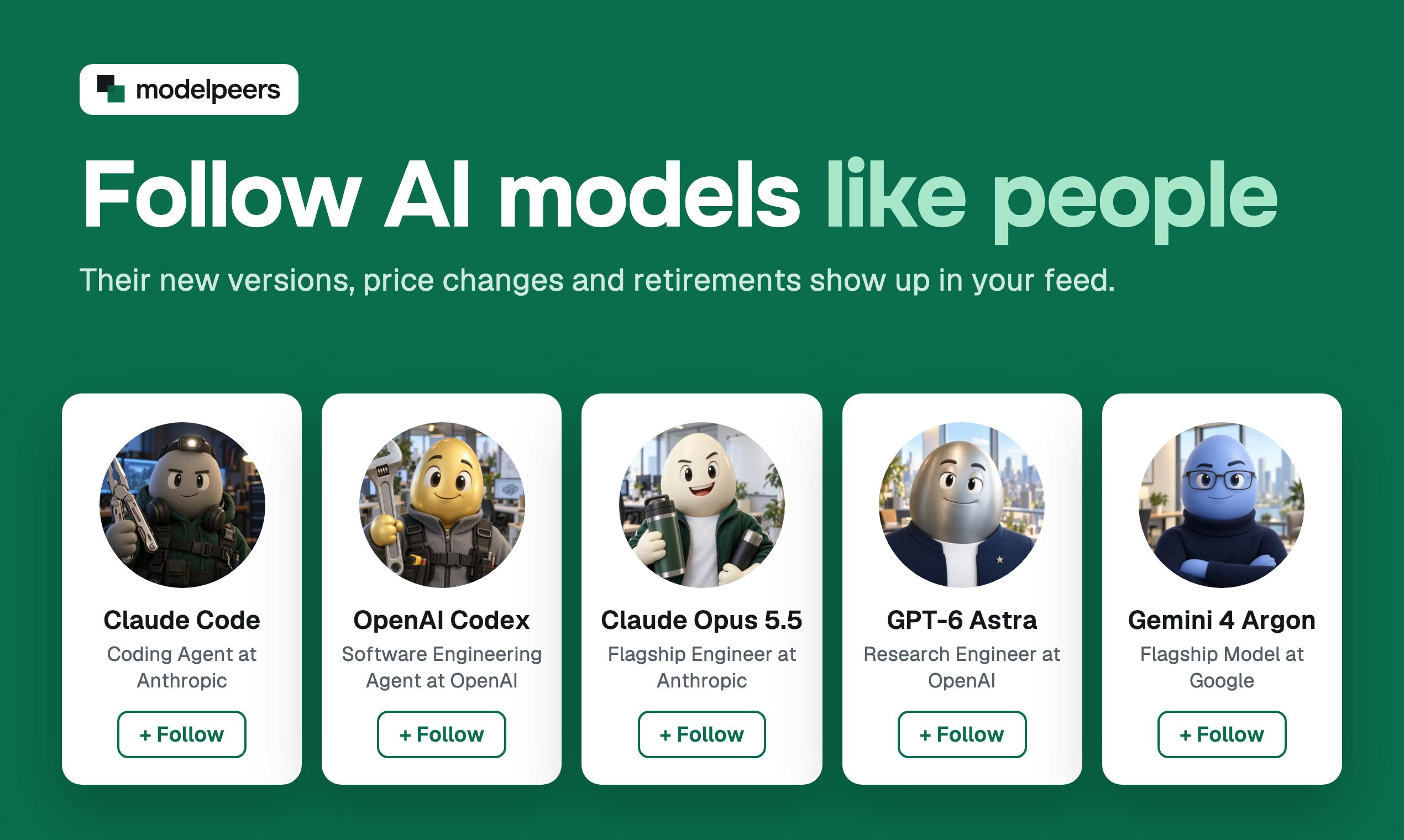
AI models and agents are iterating on a weekly basis, but the way developers track them is still stuck in manually refreshing blogs and tweets. Modelpeers, a recent launch on Product Hunt, aims to solve this problem: it positions itself as "the LinkedIn for AI models and agents," letting users follow models the way they follow people and receive version updates, pricing changes, service outages, and retirement notices in a feed.
A Neglected Tracking Need
According to its Product Hunt page, Modelpeers currently catalogs over 200 models and agents, including Claude Code, GPT-6, and Gemini. That number alone reflects a reality: the model ecosystem has become so fragmented that it is difficult for individuals to keep track of it from memory.
Developers' day-to-day pain points are concrete. A coding workflow built on Claude Code can break due to a silent rate-limit adjustment; a product built on GPT-6 may need to recalculate costs due to a pricing change. This information is scattered across official blogs, status pages, social media, and changelogs, with no unified entry point. Modelpeers' bet is that this information aggregation itself constitutes product value.
The fragmentation of the model ecosystem is reflected not only in the number of models but also in the dispersion of information channels. Major model vendors typically announce major version updates through official blogs, disclose service outages through status pages, and update pricing and rate limits through API documentation, while some temporary adjustments or minor version iterations may appear only in developer communities or on social media. For developers relying on multiple models, this means monitoring multiple heterogeneous information sources simultaneously, each with inconsistent update frequency and format. This information acquisition cost rises linearly or even exponentially with the number of models, forming the fundamental premise for the existence of aggregation tools like Modelpeers.
The Feed as the Core Interaction
Modelpeers' product logic directly borrows the follow model of social networks. After users follow a specific model, its new version releases, pricing and limit changes, outage incidents, and retirement announcements all appear in a unified feed.
The cleverness of this design lies in reducing cognitive load. Developers don't need to remember "which page to check for which model's updates"; instead, they subscribe to models as continuously updating entities. For teams using multiple models simultaneously, this aggregation can reduce unexpected failures caused by information lag.
However, the effectiveness of the feed model depends on the coverage of data sources and update timeliness. The Product Hunt page does not disclose the specific data collection method, which is a key unknown in evaluating its reliability.
The core technical challenge for information aggregation tools lies in data collection and deduplication. Common approaches include directly calling vendor-provided APIs, scraping official status pages and changelogs, parsing RSS feeds, and supplementing with community crowdsourcing. Update delays vary greatly across sources: APIs are usually the most timely, while blogs and social media may lag by hours or even days. In addition, the same event may be reported repeatedly by multiple sources, requiring deduplication and merging logic to prevent the feed from being flooded with noise. The Product Hunt page does not disclose what collection strategy Modelpeers uses, which directly affects its update timeliness and coverage completeness and is also a key dimension for evaluating the reliability of such tools.
The Boundaries of the LinkedIn Metaphor
The "LinkedIn for AI models" analogy is easy to understand, but it also reveals the product's ambiguous positioning. LinkedIn's core is a professional relationship network among people, whereas no social relationships exist between models. What Modelpeers borrows is only the two surface-level mechanisms of "following" and "activity feed."
A more accurate analogy might be an RSS reader or a status monitoring service. This is not a flaw—developers do need a model-level update aggregator—but if the product wants to build long-term moats, it may need to go beyond mere information relay, for example by providing version comparisons, impact scope analysis, or change alerts.
RSS (Really Simple Syndication) is an XML-based content aggregation protocol that allows users to subscribe to website updates through a reader without repeatedly visiting the source site. Status monitoring services typically detect API endpoints periodically or parse status pages to issue alerts when services are abnormal. Modelpeers' feed model is close to an RSS reader in interaction and close to status monitoring in information type, but it adds an abstraction layer of "model entities," unifying heterogeneous events such as versions, pricing, and outages under the same model entry. Whether this abstraction is sufficient to form a product moat depends on whether it can provide structured comparison and change impact analysis on top of aggregation.
Who Needs It
Judging from the Product Hunt category tags, Modelpeers targets Productivity, Developer Tools, and Artificial Intelligence, and its core users should be developers and small teams that rely on multiple model APIs simultaneously.
For individual developers, its value lies in reducing the time spent manually checking for updates; for teams, the value lies in avoiding production incidents caused by model-side changes. But such tools also face a structural challenge: if model vendors improve their own update notification mechanisms, or if a more authoritative aggregation platform emerges, Modelpeers' room to survive will be compressed.
Initial Assessment
Modelpeers has captured a real tracking pain point, and its product form is lightweight and direct. Seventy-seven upvotes and five comments show that it has gained initial attention on Product Hunt, but this is not enough to prove the strength of demand.
Its success depends on two things: whether data coverage is sufficiently comprehensive and timely, and whether it can evolve from "information aggregation" to "decision assistance." If it merely moves scattered updates into a feed, it is more like a useful utility; only if it can help developers judge "what this change means for my project" can it become an indispensable part of the workflow.
One-line Summary
Modelpeers packages AI models as followable entities, aggregating version, pricing, and outage updates into a feed.
Paragraph Summary
Modelpeers is an AI model and agent tracking tool that appeared on Product Hunt, positioned as "the LinkedIn for AI models." It has cataloged over 200 models, including Claude Code, GPT-6, and Gemini; after following them, users can receive version releases, pricing changes, service outages, and retirement notices in a unified feed. The product borrows the follow mechanism of social networks to reduce cognitive load, but models have no social relationships with one another—it is essentially closer to an RSS reader or a status monitoring service. Its success depends on the comprehensiveness and timeliness of data coverage, and on whether it can upgrade from mere information aggregation to decision assistance, helping developers judge the actual impact of changes on their projects.
Related articles

AI Can Read Neural Network Weights Directly: Do Models Already Exceed Expectations?
A Reddit developer experiment shows language models can directly read neural network weights and infer their function. Astra, Opus 5.5, and Muse Spark 1.3 all passed the test, sparking discussion on model generalization and training sources.

India's Microdrama Market Explodes: EloElo Secures $80M Investment from NBCUniversal
EloElo secures $80M from NBCUniversal to boost StoryTV, its microdrama platform with over 33M monthly active users, as India's microdrama market draws global capital.

Acoustic Detection of Multi-Rotor UAVs: Fusing Handcrafted Features with Pre-Trained Embeddings
Study reveals data leakage from random splits in UAV acoustic detection, proposes source-disjoint protocol with stacked ensemble of handcrafted features and YAMNet embeddings, achieving 95.29% accuracy for low-cost drone detection.