Modem: Closing the Loop on Customer Feedback with AI, Auto-Fixing and Following Up

Modem uses AI to monitor customer channels, auto-route fixes, and close the loop with customers once fixes ship.
Modem is an AI tool ranked fifth on Product Hunt that aims to bridge customer feedback and engineering execution. It plugs into support tickets, group chats, and sales calls, uses AI to spot problem signals and alert within minutes, then auto-creates issues, spins up coding agents, or escalates to the right team—and notifies customers once fixes ship. Automatic coding agents involve code-modification permissions, so approval boundaries are likely needed, and with limited community discussion, results still await real-world validation.
Customer feedback is scattered across support tickets, group chats, and sales calls, and teams often miss critical issues—let alone fix and follow up on them in time. Modem, ranked fifth on Product Hunt, aims to solve this pain point with AI: it monitors customer channels, alerts within minutes, automatically creates issues, spins up coding agents or escalates to the right team, and closes the loop by notifying customers once a fix ships. According to its Product Hunt page, it can "monitor your customer channels (support tickets, group chats, sales calls) and alert you to problems within minutes."
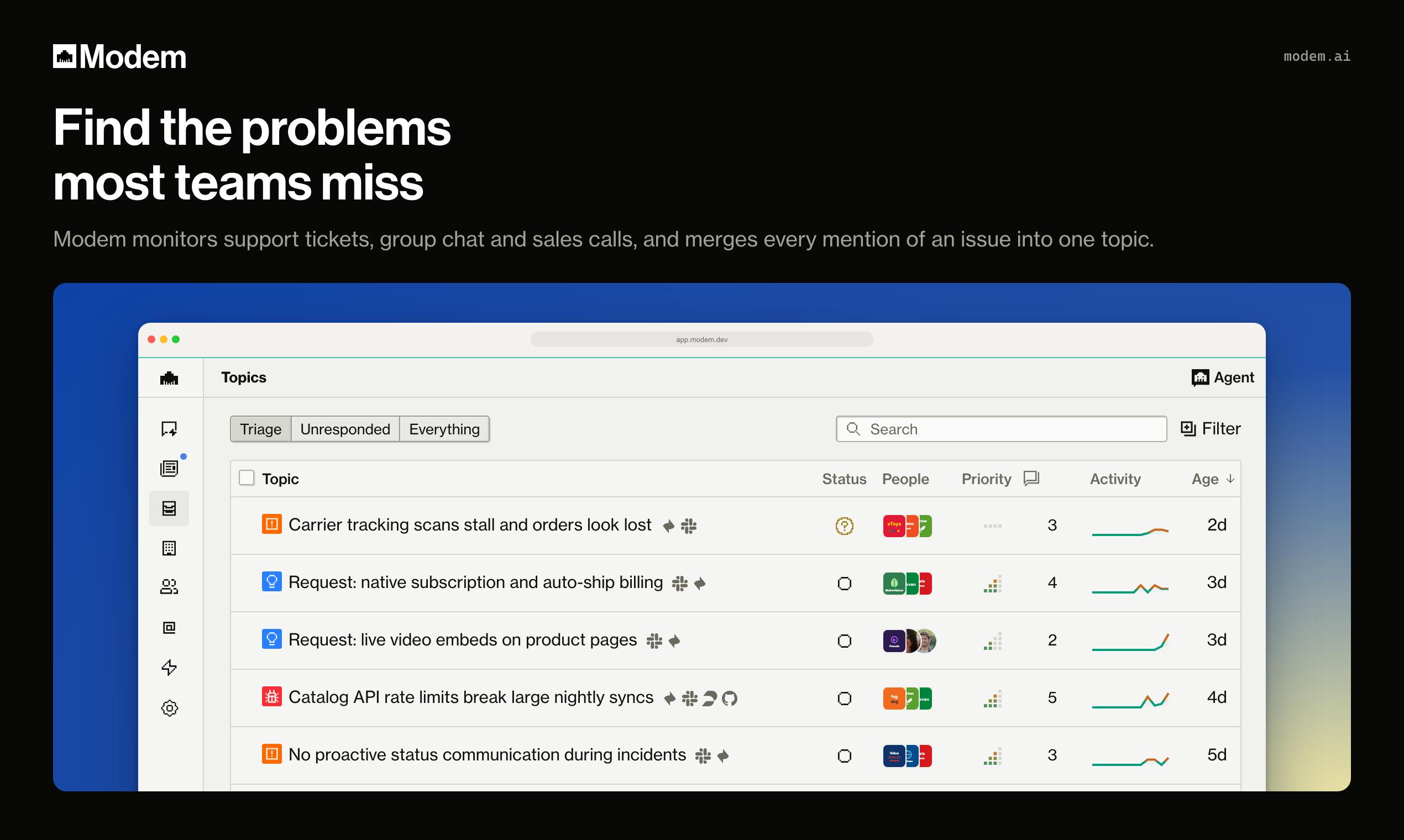
A closed-loop design from "hearing" to "fixing"
Modem's core idea isn't to build a better ticketing system, but to directly connect the voice of the customer with engineering execution. It plugs into three types of channels at once—support tickets, group chats, and sales calls—and uses AI to identify problem signals within them. Once something is judged to need handling, Modem takes action automatically based on preset rules: create an issue to track it, spin up a coding agent to attempt a fix, or escalate it to the right team. This design strings "discover—route—fix—report back" into a single pipeline, reducing the information loss caused by manual retelling.
For developers, automatically spinning up a coding agent means simple problems may not need human intervention; for customer success teams, the escalation mechanism ensures complex problems don't get stuck somewhere along the way.
A coding agent is a class of system in today's AI engineering tooling that, given repository context, can autonomously read code, locate problems, generate patches, and even open merge requests. What distinguishes it from traditional code completion tools is that completion only offers line-level suggestions, while an agent executes end-to-end on a task basis. Precisely for this reason, handing customer problems directly to an agent to attempt a fix presupposes that the agent can accurately understand the problem description and safely access the codebase—which explains why permissions and approvals are core constraints of this model.
Balancing auto-fix and human escalation
Modem claims that once a fix is released, it will "close the loop with the customer," i.e., proactively notify the customer who raised the issue. This hits a soft spot for many teams: the problem gets fixed but nobody tells the customer, so the customer experience still suffers. However, automatically spinning up coding agents involves code modification permissions and security, so in practice teams will most likely need to set approval boundaries. With only 7 comments on Product Hunt, community discussion is currently limited, and the specific degree of automation and reliability still need validation in real-world scenarios.
The makers include Mike Clarke and two others, and the product is categorized under Customer Success, Developer Tools, and Artificial Intelligence, positioning it across both customer success and R&D tooling.
"Closing the loop" comes from a common phrase in customer feedback management, referring to a team proactively going back to the customer who raised the feedback to confirm the outcome after the issue is resolved, rather than letting the issue close silently internally. In a product context, it typically manifests as tickets automatically updating status, sending fix notifications to customers, or inviting them to re-verify. The reason closing the loop is emphasized separately is that many teams optimize only for fix speed while omitting the notification step, so the service quality perceived by customers doesn't improve in tandem.
Who should use Modem
If a team uses a ticketing system, instant messaging groups, and sales call tools at the same time, and customer feedback frequently gets lost between channels, Modem's aggregated monitoring value is most obvious. For engineering teams with a mature issue-tracking process, it can serve as an upstream signal-capture layer; for customer success teams, it provides visibility from feedback to fix status. Note that multi-channel integration means configuration costs, and the accuracy of AI's parsing of sales call content directly affects alert quality.
Note on multi-source information
The information in this article mainly comes from the Product Hunt product page; the 91 upvotes, rank of 5th, and 7 comments are all cited from that page. Due to the lack of third-party reviews and in-depth user feedback, the feature descriptions herein are based on official introductions, and actual usage results await cross-validation from more sources.
Sales call parsing is a two-stage process of speech transcription plus semantic analysis: first, ASR converts call audio to text, then a language model extracts requirements, objections, or fault signals. Its accuracy is noticeably affected by accents, call quality, multiple overlapping speakers, and industry terminology, and transcription errors get amplified along the pipeline into false positives or missed detections. Therefore, for call channels, alert precision is often more worth attention than recall, and teams usually need to set confidence thresholds or retain a manual review step.
One-line Summary
Modem uses AI to monitor customer channels, automatically route fixes, and close the loop with customers once fixes ship.
Paragraph Summary
Modem is an AI tool ranked fifth on Product Hunt, aiming to bridge the gap between customer feedback and engineering execution. It plugs into three types of channels—support tickets, group chats, and sales calls—uses AI to identify problem signals, and alerts within minutes. Once an issue is judged to need handling, Modem can automatically create an issue per preset rules, spin up a coding agent to attempt a fix, or escalate to the right team; after a fix ships, it also proactively notifies the customer to close the loop. The article notes that this design reduces information loss from manual retelling, but automatic coding agents involve code modification permissions, so real-world adoption will most likely require approval boundaries, and with limited community discussion, results still await real-world validation.
Related articles

GLM-5.4 vs. Opus and Neon: How Far From the Top?
No official benchmarks for GLM-5.4. Based on a YouTube deep test and developer trials, we analyze its gap vs. Claude Opus 5.5 and Gemini Neon, the speed bottleneck from marathon-style thinking, and its real position in enterprise agent scenarios.

From Gobbler to Sloppy Joe: The Hit-Making Playbook of a New Jersey Deli Institution
NYT Cooking visits Milburn Deli in New Jersey to break down the hit logic behind the Gobbler turkey sandwich and the local Sloppy Joe: bread sliced to order, house-made sauces, a group shout culture, and customer co-creation behind six locations.
In the Age of AI Programming, When Do You Still Need to Write Code by Hand?
Is handwritten code still valuable once AI programming agents are widespread? This article outlines three scenarios where handwriting is essential—learning, style development, and prototype validation—and provides a division-of-labor framework between AI and humans to help developers balance efficiency and skill growth.