Moderna's Personalized Cancer Vaccine Succeeds in Phase 3 Trial, Stock Surges 110%
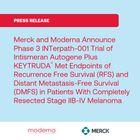
Moderna's personalized mRNA cancer vaccine achieves historic Phase 3 success, stock surges 110%.
Moderna and Merck announced the first-ever positive Phase 3 results for a personalized mRNA cancer vaccine, significantly reducing melanoma recurrence risk. The breakthrough validates mRNA as a versatile technology platform beyond COVID vaccines, combining AI-driven neoantigen selection with Keytruda immunotherapy. MRNA stock surged over 110%, signaling a potential paradigm shift toward personalized cancer treatment.
A Milestone Moment: First Successful Phase 3 Trial for a Personalized Cancer Vaccine
Moderna (ticker: $MRNA) saw its stock price surge over 110% in a single day. Behind this stunning rally lies a true milestone in biopharmaceutical history: Moderna and Merck jointly announced that their personalized cancer vaccine achieved the first-ever positive Phase 3 result in a large, late-stage clinical trial.
Drug clinical trials are typically conducted in three phases: Phase 1 primarily evaluates safety and dosing (usually with dozens of participants), Phase 2 provides a preliminary assessment of efficacy (hundreds of participants), and Phase 3 is the pivotal confirmatory study conducted in a large patient population, typically using a randomized, double-blind, controlled design — serving as the core evidence for regulatory approval. Statistics show that the overall success rate for oncology drugs making it from Phase 1 to market is less than 5%. Therefore, achieving the "first" positive Phase 3 result in an entirely new treatment paradigm means this technology has crossed the critical threshold from proof-of-concept to clinical confirmation — a truly epoch-making achievement.
According to information released by both companies, this personalized mRNA cancer vaccine significantly reduces the risk of recurrence in melanoma patients. The choice of melanoma as the first indication for validation follows a deep scientific rationale: it has one of the highest Tumor Mutational Burdens (TMB) among all solid tumors, meaning its cancer cells carry a large number of abnormal proteins on their surfaces, providing the immune system with abundant targets for recognition. For this same reason, melanoma was the first cancer type to show significant response to immune checkpoint inhibitors, and many breakthrough advances in immunotherapy were first validated in melanoma. A high mutational burden means there are more neoantigen candidates for algorithms to screen, resulting in higher success rates for personalized vaccine design.
This is not just a commercial victory — it represents a substantive step in shifting the cancer treatment paradigm from "one-size-fits-all therapy" to "personalized immunotherapy."
What Is a Personalized Cancer Vaccine: mRNA Technology's New Frontier
Unlike traditional preventive vaccines, Moderna's product is a therapeutic personalized vaccine. Its core logic is this: every patient's tumor carries unique genetic mutations that produce specific "neoantigens." The vaccine works by sequencing the patient's tumor sample, identifying these unique mutational signatures, and then using mRNA technology to "custom-build" a bespoke vaccine that guides the patient's own immune system to precisely identify and attack cancer cells.
To understand this process, it helps to first grasp the basic principles of the mRNA technology platform. mRNA (messenger RNA) is a key molecule that carries genetic information within cells — it transmits gene instructions from DNA and directs ribosomes to synthesize specific proteins. The core principle of mRNA vaccines is to inject synthetically produced mRNA into the body, leveraging the body's own protein synthesis machinery to produce target antigen proteins and thereby trigger an immune response. Unlike traditional vaccines that require culturing viruses or producing recombinant proteins, mRNA vaccines only need to know the gene sequence of the target protein and can complete vaccine design in days and begin production in weeks. This "software-like" characteristic makes it naturally suited for personalized applications — swapping out the mRNA sequence is essentially like changing a vaccine's "source code."
This is precisely an extension of the mRNA platform that Moderna validated through its COVID-19 vaccine. The COVID vaccine proved that mRNA technology could be produced rapidly and at scale, while cancer vaccines apply this advantage to "one patient, one formula" personalized manufacturing.
Synergy with Keytruda Immunotherapy
Interestingly, this vaccine (development code mRNA-4157/V940) is not used alone but administered in combination with Merck's blockbuster immune checkpoint inhibitor Keytruda (pembrolizumab).
Keytruda is a monoclonal antibody targeting the PD-1 receptor. Under normal circumstances, PD-1 serves as a "brake" mechanism in the immune system, preventing T cells from excessively attacking the body's own tissues. However, many tumor cells express the PD-L1 ligand, which binds to PD-1 on T cells, disguising cancer cells as normal cells and thereby evading immune attack. Keytruda works by blocking the PD-1/PD-L1 interaction, unleashing T cells' anti-tumor activity — often described as "releasing the brakes on the immune system." Keytruda is currently one of the world's top-selling cancer drugs, with global sales exceeding $25 billion in 2023, and has been approved for over 30 cancer indications.
The rationale for combining it with a personalized vaccine is straightforward: the vaccine is responsible for "training" the immune system to recognize tumor targets, while Keytruda is responsible for "lifting" the immune system's suppression. Together, they achieve a stronger anti-tumor effect. This "vaccine + immunotherapy" combination represents one of the most cutting-edge approaches in oncology today — activating and amplifying anti-tumor immune responses through multiple mechanisms simultaneously.
MRNA Stock Surges 110%: The Market's Emphatic Response
A single-day stock surge of over 110% is extremely rare for a mature pharmaceutical company, clearly reflecting the market's overwhelmingly optimistic interpretation of this result.
For Moderna, the post-COVID era has brought enormous revenue pressure, and the market has been questioning: beyond infectious disease vaccines, can the mRNA platform open up sustainable commercial prospects? This Phase 3 success delivers a powerful answer — mRNA is not just a "pandemic stock" but a technology platform with vast application potential.
Melanoma is just the starting point. If the principle of personalized vaccines is validated in skin cancer, it can theoretically be extended to lung cancer, kidney cancer, bladder cancer, and many other solid tumors, with the addressable market expanding exponentially.
The Intersection of Technology, AI, and Personalized Medicine
The Algorithmic Pipeline from Genetic Data to Vaccine
The realization of personalized cancer vaccines relies heavily on bioinformatics and sophisticated algorithms. Screening for the most immunogenic neoantigens from tumor genomic sequencing data requires complex predictive models to assess which mutations are most likely to be recognized by the immune system. This process is essentially an AI-driven antigen optimization problem.
Specifically, the entire algorithmic pipeline is remarkably intricate: first, Whole Exome Sequencing is performed on both tumor tissue and normal tissue from the patient, with somatic mutations unique to the tumor identified through comparison. Then, algorithms must predict whether the abnormal protein fragments (peptides) produced by these mutations can effectively bind to the patient's specific HLA (Human Leukocyte Antigen) molecules — the HLA system itself exhibits extremely high individual polymorphism, and virtually no two people in the world share the exact same HLA genotype. Deep learning models (such as NetMHCpan) are widely used to predict peptide-HLA binding affinity, and in recent years, Transformer-based large language models have also been introduced into the antigen presentation prediction field. The entire pipeline must also evaluate mutation peptide expression levels, proteasomal processing probability, T-cell receptor recognition likelihood, and multiple other dimensions, ultimately selecting the optimal 20-34 neoantigens from hundreds or thousands of candidate mutations to encode into a single mRNA molecule.
In other words, personalized cancer vaccines are the product of computational biology, machine learning, and mRNA manufacturing expertise working in concert. The creation of each vaccine is a transformation from massive datasets to a clinical product. This is why this type of technology has long been "strong on concept, hard to implement" — it wasn't until sequencing costs, algorithmic capabilities, and scalable mRNA production all matured simultaneously that personalized vaccines finally reached the threshold of Phase 3 clinical success.
Challenges to Scalable Commercialization Remain
Despite the bright prospects, commercializing personalized vaccines still faces unique challenges. Each patient requires an independent sequencing, antigen prediction, and vaccine production workflow — fundamentally different from the traditional model of "one drug treats all patients."
The production model for personalized cancer vaccines upends the traditional pharmaceutical industry's "batch manufacturing" paradigm. From biopsy sampling to gene sequencing, antigen prediction, mRNA sequence design, in vitro transcription synthesis, and quality testing, the entire process must be completed within 6-8 weeks — and for patients receiving post-surgical adjuvant therapy, this time window is critical. This places unprecedented demands on supply chain management, production automation, and quality control systems. On the regulatory front, the U.S. FDA and European EMA are exploring new approval frameworks for individualized therapeutic products, because traditional "batch consistency" quality control standards need to be redefined in a scenario where each batch serves only one patient. Ensuring that every personalized vaccine meets safety and efficacy standards without letting the approval process become a bottleneck for patient access to treatment is a new challenge for regulatory science.
How to control costs, shorten production timelines, and meet regulatory requirements for individualized products while maintaining personalization are all real-world problems that need to be addressed going forward.
Conclusion: The Dawn of a New Era in Personalized Cancer Treatment
The Phase 3 success of Moderna and Merck's collaboration carries significance far beyond a single day's stock rally. It marks a critical leap in bringing personalized cancer treatment from the laboratory to clinical reality and validates the long-term value of mRNA as a versatile technology platform.
For investors, this is a valuation re-rating. For patients, it is a new ray of hope. And for the entire biotech industry, this may be the beginning of "precision medicine" truly delivering on its promise. Of course, the road from Phase 3 success to final regulatory approval, market launch, and broad patient access remains long. But one thing is certain: the future of cancer treatment is being rewritten.
Key Takeaways
Related articles

Hexel Editor: A Native macOS Hex Editor That Actually Understands File Structures
Hexel Editor is a native macOS hex editor for reverse engineers and security researchers, with built-in Mach-O, ELF, PE parsing, instant large file loading, entropy analysis, and real-time byte decoding.

Suno 2.0 Teaser Strengthens Creative Control, Cursor Origin Reimagines Programming Infrastructure
AI roundup: Suno Studio 2.0 teases stronger creator control, Cursor Origin adds code review & repo sync, Tencent launches HY3D World Claw for text-to-3D, Ant Group open-sources Ling 3.0 Tiny, Kimi K3 arrives on Databricks.

Techietribe AI Review: An All-in-One Online Presence Management Platform for Small Businesses
In-depth review of Techietribe AI, an all-in-one online presence platform for small businesses, covering AI website building, business profiles, and integrated directories.