Suno 2.0 Teaser Strengthens Creative Control, Cursor Origin Reimagines Programming Infrastructure

AI tools shift focus from generation to controllability, production-readiness, and real-world deployment.
Suno Studio 2.0 teases deeper creative control for AI music, while Cursor Origin rebuilds coding infrastructure with AI-native code review and repo sync. Tencent launches HY3D World Claw for text-to-game-ready 3D worlds and WorkBuddy multi-device sync. Ant Group open-sources the lightweight MoE model Ling 3.0 Tiny for on-device deployment, and Kimi K3 lands on Databricks for enterprise use. The clear trend: AI is moving from impressive demos to controllable, production-grade tools.
Suno Studio 2.0: Further Empowering Creator Control
On August 12, Suno officially teased version 2.0 of its AI music workstation, Suno Studio, accompanied by a telling tagline — "Take the keys." The message clearly conveys the core direction of 2.0: giving creators stronger control.
The current Suno Studio is already a fairly full-featured web-based AI music workstation, supporting multi-track editing, AI generation, instrument tracks, recording, stem separation, and MIDI export. In other words, it's no longer just a toy that "generates a song from a text prompt" — it's a productivity tool approaching professional Digital Audio Workstation (DAW) standards. DAWs are the core software in music production, with representative products including Ableton Live, Logic Pro, Pro Tools, and others, offering multi-track recording, mixing, effects processing, MIDI sequencing, and complete music production capabilities. Suno Studio's embedding of AI generation capabilities within a DAW-style multi-track editing interface means creators can independently adjust each AI-generated track just like they would in a traditional DAW — modifying instrument arrangements on a specific track, adjusting volume envelopes, replacing particular sections, and more. The MIDI export feature is especially critical, as MIDI is the universal digital score format in the music industry; supporting export means AI-generated melodies and arrangements can be imported into any traditional DAW for further refinement, breaking down the data barrier between AI tools and professional production workflows.
The specific upgrades in 2.0 haven't been officially announced yet, but given the emphasis on "stronger creative control," it's likely to further strengthen the collaborative boundary between human intervention and AI generation — shifting creators from passively accepting generated results to actively controlling every creative element. This aligns with the broader trend of AIGC tools moving from "impressive demos" to "practical production."
Kimi K3 Lands on Databricks: Enterprise Deployment of Open-Weight Models
Moonshot AI's open-weight model Kimi K3 is now available on the Databricks platform, offering enterprise-grade access control through the Unity AI Gateway. This is a collaboration with significant signal value.
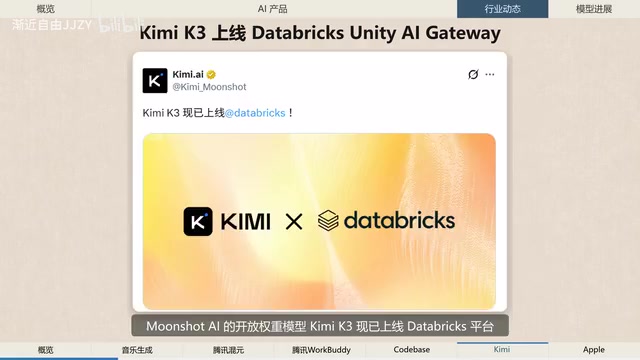
Several key concepts are worth understanding here. An Open-Weight Model refers to a model whose trained weight parameters are publicly available, allowing users to download and run it on their own infrastructure — unlike closed-source models that only offer API access. The core advantage of this approach is data sovereignty: sensitive enterprise data doesn't need to be sent to third-party servers. Databricks is a unified data and AI platform whose core Lakehouse architecture combines the flexible storage of data lakes with the structured query capabilities of data warehouses. Unity Catalog is Databricks' unified governance layer, responsible for access control, auditing, and compliance management of data and AI assets; Unity AI Gateway is the model access gateway built on top of it, allowing enterprises to call large models from different sources through a unified interface while implementing fine-grained permission control, usage monitoring, and cost management.
For enterprise users, the key value of Kimi K3 being available on Databricks lies in "data stays within your domain" — users can run the model directly where their data resides, test it alongside other frontier models, without changing any code. Databricks simultaneously announced that open-weight frontier models have officially arrived in their Lakehouse environment. Kimi K3's integration through Unity AI Gateway means enterprises can seamlessly switch between and compare multiple models within the same governance framework, without building separate infrastructure for each model.
This move reflects two clear trends: first, open-weight models are increasingly receiving first-class citizen treatment on enterprise platforms; second, enterprise AI adoption increasingly emphasizes data sovereignty and compliance — whoever can best deliver "run where data lives" and "parallel multi-model comparison" will gain the edge in the enterprise market.
Tencent's Two-Pronged Push: 3D World Generation and Multi-Device Collaboration
HY3D World Claw: From Text to Playable 3D Open Worlds
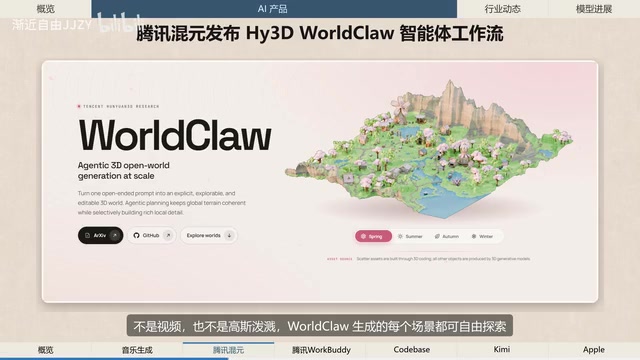
Tencent Hunyuan has launched HY3D World Claw, an agentic workflow that generates large-scale 3D open worlds from text prompts. Its positioning is very clear — what it generates is not video, nor Gaussian Splatting point clouds, but freely explorable, fully editable 3D assets ready for direct use in games.
To understand the differentiated value of this positioning, some context on Gaussian Splatting is needed. Gaussian Splatting is a recently emerged 3D scene representation method, popularized by the 2023 paper "3D Gaussian Splatting for Real-Time Radiance Field Rendering." It uses large numbers of 3D Gaussian distribution functions to represent points in a scene, enabling high-quality real-time rendering. However, Gaussian Splatting produces an implicit representation — essentially point clouds rather than traditional polygon meshes — making it difficult to directly import into mainstream game engines like Unity or Unreal Engine for editing and interactive development. HY3D World Claw's differentiation lies precisely here — it outputs explicit 3D assets with standard geometric structures (meshes, UV mapping) and texture maps that can be directly recognized and processed by game engines.
Every scene features high-quality geometry and textures, meaning it doesn't just "look like" a game environment — it's truly production-grade assets that can be taken over by game engines and further refined by developers. For the game development and digital content creation industries, tools like this could dramatically compress the upfront costs of scene building. In traditional workflows, environment art for an open-world scene typically takes weeks to months, involving terrain modeling, vegetation distribution, architectural layout, light baking, and many other steps, with extremely high labor costs.
WorkBuddy Multi-Device Sync: AI Tasks That Follow You Anywhere
Tencent WorkBuddyAd has launched multi-device sync functionality, enabling real-time synchronization of tasks, conversation history, and outputs across PC, mobile app, and Mini Programs. It also supports remote authorization and task stopping from phone to PC, even with the screen locked.
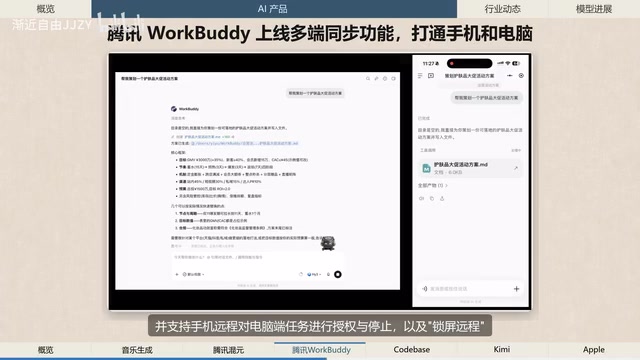
For setup, the App needs to be upgraded to version 1.2.0 or above, the PC client to version 5.3.8 or above, and users simply log in with the same account and enable the connection toggle to link devices. The mobile app can also view tasks and workspace records from multiple PC devices. This design targets scenarios where AI Agents run long-duration tasks — when AI is executing time-consuming tasks on a computer, users can leave their desk and monitor or intervene at any time via their phone.
Cursor Origin: Infrastructure Redesigned for AI Coding Speed
AI coding tool Cursor also has news. Cursor Origin has completed internal closed testing with select partners and is expected to officially launch later today.
The new version will add two new tabs: Codebase and Review. Codebase syncs with GitHub repositories, while Review provides intelligent code review and proactively notifies users when needed. The Cursor Origin page has already opened a waitlist.
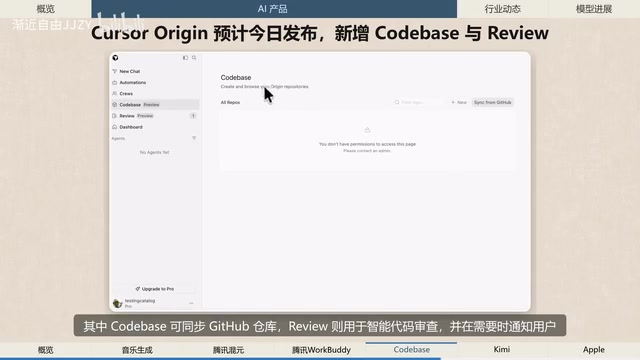
The official rationale is worth noting — "Code is evolving faster than existing infrastructure, and Origin is designed for exactly this." This statement highlights a new tension in the AI coding era: when AI generates code far faster than traditional development workflows can handle, code review, repository sync, and similar processes become the bottleneck. In traditional software development, Code Review is a core process for ensuring code quality — after developers submit code, colleagues review it for logical correctness, style consistency, and security vulnerabilities, typically through GitHub's Pull Request mechanism, with a single review potentially taking hours or even days. When AI coding assistants can generate hundreds of lines of code in minutes, the speed of human review becomes an obvious bottleneck. The deeper issue is that the volume of AI-generated code may far exceed human reviewers' cognitive capacity, making traditional line-by-line review unsustainable.
Cursor Origin attempts to restructure this workflow at the infrastructure level, making "review" and "codebase understanding" first-class AI-native capabilities rather than afterthoughts. The Codebase tab's design for syncing GitHub repositories means AI understands not just the current changes, but the entire codebase's context — a holistic understanding that traditional static analysis tools and linters lack. Essentially, this is using AI to review AI-generated code, forming a self-consistent acceleration loop.
Ant Group's Bailing Open-Sources Ling 3.0 Tiny: Lightweight Efficiency for On-Device Potential
Ant Group's Bailing today open-sourced the lightweight model Ling 3.0 Tiny on Hugging Face. The model uses a hybrid reasoning MoE architecture with 7.9B total parameters, activating only 1.3B per token.
MoE (Mixture of Experts) architecture is a sparsely activated neural network design. The model consists of multiple "expert" sub-networks, and during each inference, a gating network (Router) activates only a few experts based on input features, rather than engaging all parameters in the computation. Ling 3.0 Tiny's activation of only 1.3B out of 7.9B total parameters per token means approximately 83% of parameters remain dormant during each inference. The elegance of this design lies in the fact that the model retains rich knowledge capacity through its large total parameter count, while actual inference computation (FLOPs) and memory bandwidth requirements are far lower than a dense model of equivalent total size.
The performance numbers are noteworthy: on an M4 Pro MacBook, inference speed is approximately 86-90 tokens per second; with 8K context, peak memory usage is about 8.34 GiB. These figures mean it can run smoothly on a consumer laptop, offering a pragmatic option for on-device and local deployment. The 8.34 GiB peak memory and 86-90 tokens/s speed achieved on M4 Pro benefit from Apple Silicon's unified memory architecture with its high bandwidth characteristics. This performance level approaches real-time conversational experience, making a fully offline, cloud-API-free local AI assistant a reality — particularly important for privacy-sensitive scenarios and network-constrained environments.
The MoE architecture's characteristic of "large total parameters, small active parameters" allows Ling 3.0 Tiny to maintain solid capabilities while keeping actual computation and memory overhead low — exactly the balance that on-device AI deployment needs most. The open-source release further enriches the current lightweight model ecosystem.
Summary: AI Tools Are Moving Toward "Controllability" and "Real-World Deployment"
Looking across the August 12 batch of updates, a clear theme emerges: AI is evolving from "can generate" to "usable, controllable, and deployable." Suno emphasizes creative control, Cursor restructures programming infrastructure, Tencent bridges multi-device collaboration and editable 3D assets, while Ant Group and Moonshot push forward on on-device lightweight models and enterprise deployment respectively. Generation capability is no longer the sole competitive differentiator — how to reliably embed AI into real production workflows is the next battleground.
Related articles

Free Unlimited Claude Code Solution: Agnes AI + CC Switch Setup Guide
No paid subscription needed — pair the free AI platform Agnes AI with the open-source tool CC Switch to provide a backend for Claude Code, enabling unlimited free calls to text, image, and video models. This guide covers the full setup, test results, and usage boundaries.

A Complete Zero-Cost Guide to Getting Started with Claude Code for Beginners in China
A beginner's guide to Claude Code for users in China: two installation methods (command line and IDE plugin), full configuration steps for replacing the official API with the free domestic LongCat model, and a hands-on demo of building a small tool with natural language, plus tips.

When the NSA Gets Involved: The AI Supply Chain Crisis Behind Open-Source CVEs and API Key Hijacking
Multiple open-source projects disclosed severe CVEs in one day, PHP flaws alarmed the FBI, and Railway and OpenCode were breached with API keys stolen. This article breaks down the vulnerability window, AI-accelerated exploitation, and the AI supply chain crisis behind the API key black market, with a developer defense checklist.