Modulify 2.0 Deep Dive: How a Full-Lifecycle AI Website Platform Keeps Sites Growing

Modulify 2.0 aims to solve AI website building's biggest gap: what happens after generation.
Modulify 2.0 positions itself as a full-lifecycle AI website building platform that goes beyond one-time page generation to cover design, publishing, management, optimization, and growth in a single workspace. While most AI builders stop at generation, Modulify addresses the real pain point of ongoing operations for non-technical users. The article examines the technical challenges, competitive landscape, and whether this all-in-one approach can deliver on its promise.
From "One-Time Generation" to "Continuous Growth"
In recent years, AI website generators have sprung up like mushrooms after rain. Enter a few lines of description, and you can have a decent-looking website in minutes — that's no longer news. However, the vast majority of AI website building tools stop at the "generation" step. After a site goes live, how to manage, optimize, iterate, and scale it often becomes the pain point where users are left stranded midway.
Current AI website building tools primarily rely on Large Language Models (LLMs) and code generation technology. Early tools like Wix ADI and Bookmark used rule engines combined with template matching, while the new generation of tools emerging after 2023 (such as Framer AI, Durable, 10Web, etc.) are based on GPT-series or similar models, capable of generating HTML/CSS/JavaScript code or visual components directly from natural language descriptions. The core limitation of this technical approach is that models excel at one-time content generation based on context, rather than continuous state management and iterative optimization — the latter requires ongoing tracking and reasoning about website historical data, user behavior, and business objectives.
To understand this limitation from a technical architecture perspective: the core architecture of large language models — the Transformer — is essentially a sequence-to-sequence mapping mechanism that uses attention mechanisms to find relevant patterns in input context to predict the next token. This means LLMs are naturally good at one-time inference output given an input, rather than maintaining a state that evolves over time. For AI to truly participate in ongoing website operations, it requires memory mechanisms (such as vector databases storing historical interactions), real-time data access (such as Google Analytics API integration), and feedback loops (such as A/B test results fed back to the model) — capabilities that far exceed the native architectural design of current mainstream LLMs.
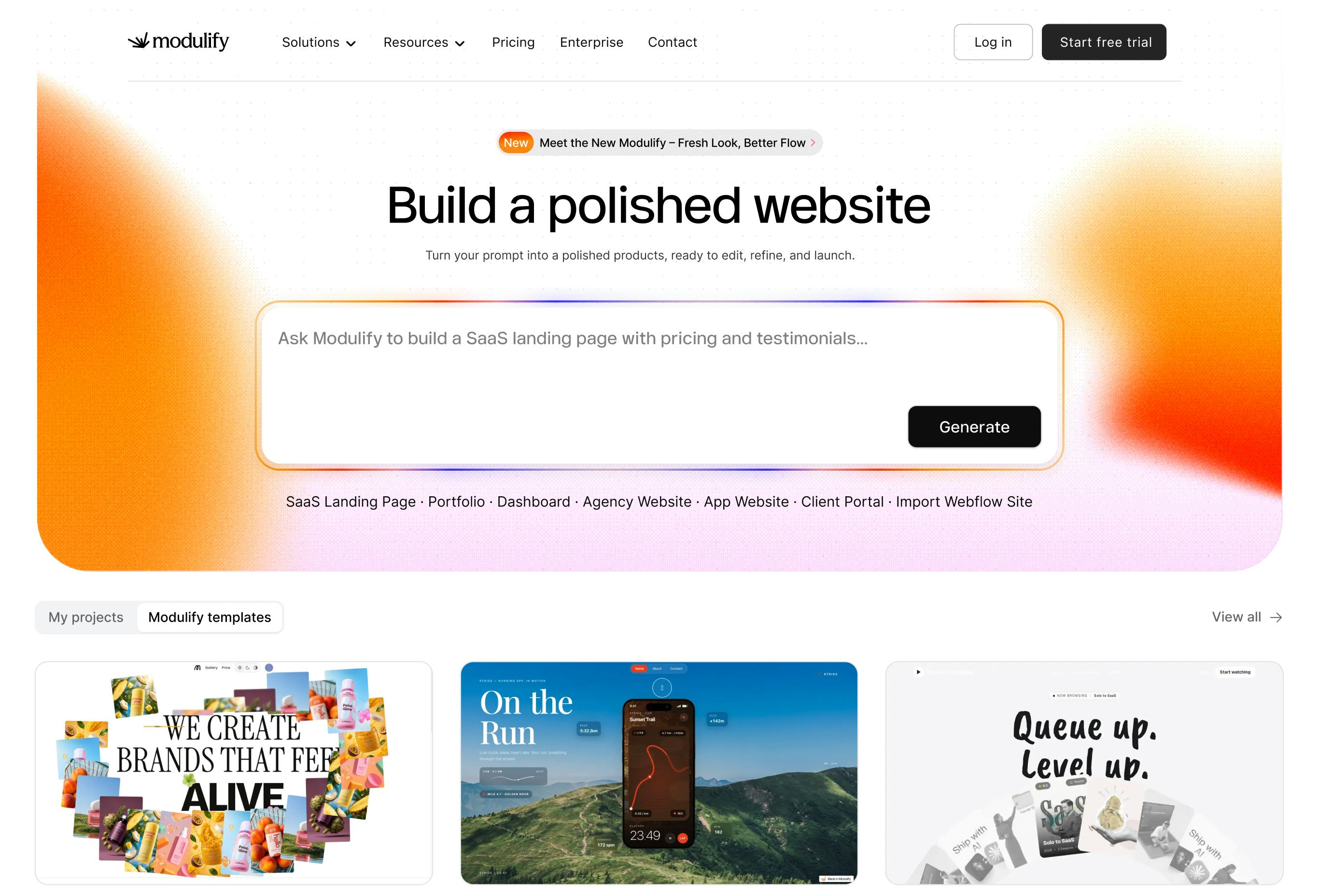
Modulify 2.0, recently launched on Product Hunt, attempts to solve this problem. Its tagline is straightforward — "Modulify: The Platform Where Websites Grow." The core philosophy is that AI website building shouldn't be a one-and-done deal, but should cover the complete lifecycle of a website from design, publishing, management, and optimization to growth.
Why "After Generation" Is the Key to AI Website Building
A widely overlooked reality in the industry is that a website's true value doesn't lie in the moment it goes live, but in the long-term operations that follow.
In professional web development, the website lifecycle is typically divided into seven stages: planning, design, development, testing, deployment, maintenance, and retirement. Maintenance costs for traditional enterprise websites often account for 60%-80% of total cost of ownership (TCO), encompassing ongoing work such as content updates, security patches, performance optimization, and SEO adjustments. DevOps and CI/CD (Continuous Integration/Continuous Deployment) concepts have become widespread among technical teams, but for non-technical users, these concepts remain almost entirely inaccessible.
DevOps is a culture and practice emphasizing collaboration between Development and Operations, while CI/CD is its core technical implementation — continuous integration ensures code changes are frequently auto-tested and merged, and continuous deployment automatically releases changes that pass testing to the production environment. In website operations, this means every content update, style adjustment, or feature addition can go live quickly and safely. For non-technical users, a full-lifecycle AI website platform essentially hides this DevOps workflow behind natural language interaction and visual interfaces, making "edit and publish instantly" a zero-barrier operation. The essential demand of full-lifecycle AI website building is to deliver these professional operational capabilities to ordinary users at zero threshold.
The Functionality Gap in Traditional AI Website Tools
The workflow of most AI website building tools on the market today looks like this: user inputs requirements → AI generates pages → export or publish → done. Afterward, if users want to adjust layouts, update content, do SEO optimization, or analyze traffic performance, they often need to switch to completely different tools or even need a certain level of technical background. This "tool fragmentation" traps non-professional users in a predicament precisely when their website actually needs operational attention.
Modulify's Full-Lifecycle Website Building Proposition
Modulify emphasizes completing the five stages of "design, publish, manage, optimize, and grow" within a single platform. This means users don't need to look elsewhere after generation is complete, but can continuously manage and optimize their website within a unified workspace. This closed loop from "generation to growth" is the core positioning that distinguishes it from similar AI website building products.
Modulify 2.0's Target User Groups
Looking at the Product Hunt category tags, Modulify 2.0 is classified under Design Tools, Website Builder, and Web Design. This indicates it's not positioned purely as a technical development tool, but rather as a design-driven website building platform targeting a broad user base.
Product Hunt is one of the world's most influential tech product launch platforms, with dozens of products competing for attention daily. The ranking mechanism is based on a composite algorithm factoring in upvotes, comment quality, and time decay. Top products can receive hundreds or even thousands of votes in a single day, while new product rankings are influenced by multiple factors including launch timing, community network effects, and product maturity.
Typical users of this type of product include:
- SMB owners and entrepreneurs: Need to quickly build and maintain a long-term company website but lack dedicated technical teams;
- Freelancers and designers: Want to complete the entire process from design to delivery within a single platform;
- Marketing professionals: Focused on continuous optimization and growth metrics after the website goes live.
For these users, the value of "still being usable after launch" is often more critical than "how fast it generates."
Research shows that small businesses use an average of 27 SaaS tools, and the "context-switching cost" caused by tool fragmentation can result in weeks of productivity loss annually.
Cognitive science research further reveals the deeper mechanism behind this problem: humans incur significant "switching costs" when transitioning between different tasks and tools — each switch requires reloading mental models, recalling operational logic, and re-establishing context. Research from UC Irvine found that it takes an average of 23 minutes to fully regain focus after being interrupted. For SMB operators who need to simultaneously use website building tools, SEO analysis platforms, data dashboards, and content management systems, they may face dozens of such tool switches daily. The core value of an all-in-one platform lies precisely in eliminating this cognitive friction, keeping users within the same mental model and operational environment.
This is exactly the core efficiency problem that full-lifecycle website building platforms aim to solve — consolidating website building, operations, and optimization capabilities scattered across different tools into a single interface, reducing cognitive load and operational complexity.
The Value and Challenges of Full-Lifecycle AI Website Building
It should be objectively noted that as a product just launched on Product Hunt, Modulify 2.0's community response is still quite limited — with 0 upvotes, only 1 comment, and a 20th-place daily ranking. This early data is insufficient to prove market performance and more likely reflects that the product is still in its early promotion phase. It's worth noting that many later-successful products (such as early versions of Notion and Figma) also didn't perform impressively in their first Product Hunt appearance — there is no inevitable causal relationship between a product's long-term market performance and its first-day ranking.
Core Value at the Conceptual Level
Nevertheless, the "full-lifecycle website building" philosophy proposed by Modulify is worth discussing. It addresses a real pain point in the AI website building space: AI has lowered the barrier for going "from 0 to 1," but hasn't solved the problem of going "from 1 to continuous operations."
Real-World Challenges in Implementation
From concept to execution, the challenges facing this type of full-lifecycle AI website building platform are considerable:
-
Balancing feature depth and breadth: Spanning five major stages — design, publishing, management, optimization, and growth — making each stage sufficiently usable is no easy feat. It's easy to fall into the trap of "can do everything, but nothing professionally enough." In the SaaS space, the debate between "all-in-one platforms" and "best-of-breed specialized tools" has a long history — the competition between HubSpot (an all-in-one marketing platform) and Salesforce plus various specialized plugins is a classic case. All-in-one platforms have the advantage of data interoperability, lower learning curves, and workflow continuity, but the disadvantage is that individual feature depth often can't match vertical specialized tools.
-
Competition with mature tools: In established domains like SEO optimization and data analytics, numerous specialized tools already exist. Modulify needs to prove that the convenience of its integration can offset the gap in feature specialization. Search Engine Optimization (SEO) involves multiple dimensions including technical SEO (site speed, structured data, Core Web Vitals metrics), content SEO (keyword research, content quality assessment), and off-page SEO (backlink building). Core Web Vitals is a set of user experience quantification metrics introduced by Google in 2020, including LCP (Largest Contentful Paint, measuring loading speed), INP (Interaction to Next Paint, measuring interaction responsiveness), and CLS (Cumulative Layout Shift, measuring visual stability). These metrics not only affect user experience but also directly serve as Google search ranking signal factors. Continuously monitoring and optimizing these metrics requires frontend performance analysis tools, CDN configuration tuning, and code-level rendering optimization. Google makes thousands of algorithm updates annually, meaning SEO optimization is essentially a dynamic, ongoing process. Professional SEO tools currently on the market (such as Ahrefs, SEMrush, Moz) have formed mature feature ecosystems with annual subscription costs ranging from hundreds to thousands of dollars. For an AI website building platform to provide truly valuable SEO recommendations, it needs to track search engine algorithm changes in real time and combine them with site-specific data for personalized recommendations.
-
Sustainability of AI capabilities: True "growth" requires AI to continuously provide valuable optimization suggestions during the operational phase, not just during the generation phase. This demands that AI systems possess continuous learning capabilities regarding website traffic data, user behavior patterns, and industry trends — evolving from a passive content generation tool to a proactive operational advisor. Technically, this requires deep integration of LLM generative capabilities with real-time data analysis pipelines, a challenge far greater than simple page generation. A key enabling technology is vector databases (such as Pinecone, Weaviate, Chroma), which encode a website's historical content, user behavior data, and business metrics as high-dimensional vectors, allowing AI systems to quickly retrieve relevant historical context through semantic similarity search. Combined with RAG (Retrieval-Augmented Generation) architecture, LLMs can provide targeted recommendations based on a website's specific historical data rather than generic answers. This "long-term memory + real-time reasoning" architecture is the technical prerequisite for AI to evolve from a one-time generation tool to an ongoing operational advisor.
Conclusion: AI Website Building Evolves from "Generator" to "Operations Platform"
Modulify 2.0 represents an evolutionary direction for AI website building tools: from "generator" to "operations platform." This approach deserves recognition — it reminds the entire industry that a website's value lies in long-term growth, not in the brief moment of birth.
For practitioners and users following the AI website building space, whether Modulify can truly deliver on its promise to "let websites grow" still requires time and more user feedback to validate. But at least at the conceptual level, it poses a correct question: when AI can already easily generate websites, what we should be more concerned about is how they go further after going live.
Related articles

Deep Dive into webpack: Core Features, Code Splitting, and Frontend Build Practices
A comprehensive analysis of webpack's core mechanisms including Loaders, Code Splitting, and its vital role in modern frontend engineering and ecosystem value.

Weak at ML Programming? A Complete Path to Breakthrough Through Systematic Practice
A systematic coding practice path for ML practitioners who 'understand theory but can't implement,' covering math basics to deep learning components with Deep-ML platform guidance.

Deep Analysis of the Potomac River Air Disaster: Why Multiple Safety Barriers Failed Simultaneously
Deep analysis of the 2025 Potomac River midair collision near Reagan Airport, examining airspace design, ATC staffing, TCAS limitations, and systemic safety failures.