MoFlow: A New Paradigm for Multi-Objective Agentic Workflow Generation

MoFlow covers the full Pareto front in one search, delivering optimal agentic workflows for any preference without retraining.
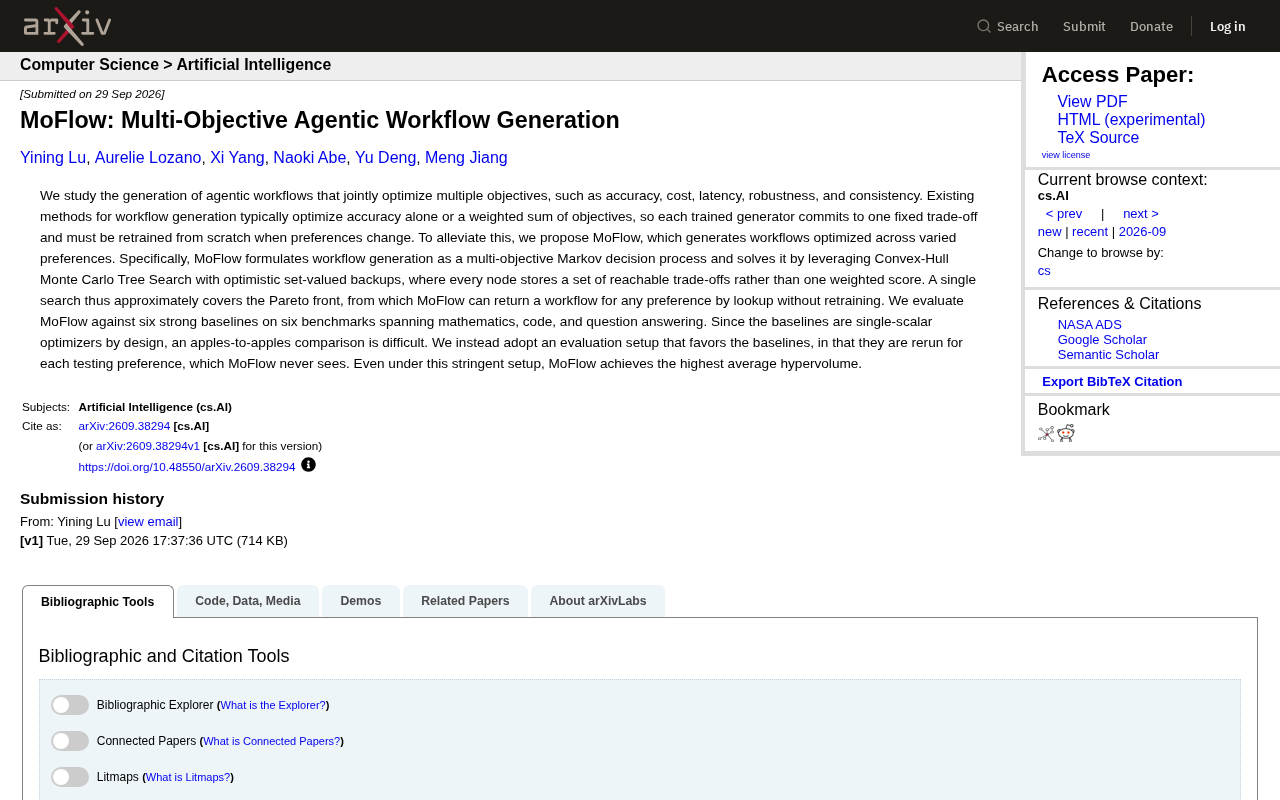
Existing agentic workflow generators optimize a single objective or fixed weighted combination, requiring retraining whenever user preferences change. MoFlow frames workflow generation as a multi-objective MDP and uses Convex-Hull MCTS with optimistic set-valued backups so that each search tree node stores a set of reachable trade-offs, approximating the full Pareto front in a single pass. Any new preference can be served via a simple lookup with zero retraining overhead. In rigorous experiments across six benchmarks — where baselines could re-run per test preference while MoFlow operated blind — MoFlow achieved the highest average hypervolume, demonstrating clear advantages in multi-objective settings.
Why Agentic Workflow Generation Needs Multi-Objective Optimization
As LLM-driven agent systems grow increasingly complex, automatically generating high-quality agentic workflows has become a hot research topic. However, existing approaches share a fundamental limitation: most optimize for a single objective — typically accuracy — or reduce multiple objectives to a weighted sum.
This means every trained generator is "locked into" a fixed set of trade-offs. The moment a user's preferences shift (say, from maximizing accuracy to controlling cost or reducing latency), the entire generator must be retrained from scratch. In real-world deployments, metrics like accuracy, cost, latency, robustness, and consistency often need to be balanced dynamically, and single-objective optimization is simply too rigid to meet these evolving demands.
MoFlow, a research paper published on arXiv, directly addresses this pain point by enabling a single search to cover optimal workflows across a wide range of preferences.
MoFlow's Core Method: Convex-Hull Monte Carlo Tree Search
MoFlow frames workflow generation as a multi-objective Markov decision process. This is the key departure from conventional approaches — rather than collapsing multiple objectives into a single scalar score, it preserves the full trade-off space throughout the decision-making process.
To solve this problem, MoFlow employs Convex-Hull Monte Carlo Tree Search with optimistic set-valued backups. The elegance lies in what each node of the search tree stores: not a single weighted score, but a set of reachable trade-offs.
One Search Pass Covers the Entire Pareto Front
This set-valued representation yields a significant advantage — a single search pass can approximately cover the entire Pareto front. The Pareto front represents the set of optimal solutions where no objective can be further improved without degrading another.
With this front in hand, MoFlow can respond to any new preference with a simple lookup, returning the corresponding optimal workflow without any retraining. This fundamentally resolves the efficiency bottleneck of traditional methods — the need to retrain every time preferences change — making it practically valuable for production environments where optimization targets shift frequently.
The concept of the Pareto front originates from economist Vilfredo Pareto and is central to multi-objective optimization. Intuitively: suppose you're optimizing both accuracy (higher is better) and inference cost (lower is better). Every solution on the Pareto front satisfies the condition that you cannot improve accuracy further without increasing cost, and cannot reduce cost further without sacrificing accuracy. Solutions outside the front are "dominated" — there exists another solution that is no worse on all objectives — and can be safely discarded. In single-objective optimization, the optimal solution is unique; in multi-objective settings, the Pareto front is a curve or hypersurface representing the full set of reasonable trade-offs. Users can freely select any point along this front based on their business priorities, without rerunning the search algorithm.
Experimental Validation: Wins Even Under Unfavorable Conditions
The research team evaluated MoFlow against six strong baseline methods across six benchmarks spanning three task categories: math, coding, and question answering.
The fairness of the experimental design deserves attention. Since baseline methods are fundamentally single-scalar optimizers, a truly apples-to-apples comparison with a multi-objective method like MoFlow is inherently difficult. To address this, the researchers used an evaluation setup that favors the baselines: baseline methods were re-run for each test preference, while MoFlow never saw those test preferences beforehand.
In other words, the competition was given the answers in advance, while MoFlow operated entirely blind. Even under these demanding, self-disadvantageous conditions, MoFlow still achieved the highest average hypervolume. Hypervolume is the core metric for measuring solution set quality in multi-objective optimization — a higher value indicates better coverage of the Pareto front and higher overall solution quality.
The Hypervolume Indicator (HV) is one of the most widely used comprehensive evaluation metrics in multi-objective optimization. It is computed by selecting a reference point (typically the worst acceptable value across all objectives) and measuring the volume of objective space "dominated" by the Pareto solution set relative to that reference point. A larger volume means the algorithm's solutions cover a broader range across objective dimensions with higher overall quality. Compared to reporting single-point performance at a specific weight setting, hypervolume comprehensively reflects solution set performance across the entire Pareto front — making it particularly well-suited for evaluating multi-objective methods like MoFlow. It's worth noting that hypervolume is sensitive to reference point selection; values across different papers cannot be directly compared unless the same reference point settings are used.
Significance and Limitations
MoFlow's contribution lies in systematically bringing multi-objective optimization thinking into the domain of agentic workflow generation — trading a single search pass for instant responsiveness to any preference. This holds practical value for cost-sensitive and latency-sensitive AI applications, where developers no longer need to train a separate generator for each business requirement.
That said, as an initial research publication, its limitations should be acknowledged objectively: while the experiments span multiple task types, the number of benchmarks remains limited; the computational overhead of Convex-Hull MCTS as the number of objectives grows, and the scalability of set-valued backups, still need further validation in larger-scale settings. Readers interested in this direction can consult the original arXiv paper for complete methodological details and experimental data.
Related articles

Random Pruning of the DPO Computation Graph: 1.4x Training Speedup and Lower Peak Memory
DPO training too slow and memory-hungry? This paper proposes a random pruning framework for the DPO computation graph, sampling independently across position, sequence, and branch dimensions; branch pruning achieves a 1.426x step-time speedup and cuts training time by about 30%, with in-depth attribution of memory and time gains.

Why Does JEPA Underperform MLM in Longitudinal EHR Representation Learning?
New study compares JEPA and MLM for longitudinal EHR representation learning on MIMIC-IV: three JEPA variants train stably without collapse but underperform MLM; target size, not heterogeneity, drives prediction error.

Transfer Learning + Visible Light Communication: A New Approach to Energy-Efficient Indoor Positioning
A study proposes a transfer learning-based visible light communication indoor positioning method, achieving 47% accuracy improvement on the BOSCH factory dataset, 67.5% model efficiency under high noise, and introducing the ME composite metric for energy-efficient positioning in energy-constrained industrial IoT scenarios.