Momentic: Let AI Agents Use Your App to Catch Bugs
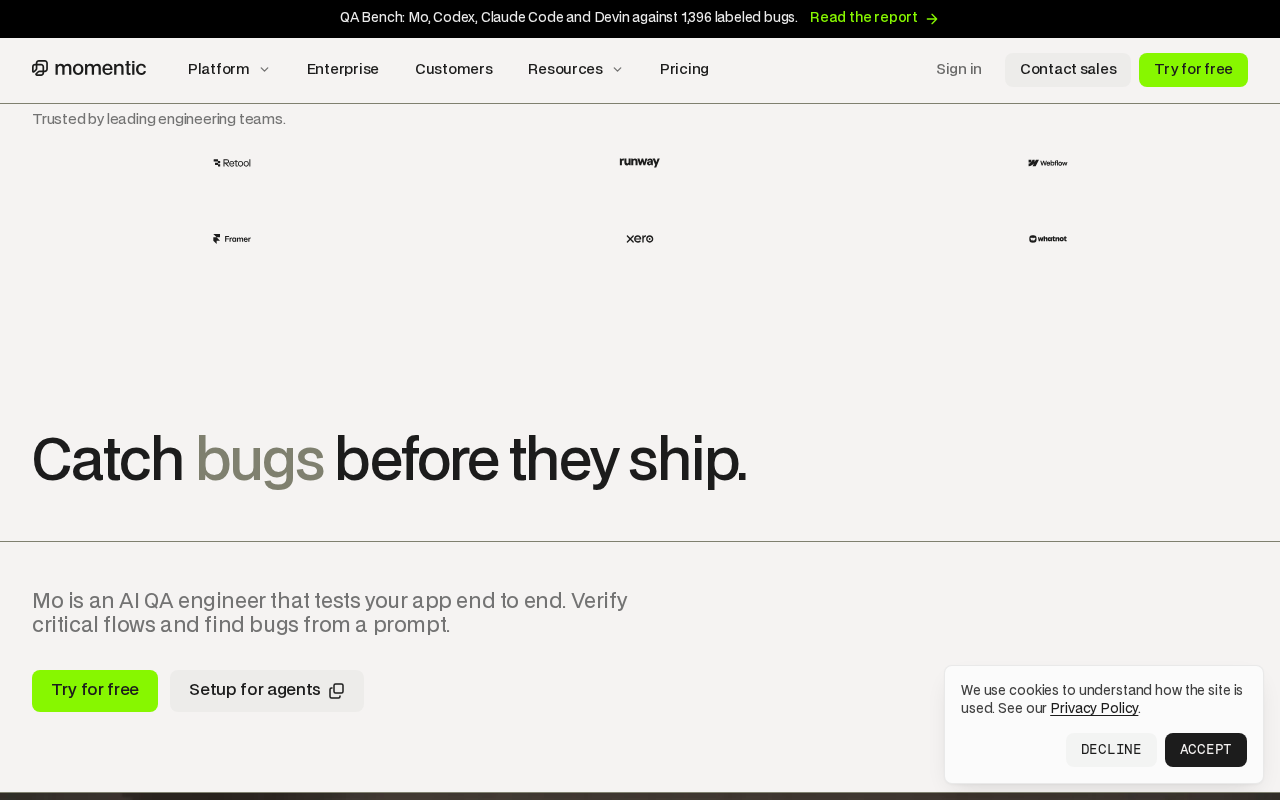
Momentic lets AI Agents operate apps like users to find defects, aiming to replace fragile traditional E2E testing.
Momentic is a YC W24-incubated AI testing tool whose core idea is to let Agents find defects by using the app rather than executing pre-written scripts. The article analyzes the fragility of traditional E2E testing's reliance on selectors and assertions, noting that Agent-based testing is built on semantic understanding and is more robust to front-end refactoring. The technical prerequisite is the maturation of GUI Agent capabilities, while the pain point is high test maintenance cost and insufficient coverage. But implementation faces three major challenges: false-positive control, execution reproducibility, and CI integration depth. Momentic received 44 upvotes and 26 comments on HN; the discussion reflects genuine developer interest and skepticism, and the product still needs to prove itself with engineering answers.
From "Writing Tests" to "Using the App": Momentic's Differentiated Angle
A product launch post for something called Momentic appeared on Hacker News, and its title bluntly captures its core proposition: Agents that catch bugs by using your app. The project comes out of the YC W24 batch and garnered 44 upvotes and 26 comments on HN—a solid level of discussion for a Launch HN post, suggesting that the "AI Agent + software testing" direction is hitting a genuine developer pain point.
The traditional automated testing path is: engineers write scripts, scripts replay predefined steps, and assertions check whether results match expectations. The problem is that this model requires someone to first spell out "what counts as correct," and the state combinations in modern web applications are almost explosive—wherever scripts can't reach is where bugs hide. Momentic's approach flips the roles: instead of having scripts execute steps written by humans, it lets an Agent operate within the app like a real user and identify anomalies during that interaction.
The significance of this shift isn't the slogan "AI replaces test engineers," but rather that the input to testing changes from "explicit rules" to "semantic understanding of the application." When an Agent can read page structure and understand interaction intent, it has the opportunity to find problems that no assertion ever covered.
The Key Divide Between Agent-Based Testing and Traditional Automation
To understand Momentic's value, you first need to see clearly what it's trying to replace or supplement.
The Fragility of Traditional E2E Testing
The core assets of end-to-end testing frameworks (like the Playwright and Cypress ecosystems) are selectors and assertions. Once selectors change due to front-end refactoring, tests fail en masse; assertions written too loosely miss bugs, while those written too tightly produce frequent false positives. Maintaining a healthy E2E test suite is often one of the least beloved jobs on any team.
Accessibility Tree is the semantic representation of a page that browsers build for assistive technologies (such as screen readers). It strips away pure styling and layout details, retaining semantic information such as role, name, and state. Unlike directly manipulating the DOM, automation tools based on the accessibility tree locate elements through semantic nodes—for example, "the button named 'Submit'" rather than "the div with class btn-primary." This makes test scripts more robust against front-end refactoring (such as switching UI frameworks or adjusting DOM hierarchy). Modern frameworks like Playwright already provide accessibility-based selectors such as getByRole, while Agent-based testing further combines this semantic understanding with autonomous decision-making.
The Operating Assumptions of Agents
Agent-based testing assumes that the interactive semantics of an application are relatively stable, while implementation details (DOM structure, class names, component hierarchy) are volatile. If an Agent understands the interface through vision or the accessibility tree, its tolerance for refactoring is naturally higher. Momentic's positioning—"catch bugs by using your app"—implies it cares more about "whether a user can successfully complete a goal" than about "whether a button's id equals submit-btn."
Vision-Language Models (VLMs) and GUI Agents are the key technologies for "operating an app like a user." Traditional GUI automation relies on coordinates or DOM paths, whereas VLMs can directly parse screen screenshots, understand the visual semantics of controls such as buttons, input fields, and menus, and output actions like clicks and typing. GUI Agents typically combine VLM perception with a planning module to decompose high-level goals (such as "complete login") into multi-step operations. Their advantage lies in cross-platform generality—the same model can handle web, desktop, and even mobile interfaces without depending on the app's internal implementation. But the challenges are also obvious: high inference latency, limited temporal understanding of dynamic content, and the randomness of actions that can affect test determinism.
Questions Still Unanswered
Judging from the context of the HN discussion, products like this can't escape three concerns: whether the cost and speed of Agent-executed tests can match CI pipelines; how accurate the Agent is at judging "is this a bug," and whether false positives will actually increase the manual burden; and whether, when application states are complex, the Agent's exploration is reproducible and auditable. The answers to these questions determine whether Agent testing is "an impressive demo" or "production-ready."
Flaky test refers to the phenomenon where the same test case sometimes passes and sometimes fails under identical code—a chronic problem in the field of automated testing. Common causes include insufficient asynchronous waits, network fluctuations, test data contamination, and non-deterministic behavior. Because Agent-based testing introduces the randomness of model decisions, it may exacerbate flaky problems—under the same goal, the Agent may choose different operation paths, making failures hard to reproduce. Therefore, mature Agent testing products need to provide execution trace records (such as screenshots, actions, and model outputs at each step) and state snapshots to support post-failure backtracking and auditing. This is also one of the engineering concerns that engineers care about most in the HN discussion.
Why This Direction Deserves Attention Right Now
Momentic's appearance on HN is no accident. Over the past period, LLM-based GUI Agent capabilities have been evolving rapidly—from web operations to desktop applications, the success rate of Agents understanding interfaces and executing multi-step tasks continues to climb. This provides the technical foundation for "using Agents instead of scripts to run tests."
At the same time, software delivery pace is accelerating, and the testing phase has become a bottleneck. Manual QA cannot scale linearly with release frequency, and the marginal maintenance cost of scripted tests remains high. If Agent testing can lower the marginal cost of "finding defects," it is especially attractive to small and medium-sized teams.
Interestingly, Momentic chose YC's Launch HN as its launch venue, meaning it targets an engineering audience that is picky about tools and immune to marketing speak. Earning a discussion with 26 comments in this community is itself a stress test: whether the product's narrative can withstand follow-up questions like "so how exactly do you handle flaky tests" is more persuasive than any promotional copy.
Three Things to Think Through Before Implementation
For teams considering adopting Agent testing, there are several practical issues to evaluate in advance.
First, the determinism boundary of testing. Part of the value of software testing comes from repeatability. If the Agent's exploratory behavior carries randomness, reproducing failed cases becomes harder. Whether a product provides complete execution traces and state snapshots directly determines whether it can fit into existing defect investigation workflows.
Second, the cost of integration with existing CI. Where Agent tests run, how they're triggered, and how results are reported back determine whether it's "yet another standalone tool" or "a link in the pipeline." Without deep enough integration, the tool will degenerate into a demo that gets run manually once in a while.
Third, the redefinition of human-machine division of labor. Agents handle exploration and discovery, while humans handle judgment and attribution—this may be the more realistic collaboration model. What teams need to adjust is how they write test strategy—shifting from writing test cases to defining "what counts as anomalous behavior" and "which paths are worth exploring."
Summary
Momentic's launch title sums up its ambition in one sentence: let Agents catch bugs by using your app. The technical prerequisites for this direction are maturing, and the pain point genuinely exists. But judging from the scale of the HN discussion, it's still at a stage where it needs to prove itself to the engineering community. Whether Agent testing can move from "interesting" to "trustworthy" depends on its engineering answers regarding false-positive control, execution reproducibility, and CI integration—not on how smooth the demo is. For teams focused on AI programming and test automation, this is a product worth adding to the watchlist.
One-line Summary
Momentic lets AI Agents operate apps like users to find defects, attempting to replace fragile traditional E2E testing.
Paragraph Summary
Momentic is a YC W24-incubated AI testing tool whose core idea is to let Agents find defects by using the app rather than executing pre-written scripts. The article analyzes the fragility of traditional E2E testing's reliance on selectors and assertions, noting that Agent-based testing is built on semantic understanding of the app and is more robust to front-end refactoring. The technical prerequisite for this direction is the maturation of GUI Agent capabilities, while the pain point is the high cost of test maintenance and insufficient coverage. But implementation still faces three major challenges: false-positive rate control, execution reproducibility, and depth of CI integration. Momentic received 44 upvotes and 26 comments on HN; the level of discussion reflects developers' genuine interest in—and skepticism about—AI testing tools, and the product still needs to prove itself with engineering answers.
Related articles

Qwen 3.8 Beats Opus at Coding—But Can Your Mac Run It?
Open-source Qwen 3.8 beats Opus 4.6 at coding at just 18GB, but how much Mac memory do you need? 24GB crashes; 32GB is the sweet spot. Full config guide inside.

Claude Code + Agent: Building a Fully Automated AI Testing Loop
Bilibili course breakdown: how test developers can use Claude Code terminal-based Agents to build a fully automated AI testing loop. Compares permission boundaries of terminal vs. device Agents, explains why enterprise projects choose Claude Code over Open Claude-type tools, and outlines the Node.js environment setup and DeepSeek model integration path.

Working with AI Agents Requires Nerves of Steel
The more autonomous AI agents become, the heavier the user's psychological burden. Drawing from a Hacker News discussion, this article analyzes black-box anxiety, behavior drift, and monitoring fatigue in agent collaboration, and offers practical approaches like sandbox isolation, permission control, and task granularity management to reduce cognitive load.