Monolito-V2: An AI Agent Project Aiming to Become a "Digital Symbiote in the Cloud"
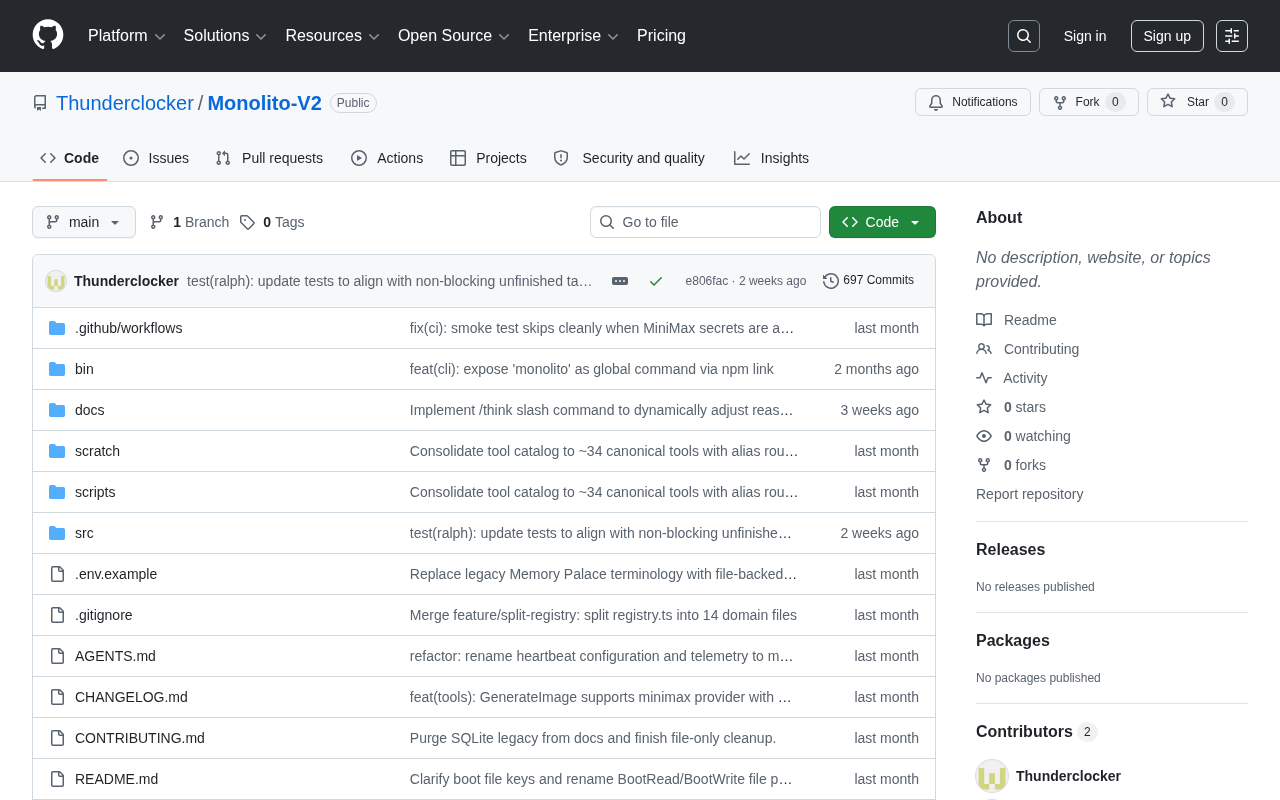
Monolito-V2 is an early-stage TypeScript AI Agent with a bold 'digital symbiote' vision but minimal implementation so far.
Monolito-V2 is an ambitious personal GitHub project that positions itself as a 'digital symbiote' and 'new cerebral cortex in the cloud' — not a chatbot, but a persistent AI deeply woven into the user's cognitive workflow. Built with TypeScript and aligned with the industry's shift toward long-term memory and persistent context, it remains extremely early-stage with just 1 Star and 0 Forks. Its core ideas are compelling, but realizing the symbiote vision requires solving hard problems around memory reliability, AI hallucination accumulation, privacy, and cloud dependency.
An Ambitious Name, A Project Just Getting Started
On GitHub, Thunderclocker/Monolito-V2 defines itself with a remarkably imaginative tagline: an AI Agent dedicated to becoming a "digital symbiote" — a "new cerebral cortex existing in the cloud."
This kind of description naturally evokes science fiction visions of human-machine fusion, where AI is no longer a passive tool that simply responds to commands, but rather an extension of the user's own cognitive apparatus — much like an organ of the body. Judging by its name and positioning, the author clearly isn't trying to build yet another chatbot, but something that stays persistently online and deeply integrated into the user's thinking process.
That said, there's often a gap between vision and reality. As of now, the project has just 1 Star and 0 Forks on GitHub. Written in TypeScript, it's a classic early-stage personal exploration project.
What Does "Digital Symbiote" Actually Mean?
The word "symbiote" comes from biology, referring to two organisms that coexist closely over time in a mutually dependent relationship. Applying this concept to an AI Agent carries a clear intent: the relationship between AI and humans shouldn't be one of user and tool, but rather a continuous, bidirectional, mutually reinforcing bond.
The metaphor of a "cloud-based cerebral cortex" is equally thought-provoking. The cerebral cortex handles higher cognitive functions — memory, reasoning, and decision-making. Describing an AI Agent as a "new cerebral cortex" implies it should serve as the user's external memory store and thinking assistant, with these capabilities living persistently in the cloud, always accessible and synced across devices.
This kind of vision isn't unique. The AI Agent space is broadly evolving from "one-off conversations" toward "long-term memory + persistent context." The industry is widely focused on how to help agents remember user preferences, accumulate interaction history, and proactively offer assistance. Monolito-V2's positioning lands squarely in that direction.
Reading the Tech Stack: What's the Real Foundation?
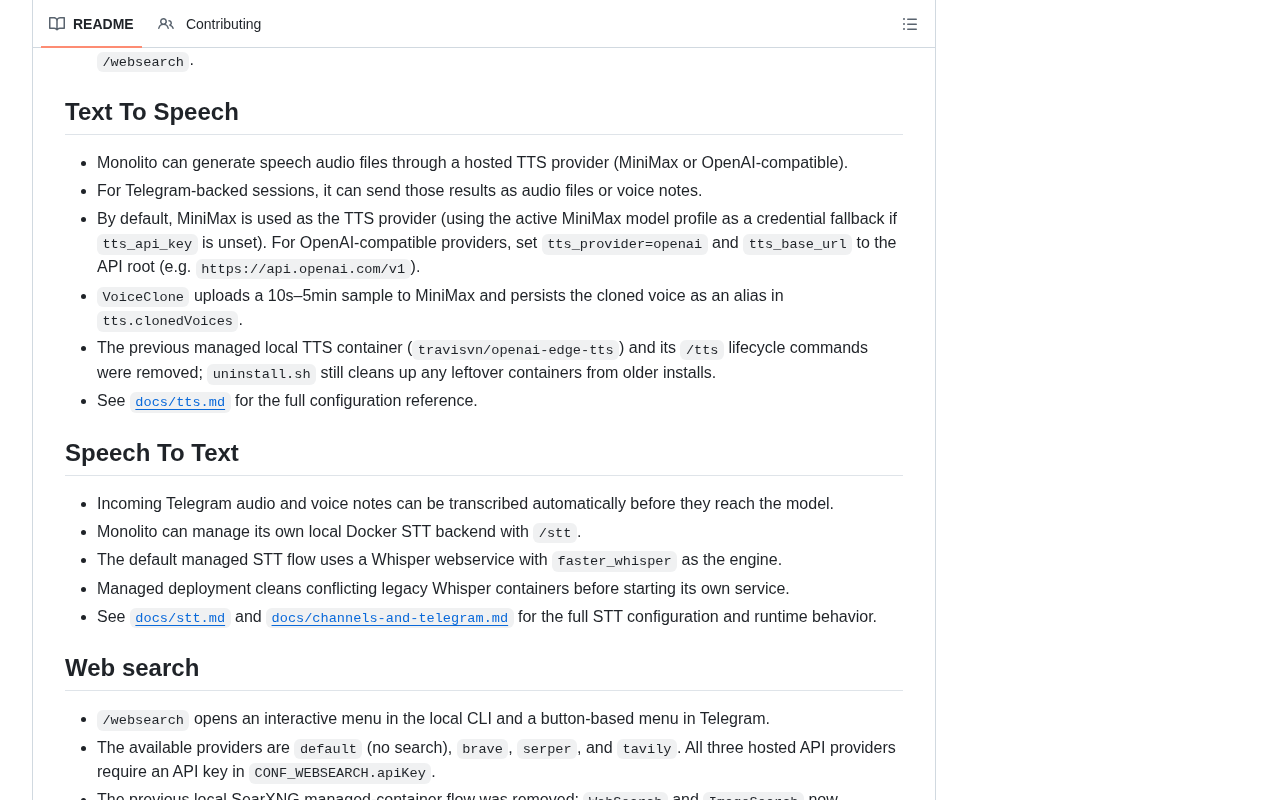
The project is built with TypeScript — a pragmatic choice in today's AI Agent ecosystem. TypeScript's type system is well-suited for building complex state management and tool-calling logic. It also integrates naturally with Node.js, major LLM SDKs (such as the official libraries from OpenAI and Anthropic), and frontend frameworks, making it a solid foundation for a "cloud-resident, multi-client" service architecture.
To genuinely realize the "digital symbiote" vision, an Agent needs at minimum a few core capabilities: a long-term memory mechanism (vector databases or structured storage), multi-turn context management, the ability to call tools and external APIs, and some form of proactive behavior — rather than purely reactive responses. These are exactly the areas that current Agent frameworks like LangChain and AutoGPT-style projects have been iterating on extensively.
Public information about the project is still limited, making it hard to assess how far along it is on any of these fronts. The 1 Star / 0 Fork data speaks for itself — this is a very early-stage project, more of a concept-first personal experiment than a finished system.
Long-term memory is one of the most challenging aspects of Agent development today. There are two mainstream approaches: vector databases (such as Pinecone, Chroma, or Weaviate), which embed conversation history and user information as high-dimensional vectors and retrieve relevant memory fragments via semantic similarity; and structured knowledge graphs or relational stores, which are better suited for scenarios requiring precise associative queries. Each approach involves trade-offs — vector retrieval is flexible but can introduce noise, while structured storage is precise but costly to maintain. "Memory compression" is another unavoidable challenge: as interactions accumulate, raw history can exceed the model's context window, requiring periodic summarization or tiered storage. Projects like LangChain's Memory module and MemGPT have done significant work in this area, but the goal of an AI that truly "remembers you like a person" remains a considerable distance away.
What's the Value of a Concept-First Project?
For early-stage projects like this, it's more useful to focus on the questions they raise than to critique their maturity. "Can AI become a natural extension of human cognition?" is an unavoidable question across the entire Agent space, and Monolito-V2 gives it a vivid, concrete metaphor to work with.
It's worth noting, however, that grand narratives like "digital symbiote" and "cloud cerebral cortex" run into significant real-world constraints at the implementation level: privacy and data sovereignty, the reliability of memory versus hallucination, availability risks from cloud dependency, and — most fundamentally — how to make an AI's "understanding" genuinely align with user intent rather than creating new cognitive overhead.
For developers, this project reads more like a statement of intent than a finished tool. If you're interested in long-term memory architectures for AI Agents or human-AI symbiosis models, it's worth keeping an eye on as a reference point. But for practical use, there's far too little information available right now — the recommendation is to follow its future iterations and watch for improved documentation.
"AI hallucination" can have an amplified effect in long-term memory scenarios that deserves special attention. In a single conversation, the impact of a model generating incorrect information is relatively contained — users can verify it immediately. But if that erroneous information gets written into a persistent memory layer, the Agent may repeatedly use it as the basis for future reasoning, creating "memory contamination." The more a user trusts the AI's accumulated history, the harder it becomes to detect this kind of compounding drift. This is precisely why AI systems designed around the "symbiote" model require especially careful attention to safety: memory auditability, the ability to delete records, and error-correction mechanisms should be architectural priorities — not afterthoughts.
Conclusion
Monolito-V2 is a textbook example of a "concept-over-implementation" early AI Agent project: imaginative in name and vision, pragmatic in its technology choices, but still in its infancy in terms of public deliverables. What it reflects is the broader industry's collective imagination about AI moving from tool to symbiont. If this direction interests you, consider adding it to your watchlist — and see whether it can gradually turn the grand ambition of "digital symbiote" into actual, working code.
Related articles
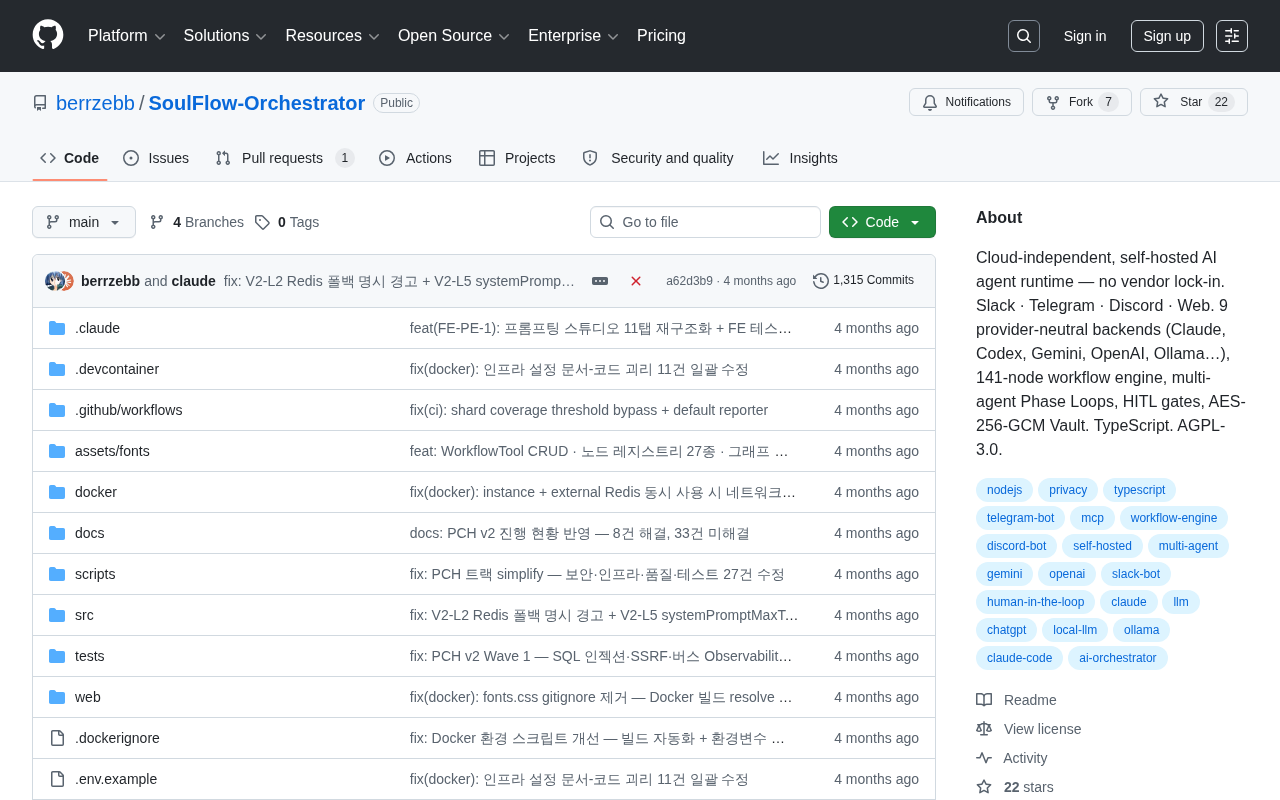
SoulFlow-Orchestrator: A Self-Hosted, Vendor-Lock-In-Free AI Agent Runtime
SoulFlow-Orchestrator is an open-source, self-hosted AI agent runtime with no vendor lock-in. Supports 9 neutral backends (Claude, OpenAI, Ollama), 141-node workflow engine, multi-agent loops, and HITL gates.
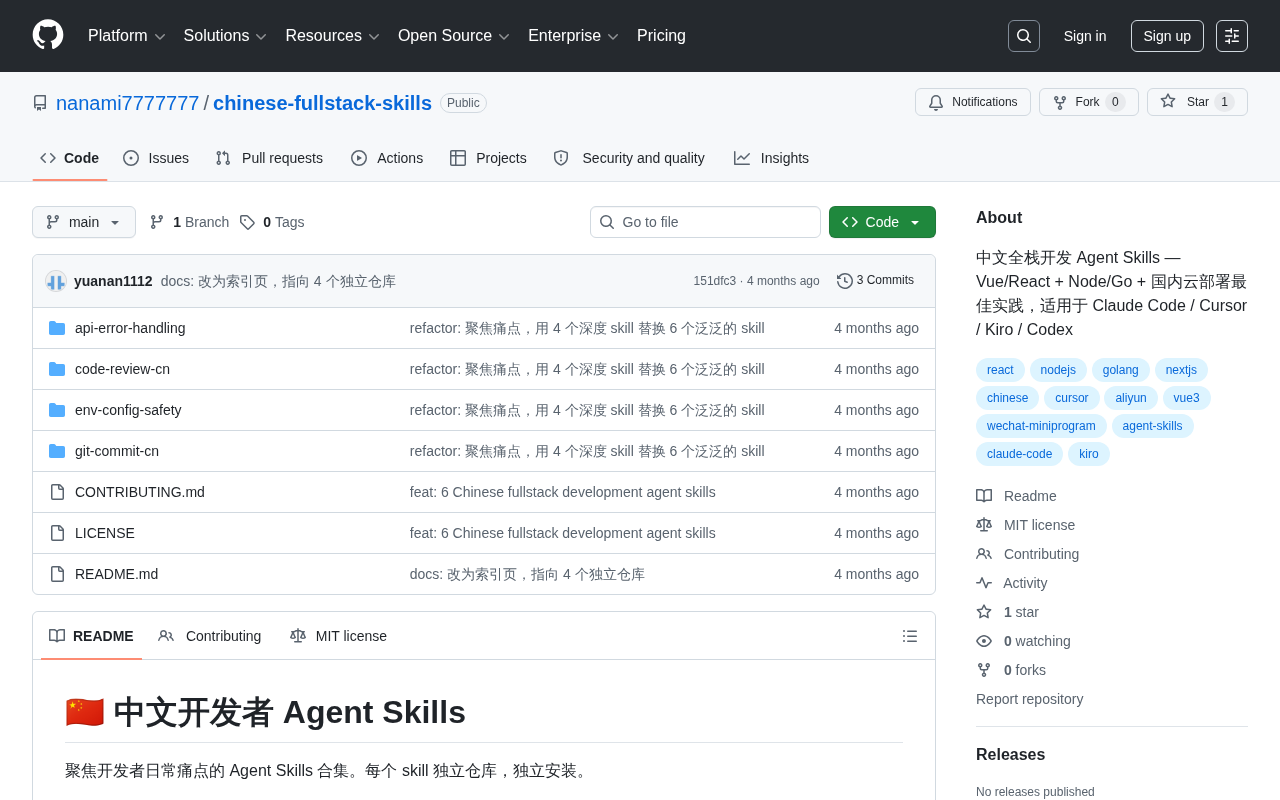
Chinese Full-Stack Agent Skills: A Skill Library Tailored for Domestic AI-Assisted Development
chinese-fullstack-skills is an Agent Skills library for Chinese full-stack development, covering Vue/React, Node/Go, and domestic cloud deployment best practices. Compatible with Claude Code, Cursor, Kiro, and Codex.
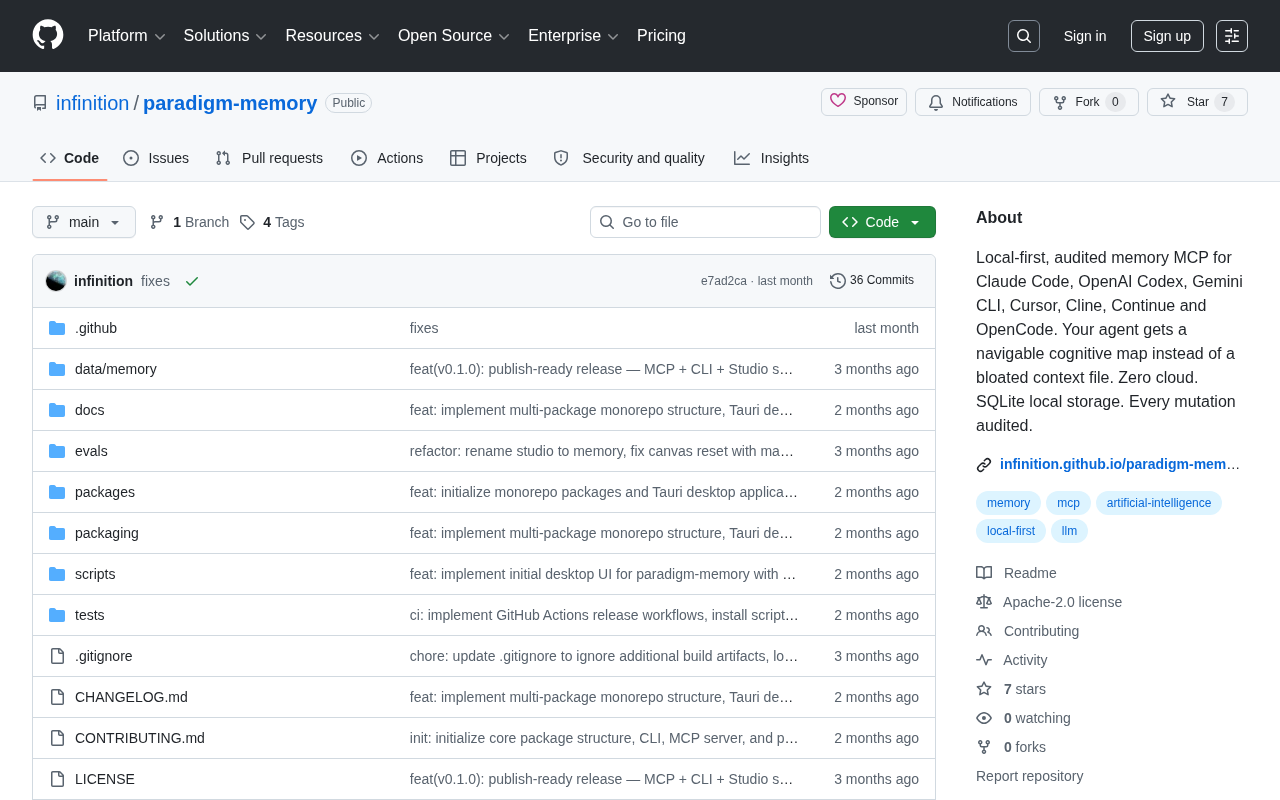
Paradigm Memory: A Local-First Memory System for AI Coding Assistants
paradigm-memory is a local MCP memory tool for Claude Code, Cursor, and Cline. It uses SQLite local storage, zero cloud, full audit trails, and a navigable cognitive map instead of bloated context files.