Monzo's In-House AI Coding Agent: 1,800 Tasks a Day and Over 10% of Merged Code

Monzo's in-house Slack coding agent Agent Chip handles 1,800+ tasks a day and contributes over 10% of merged PRs—the key is the platform, not the model.
Monzo engineers shared how Agent Chip, their in-house Slack coding agent, grew from a custom emoji interaction into a tool handling 1,800+ tasks a day and contributing over 10% of merged PRs across the tech org. The core insight: success stems from Monzo's accumulated platform capabilities—monitoring, pre-production environments, abstractions, and a self-built MCP gateway—not any single model. As a regulated bank, Monzo runs remote agents in isolated Pod sandboxes with strict egress control, keeping non-determinism away from production. Agent Chip now spans incident response, cross-team info flow, and data quality, while preserving the full review-test-deploy chain.
Why Would a Bank Build Its Own Coding Agent?
In a talk at the AI Engineer conference, two Monzo engineers, Felipe and Francesco, posed a provocative question: if you aren't already building your own AI coding toolchain, are you really a serious tech company? It was said half in jest, but it pinpoints the divide opening up among technical teams today—some plug into off-the-shelf tools, while others fold agent capabilities into their own platforms.
Monzo chose the latter. This digital bank maintains more than 3,000 backend services, roughly 13,000 data warehouse models, and dozens of machine learning predictors, spanning complex domains such as credit decisioning and financial crime detection. It was under exactly this kind of scale pressure that their in-house Slack coding agent, Agent Chip, started life as a "cute emoji" and grew into a productivity tool capable of handling over 1,800 tasks a day and contributing more than 10% of all merged PRs across the entire technology org.
What makes this number worth paying attention to isn't how impressive it is, but the environment in which it happened—a strictly regulated bank. That means Agent Chip's success is not just a victory for model capability, but a victory for platform engineering and security boundaries.
How Agent Chip Grew from an Emoji into a Colleague
The story begins with a Slack channel at Monzo that went viral internally in January 2026. Agent Chip's initial design was extremely lightweight: you add a custom emoji reaction to a message, and it takes that message as a prompt and processes it. This low-friction interaction spread quickly across the company, and the team then doubled down, turning it into an "always-on" member of the team.
The work Agent Chip takes on today is quite diverse: answering questions, pulling together architectural information, doing code reviews (the talk jokes that it's like a senior engineer who takes two looks, says "looks fine to me," and approves), and picking up Linear tickets and driving them autonomously. Its users aren't limited to engineering teams either; business users have started using it to write queries and answer business questions, enabling self-service support.
The most thought-provoking detail here is that "interaction form determines adoption." Compared with making engineers open a standalone IDE plugin, embedding the agent in Slack—an everyday communication space—significantly lowers the barrier to invocation. This also explains why non-technical roles were able to get involved so quickly.
The Secret Sauce Isn't the Model, It's the Platform
The most counterintuitive—and most valuable—point from the talk is this: what made Agent Chip successful wasn't some powerful model, but the platform capabilities Monzo had built up over the years. The two engineers reframed the LLM as "lots of little multipliers."
These multipliers include the existing alerting and monitoring systems, third-party integrations, pre-production environments that make testing easy, queue abstractions, database abstractions, and simple deployment pipelines. In other words, Agent Chip can do "send a prompt, click an emoji, sit back and wait for the result" because years of polished infrastructure sit underneath. Without these, even the strongest model would remain stuck at the demo stage.
Before Agent Chip appeared in its remote-agent form, Monzo had already been investing in supporting local AI coding agents, and a key step was building its own MCP gateway. This gateway exposes internal services and knowledge sources to agents in a unified way, applies deterministic filtering to what gets exposed, and manages authentication and authorization for different agents. The judgment repeated throughout the talk: the more context and data you can safely feed an agent, the better the results.
MCP (Model Context Protocol) is an open protocol proposed by Anthropic at the end of 2024 to standardize how AI applications connect to external data sources and tools. You can think of it as a "USB-C port" for agents: whether the backend is a database, a code repository, a monitoring system, or an internal knowledge base, as long as it implements a unified protocol endpoint, agents can discover and call it in a consistent way. For an organization like Monzo with hundreds of internal systems, the value of an MCP gateway is concentrating "what to feed the agent, with what permissions, and how to audit it afterward" in one place, rather than having every agent hard-code its own integrations. This also explains why the talk emphasizes "deterministic filtering"—the protocol itself only standardizes connectivity; which capabilities to expose, and at what granularity, still requires policy control on the platform side.
Sandboxes, Permissions, and the Balancing Act of a Regulated Environment
As a bank, Monzo has a natural wariness of non-deterministic behavior. Agent Chip's overall architecture is built around one core principle: completely isolate the agent runtime from production infrastructure.
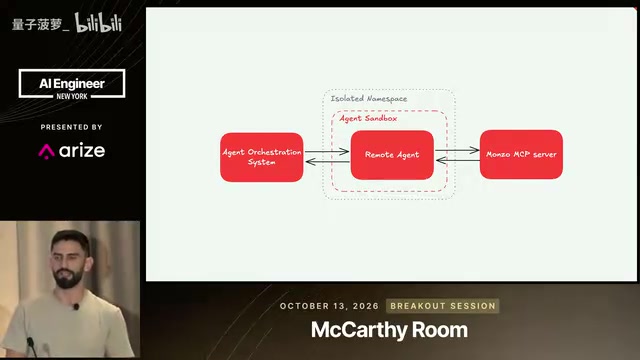
Specifically, remote agents run in Pod sandboxes within isolated namespaces, triggered by the orchestration system to read information. The agent image explicitly pins down the tools it can access, the command-line environment, and its authentication and authorization information; the agent's outbound connections (such as to code repositories) must go through a proxy layer, and only egress explicitly chosen and granted by the team is opened. The speakers described this structure as "a box within a box"—non-determinism happens only in the innermost layer, while all outer boundaries are governed by deterministic rules.
This design has the benefit of letting agents freely try and fail in development environments while ensuring production is unaffected by uncontrolled behavior. For any team looking to deploy agents in a regulated industry, this layered approach offers directly transferable lessons.
A Pod is the smallest deployable unit in Kubernetes, typically encapsulating one or more tightly coupled containers that share a network namespace and storage volumes. Agent Chip runs remote agents "in Pod sandboxes within isolated namespaces," meaning each agent instance starts in an independent logical partition with its own network boundary, resource quotas, and mount permissions, and cannot directly reach other workloads in the production cluster. A namespace is the virtual cluster isolation mechanism Kubernetes provides; combined with network policies and RBAC, it can achieve "mutual invisibility within the same cluster." This structure confines non-deterministic agent behavior to lightweight containers that can be destroyed and rebuilt at any time—even if an agent suffers a prompt injection or executes an unexpected command, the blast radius is contained within the sandbox, and the deterministic boundary of production infrastructure remains intact.
From Writing Code to Handling Live Incidents
Agent Chip's uses have long gone far beyond coding itself. The talk listed several directions that have already delivered real value.
In incident response mode, once the system identifies and triggers a new incident, Agent Chip joins the relevant channel and automatically starts investigating—reading logs, examining traces, connecting specific services and code—to give human engineers high-signal information. The team specifically emphasized that they don't want the agent flooding output with speculative hypotheses during an incident; instead it should maintain a high signal-to-noise ratio while leaving humans in control of how deeply the agent intervenes.
In cross-team collaboration, Monzo's internal "ask channels" let the agent participate in information flow between teams. When one team needs to understand another backend service, product progress, or roadmap, Agent Chip can draft a reply based on knowledge sources; if the information is sufficient, it may resolve the request directly, and if not, it brings in a human to fill the gaps.
In the data quality space, "Agent Chip on call" has emerged. It first observed failures passively and automatically triggered investigations, then evolved into a proactive version: monitoring backend changes and anticipating, before the next batch of data processing, what impact those changes might have on the data.
Distributed tracing is foundational infrastructure for pinpointing problems in microservice architectures: a single user request often spans dozens of services, and a tracing system assigns a globally unique trace ID to each request and records the call chain, latency, and error points across services. Monzo has more than 3,000 backend services, and during incident investigation it's hard for human engineers to piece together the causal chain log by log; Agent Chip, however, can follow a trace to automatically link "which service slowed down, whom it called, which code that corresponds to, and which recent change is responsible." This is also the technical prerequisite behind the talk's emphasis on "high signal-to-noise ratio"—trace data is itself highly structured, so after reading it the agent can reach fairly deterministic conclusions rather than emitting a flood of speculative hypotheses in an ocean of logs. For a regulated bank, every judgment an agent outputs during an incident can influence response decisions, so "few but accurate" is more valuable than "many but exhaustive."
Non-Specialist Roles Are Starting to Contribute Code, Without Compromising Rigor
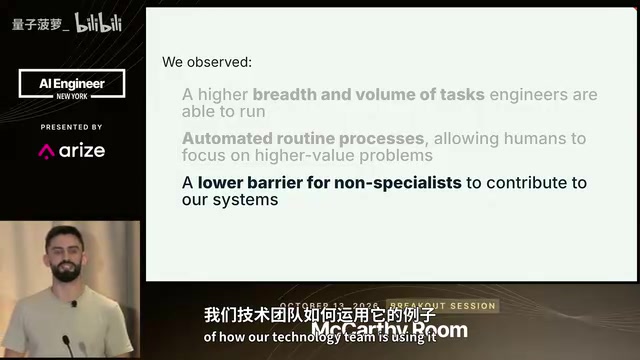
An easily overlooked but far-reaching change is that Agent Chip significantly lowers the barrier for non-specialist roles within the company to participate in building systems. Product feedback, everyday discussions, and new ideas can all be handed to Agent Chip first to produce a draft tested in a pre-production environment, after which engineers are brought in for review and deployment.
The speakers were quite measured in how they put it: this doesn't change the rigor with which Monzo develops software; it simply lets more non-specialist roles participate more closely in team work. That distinction matters—the agent lowers the starting barrier, not the bar for shipping. The chain of responsibility for review, testing, and deployment remains intact, and that is precisely what gives a regulated institution the confidence to let agents participate in production.
Why They Aren't Worried About the Market Moving Faster
Faced with an endless stream of new products and features on the market, Monzo offered three judgments on Agent Chip's long-term value.
The first is composability. Agent Chip has itself become a new building block in the platform; Slack, GitHub, Linear, and even the 3,000+ services can all be connected in the same way, drastically reducing the cost of building new use cases. The second is provider independence. The agent runtime box in the architecture can be swapped out for any model as needed, letting the team dynamically choose the model that best fits the current task without being locked into a single vendor. The third is a continuously expanding development window. Today the agent can already draft backend changes, apply them and test in pre-production, and cover data testing; in the future it may extend to the predictor layer as well. When remote agents can complete these steps end to end, the way systems are understood and integrated will change further.
The talk closed by returning to that redefined acronym: the real payoff doesn't come from the large model in the traditional sense, but from the many little multipliers you and your team can stack on top of it—platform, permissions, environments, integrations, and processes. For teams evaluating build-versus-buy, Monzo's case points to a more pragmatic path: first ask how much context your platform can safely provide to agents, and then decide how far agents can go.
One-line Summary
Monzo's in-house Slack coding agent Agent Chip handles 1,800+ tasks a day and contributes over 10% of merged PRs, with the platform—not the model—as the key to success.
Paragraph Summary
Monzo engineers shared the story of Agent Chip, their in-house Slack coding agent, at the AI Engineer conference: starting from a custom emoji interaction, it grew into a productivity tool that handles over 1,800 tasks a day and contributes more than 10% of merged PRs across the entire technology org, spanning data, ML, backend, and app teams. The talk's core counterintuitive point is that Agent Chip's success doesn't depend on any single powerful model, but on the platform capabilities Monzo built up over years—alerting and monitoring, pre-production environments, queue and database abstractions, simple deployments, and its own MCP gateway. As a regulated bank, Monzo runs remote agents in Pod sandboxes within isolated namespaces, with egress strictly controlled by a proxy layer, completely isolating non-deterministic behavior from production infrastructure. Agent Chip's uses have expanded from writing code to incident response, cross-team information flow, and data quality monitoring, and it lets non-specialist roles participate in building systems—without changing the rigorous chain of responsibility for review, testing, and deployment.
Related articles

Deleted Reddit Post Sparks Debate Over AI Content Moderation
A Reddit post removed with only a 'Removed by Reddit' notice highlights AI content moderation's transparency gaps, misjudgment risks, and appeal challenges for platforms and creators.

DSH + Ollama Local LLM Deployment in Practice: Free Chat with Da Fei Yu
Bilibili creator tests DSH + Ollama local LLM deployment end to end: Ollama install, Xunlei-accelerated downloads, ModelScope GGUF model import, DSH custom API address setup, and a comparison of Qwen 3.5 4B, 8B, Gemma, and other models on 8GB VRAM, with advice on choosing local deployment vs. API calls.

Tested: A $899 Mac Mini vs. a $200/Month AI Subscription
Real-world test of whether an M4 Mac mini can replace a $200 AI subscription: 16GB can't fit large models, and both speed and quality fall short—but privacy, no caps, and near-zero running costs make it an ideal host for an always-on agent. Includes buying advice per configuration and money-saving strategies.