MoPrO-SD: A Modular Prompt Optimization Framework for Stance Detection

MoPrO-SD optimizes stance detection prompts via modular decomposition and class-conditioned error feedback.
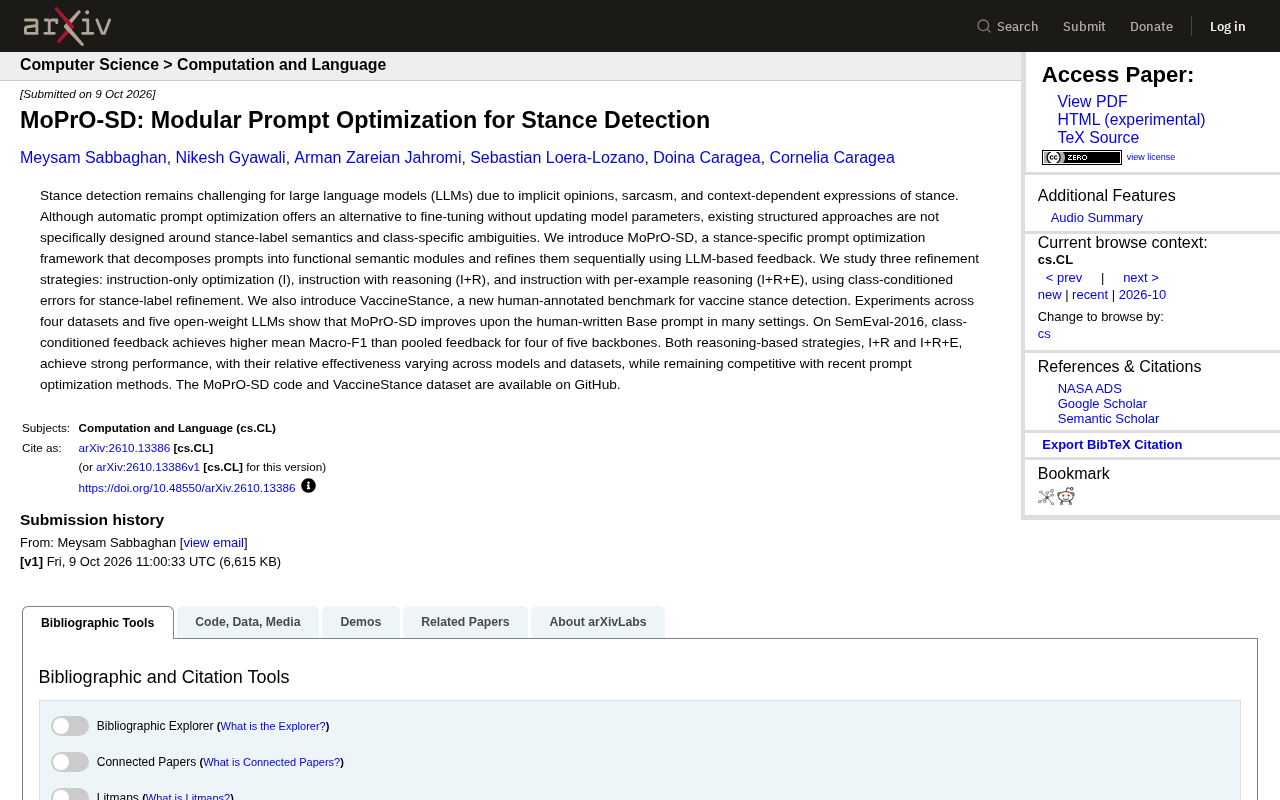
MoPrO-SD is an automatic prompt optimization framework for stance detection. Its core innovations are decomposing prompts into functional semantic modules for sequential refinement, and analyzing prediction errors separately per stance class (support, oppose, neutral) to generate targeted feedback rather than pooling all errors together. The framework offers three progressive strategies: instruction-only (I), instruction with reasoning (I+R), and per-example reasoning (I+R+E). Experiments across four datasets and five open-source LLMs show class-conditioned feedback consistently outperforms pooled feedback on SemEval-2016, while reasoning strategies are broadly beneficial though optimal granularity varies by model. The team also open-sourced VaccineStance, a new human-annotated benchmark for vaccine stance detection.
Why Stance Detection Is So Challenging for LLMs
Stance detection requires a model to determine whether a piece of text expresses support, opposition, or a neutral attitude toward a given target (a topic, person, or policy). While this sounds straightforward, the task is full of pitfalls: implicit opinions, ironic expressions, and highly context-dependent phrasing all lead large language models (LLMs) astray.
Compared to traditional fine-tuning, Automatic Prompt Optimization (APO) offers an alternative path that requires no parameter updates. However, most existing structured prompt optimization methods are designed for general use and don't specifically address the semantic characteristics of stance labels or the class-specific ambiguities inherent in stance detection. In short, they don't tackle the core pain points of this particular task.
This is the context in which researchers introduced MoPrO-SD — a prompt optimization framework designed specifically for stance detection.
Automatic Prompt Optimization (APO) refers to algorithmically searching for or rewriting prompt text — without adjusting model weights — to maximize model performance on a target task. Compared to manually crafted prompts, APO systematically explores a much larger prompt space; compared to fine-tuning, it demands far less compute and data. Common APO approaches include gradient-based soft prompt tuning, LLM-driven text-level optimization (e.g., OPRO, ProTeGi), and reinforcement learning-based policy search. The limitation of these general-purpose methods is that they treat the prompt as a monolithic unit, without distinguishing segments that serve different functions or handling label ambiguity in task-specific ways — which is precisely the bottleneck MoPrO-SD aims to break through.
MoPrO-SD's Core Idea: Modular Decomposition and Sequential Refinement
The core approach of MoPrO-SD is to decompose a prompt into a set of functional semantic modules, then use LLM-generated feedback to sequentially refine these modules. This modular design makes the optimization process more targeted — each segment of the prompt that serves a distinct function can be improved individually, rather than treating the prompt as an indivisible whole.
The framework explores three refinement strategies, forming a progressively stronger hierarchy:
- Instruction only (I): Only the instruction itself is rewritten and optimized.
- Instruction + Reasoning (I+R): A reasoning process is introduced alongside instruction optimization.
- Instruction + Per-example Reasoning (I+R+E): Reasoning is further added for each individual sample, at a finer granularity.
A key innovation is MoPrO-SD's use of class-conditioned errors to refine stance labels. Rather than pooling errors from all categories together, it analyzes mistakes separately for each specific stance class (e.g., "support," "oppose"). This directly addresses the fundamental problem in stance detection: different classes carry different kinds of ambiguity.
The concept of class-conditioned errors is worth unpacking further. In a conventional prompt optimization pipeline, the model typically collects all mispredicted samples, aggregates them, and generates a single unified improvement signal (pooled feedback). This "one-size-fits-all" approach ignores the fact that error patterns differ across categories — for instance, the reasons a model misclassifies "oppose" labels (often due to subtle irony) are fundamentally different from why it misclassifies "neutral" labels (commonly caused by vague or two-sided statements). The class-conditioned approach collects error cases for each stance class separately, independently generates diagnostic feedback and revision suggestions for that class, and then integrates the per-class revisions back into the prompt. This fine-grained feedback mechanism makes the optimization signal more precise and prevents error signals from different classes from diluting each other.
VaccineStance: A New Human-Annotated Benchmark
Beyond the methodology itself, the research team has also contributed a new dataset — VaccineStance — a human-annotated benchmark specifically for vaccine stance detection.
Publicly available benchmarks for stance detection are relatively scarce, and vaccine discourse is a prime example of a domain where stance expression is highly polarized and context-sensitive, with implicit opinions and emotionally charged language being especially common. VaccineStance provides a test environment that more closely mirrors real-world public opinion dynamics. Both the dataset and the MoPrO-SD codebase have been open-sourced on GitHub.
Experimental Results: The Advantage of Class-Conditioned Feedback
Experiments were conducted across four datasets and five open-weight LLMs, with results showing that MoPrO-SD outperforms manually written baseline prompts (Base prompts) in many settings.
Several notable findings:
- On the SemEval-2016 dataset, class-conditioned feedback achieved higher average Macro-F1 scores than pooled feedback on four out of five backbone models — validating that treating errors per class is indeed more effective than a pooled approach.
- Both reasoning-based strategies, I+R and I+R+E, performed strongly, but their relative advantage varies across different models and datasets — neither strategy dominates universally in all scenarios.
- Overall, MoPrO-SD remains competitive against recent prompt optimization methods.
These results demonstrate that task-specific customization of prompt optimization — tuned to the semantic characteristics of the task — can yield substantial performance gains. Incorporating reasoning is broadly beneficial, though the optimal granularity needs to be calibrated for specific models and data.
Macro-F1 is a commonly used metric for multi-class classification tasks, particularly suited to imbalanced class distributions. It is computed by first calculating the F1 score (harmonic mean of precision and recall) for each class separately, then taking a simple average across all classes with equal weight — rather than weighting by sample count. In stance detection datasets, the "neutral" class typically has far fewer samples than "support" or "oppose." With weighted averaging, a model could achieve an inflated score simply by performing well on majority classes. Macro-F1 forces the model to perform well across all classes equally, making it a stricter and more meaningful benchmark — and the standard metric used in comparison experiments across the field.
Implications for Practitioners
MoPrO-SD's value extends beyond its performance on stance detection. It demonstrates a transferable methodology: decomposing prompts into functional modules and iteratively refining them with class-conditioned error feedback. For teams constrained by compute resources who cannot frequently fine-tune models, this "optimize the prompt, not the parameters" approach is particularly appealing.
That said, the varying effectiveness of the three refinement strategies across models and datasets serves as a reminder that prompt optimization is not a one-time solution — empirical validation tailored to your specific scenario is still necessary when deploying in practice. With the open release of the code and the VaccineStance dataset, the reproducibility and extensibility of this line of research will only continue to improve.
Related articles

Random Pruning of the DPO Computation Graph: 1.4x Training Speedup and Lower Peak Memory
DPO training too slow and memory-hungry? This paper proposes a random pruning framework for the DPO computation graph, sampling independently across position, sequence, and branch dimensions; branch pruning achieves a 1.426x step-time speedup and cuts training time by about 30%, with in-depth attribution of memory and time gains.

Why Does JEPA Underperform MLM in Longitudinal EHR Representation Learning?
New study compares JEPA and MLM for longitudinal EHR representation learning on MIMIC-IV: three JEPA variants train stably without collapse but underperform MLM; target size, not heterogeneity, drives prediction error.

Transfer Learning + Visible Light Communication: A New Approach to Energy-Efficient Indoor Positioning
A study proposes a transfer learning-based visible light communication indoor positioning method, achieving 47% accuracy improvement on the BOSCH factory dataset, 67.5% model efficiency under high noise, and introducing the ME composite metric for energy-efficient positioning in energy-constrained industrial IoT scenarios.