MOSS-VL-Realtime Hands-On: 11B-Parameter Real-Time Video Understanding on Consumer GPUs
11B-parameter MOSS-VL-Realtime enables real-time video understanding on dual consumer GPUs with 13.3GB memory
MOSS-VL-Realtime delivers real-time video understanding with 11 billion parameters and open weights. Unlike traditional models that process complete videos, it continuously understands footage while playing, dynamically generating descriptions and answering questions. Successfully deployed on dual RTX 4070Ti Super GPUs using 13.3GB memory via 4-bit quantization. Features include watch-while-answering, active silence when evidence is insufficient, and dynamic judgment updates. 256K context with 1fps sampling suits live monitoring and experimental observation scenarios.
MOSS-VL-Realtime Hands-On: 11B-Parameter Real-Time Video Understanding on Consumer GPUs
MOSS Intelligence's MOSS-VL-Realtime brings a fundamentally new interaction paradigm to video understanding with its 11 billion parameters and open weights. Unlike traditional video Q&A models that follow a "watch-then-answer" logic, this real-time variant continuously understands footage as it plays, dynamically generating descriptions and answering questions on the fly.
Real-Time Understanding: From "Watch Then Speak" to "Watch While Speaking"
Traditional video Q&A models (such as VideoQA tasks) typically adopt an "offline processing" paradigm: they first extract features from an entire video segment, encoding all frames into fixed-dimensional representation vectors, then perform reasoning combined with text queries. This approach is essentially retrospective analysis of completed events—it must wait for the entire video to finish playing before producing output. MOSS-VL-Realtime breaks this limitation by adopting an "online processing" paradigm closer to human visual cognition—our brains don't wait for a scene to completely end before beginning to understand it, but rather continuously construct and revise cognitive models of the current situation as information flows in. In testing, the model could identify coffee shop scenes, people entering, conversations at the counter, and other continuous footage in real time, with text descriptions continuously generated and updated as the video progressed. This shift from offline to online technically requires the model to possess incremental reasoning capability—the ability to integrate new frame visual features into existing semantic representations without reprocessing all historical information.
This capability relies on three key features:
- Watch-While-Answering: Understanding and text generation happen simultaneously as new frames arrive
- Active Silence: When visual evidence is insufficient, the model chooses to remain silent, avoiding false judgments
- Dynamic Updates: When subsequent frames change the context, the model can supplement or correct previous judgments
In actual testing, when the question "how many people are in the frame now" was inserted at around 10 seconds into the video, the model first answered "two people"; 7 seconds later, when a staff member behind the counter entered the frame, the model proactively updated the answer to "three people" without being asked again. This dynamic perception capability is precisely the core value of the real-time version.
Consumer GPU Deployment: Full Pipeline on Dual 4070Ti Super
The official release provides a 4-bit quantized version designed for a single RTX 4090. Quantization is one of the core techniques for model compression—its principle is compressing model parameters from high-precision floating-point numbers (such as 16-bit FP16) to lower bit-width representations. 4-bit quantization means each weight parameter is stored using only 4 binary bits, theoretically compressing the model size to about one-quarter compared to FP16. Current mainstream 4-bit quantization schemes include GPTQ, AWQ, and GGUF, which employ different calibration strategies and group quantization techniques to minimize memory usage while preserving model accuracy as much as possible. For an 11-billion-parameter model, FP16 precision requires approximately 22GB of memory just to store weights, while 4-bit quantization reduces weight storage to about 5.5GB. Adding KV cache and intermediate activations during inference brings total memory requirements down to a range that consumer-grade GPUs can handle.
This test used two RTX 4070Ti Super cards, allowing the program to automatically split the model workload. This multi-GPU deployment employs a model parallelism strategy—when a single GPU's memory cannot accommodate the complete model, the model is split by layers or matrix dimensions across multiple GPUs. This test most likely adopted a pipeline parallelism approach, where the first half of the model layers are placed on the first card and the second half on the second card, with data flowing sequentially between the two cards. For inference scenarios, the efficiency loss from pipeline parallelism is relatively manageable, especially during continuous streaming inference when computations in front and back layers can form good pipeline overlap.
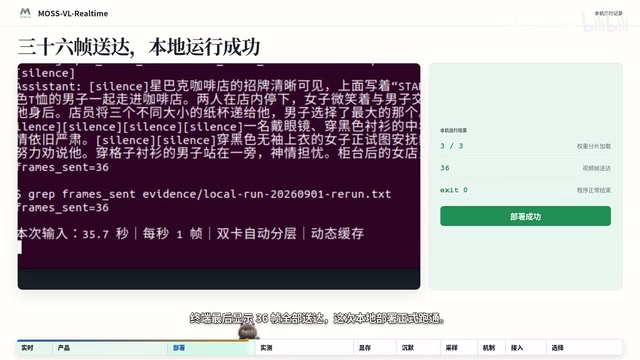
The deployment process was clear and smooth:
- Clone the repository and create an isolated environment
- Install runtime dependencies
- Download official quantized weights (three shards)
- Launch the real-time inference program
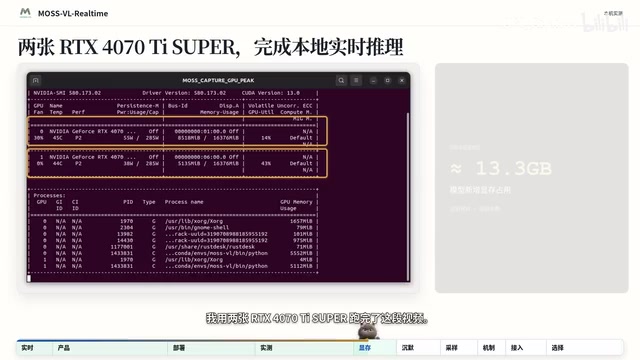
After subtracting baseline system usage, the model consumed approximately 13.3GB of additional memory. This data demonstrates that dual 4070Ti Super cards are fully capable of local real-time inference tasks, providing concrete hardware reference for consumer GPU users.
Technical Architecture: 256K Context and Dynamic Sampling Mechanism
The officially stated 256,000 context length is not a fixed video duration limit, but rather the information capacity that can be referenced in a single inference. Context length is the maximum number of tokens a large language model can process in a single inference—256K equals 262,144 tokens, which represents a relatively large context window among current open-source multimodal models. For video understanding tasks, each frame processed by the visual encoder (typically a ViT-based vision Transformer) is converted into a set of visual tokens, with one frame typically producing hundreds of tokens. Therefore, the 256K context capacity is essentially an "information budget"—the number of sampled frames, visual tokens per frame, and text tokens from user dialogue all compete for this budget. Achieving such ultra-long context typically relies on position encoding extrapolation techniques (such as NTK-aware extensions of RoPE or YaRN), as well as efficient attention computation mechanisms (like FlashAttention) to reduce memory and computational overhead.
The actual processable video duration depends on multiple factors:
- Sampling Density: More frames extracted per second consume more context per unit time
- Dialogue Length: More frequent Q&A interactions correspondingly reduce accommodatable video duration
- Scene Complexity: Complex scenes may require more information encoding
The test used a sampling rate of 1 frame per second, fully processing a 30-plus-second coffee shop video (36 frames total). In real-time video inference, frames per second (FPS) directly determines the balance between temporal resolution of information and computational load. 1 frame per second means a 1-second interval between frames, sufficient to capture most scene-level changes (such as people entering/exiting, scene transitions), but missing instantaneous actions lasting less than 1 second. The model first identified the storefront and entering people, then described a man walking to the counter and a staff member handing over a paper cup, and finally tracked subsequent character interactions. The entire output was continuously supplemented as the video progressed, rather than generated all at once at the end.
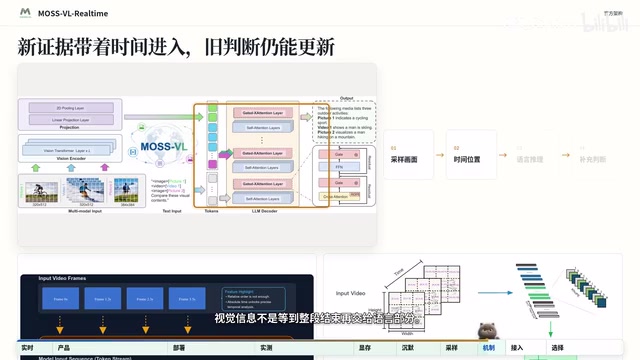
The model's input uses a continuous update mechanism: visual information is not held until the entire segment ends before being passed to the language component; each sampled frame carries its own temporal position information, so event sequences and state changes can be incorporated into the same inference process. Meanwhile, Transformer models need to maintain KV cache during autoregressive generation—storing attention key-value pairs for all processed tokens to avoid redundant computation. As the video continues playing, the KV cache grows linearly, not only consuming memory but also causing attention computation complexity to continuously increase with each new token generation. How to effectively manage KV cache during long video streams—for example, through sliding windows, importance sampling, or cache compression—is a key engineering challenge facing real-time video understanding models.
Practical Applications: Strengths and Limitations Coexist
Core Advantages
MOSS-VL-Realtime's differentiated value lies in its real-time interaction capability:
- Immediate Feedback: Get question answers while video is playing, no need to wait for playback to finish
- Scene Adaptation: Supports local video, camera, screen capture, and external video frame input
- Application Potential: Can serve as a visual foundation for live streaming assistance, experimental observation, process reminders, or screen task monitoring
Testing also revealed a noteworthy feature: when the frame shows no significant change, the terminal doesn't continue outputting repetitive descriptions; text reappears only after subsequent people enter. This "active silence" mechanism holds important significance in multimodal models. Traditional language models tend to always generate output when prompted—even fabricating content "hallucinatorily" when information is insufficient. This is particularly dangerous in real-time video understanding scenarios, as continuous input streams inevitably contain numerous redundant or meaningless moments. The active silence mechanism is essentially an output gating strategy—the model needs to learn to judge "whether there is new information worth reporting right now." This may be implemented through special control tokens: when the model determines there's no significant frame change or insufficient evidence, it generates specific silence markers rather than regular text. This design relates to the "negative sample learning" philosophy—models must learn not only "when to say what" but also "when not to say anything." This mechanism effectively avoids invalid output, but the raw interface writes this state as control markers, requiring filtering at the application layer in actual deployment.
Real-World Constraints
Understanding technical boundaries is equally important:
- Sampling Gaps: The 1-frame-per-second sampling rate misses brief actions; a quick striking motion in testing was not reliably recognized. This is an unavoidable tradeoff between temporal resolution and computational cost—increasing to 2 frames per second can shrink the capture window to 0.5 seconds, but corresponding token consumption and KV cache pressure also double
- Context Pressure: Increasing sampling frequency preserves more detail but simultaneously increases input and cache burden. When video stream duration exceeds context window capacity, the model must choose between "discarding early information" and "reducing sampling rate"
- Application Layer Supplements: Alert rules, permission control, and manual review still need to be implemented at the application layer. The model provides visual understanding capability, not an end-to-end application solution
Series Positioning: Choosing the Right Version for Your Scenario
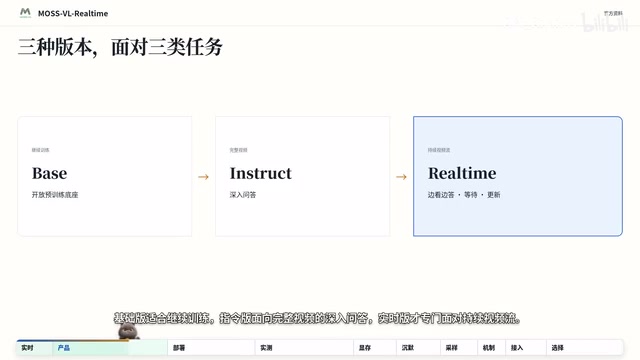
The MOSS-VL series includes three versions, each with its own focus:
- Base Version: Suitable for continued training and fine-tuning, providing researchers and developers with a customizable foundation model
- Instruction Version: For in-depth Q&A on complete videos, suitable for post-video summary analysis. This version can fully leverage all video information for global reasoning, performing better in scenarios requiring comprehensive understanding of entire content
- Real-Time Version: Specifically handles continuous video streams, suitable for scenarios requiring real-time observation, questioning, and dynamic judgment. Its core design goal is low latency and incremental reasoning, sacrificing some global analysis depth in exchange for immediate response capability
If the task is simply summarizing after video ends, the instruction version is more straightforward and efficient. Only when continuous observation during video playback and updating judgments based on new frames are needed does the real-time version truly fit the bill.
Conclusion
MOSS-VL-Realtime provides a deployable technical solution for real-time video understanding with its 11 billion parameters and open weights. Successful deployment on dual 4070Ti Super validates the feasibility of consumer-grade hardware, while three features—watch-while-answering, active silence, and dynamic updates—clearly demonstrate the unique value of real-time understanding.
Sampling gaps and context pressure are clearly existing technical boundaries, but for scenarios requiring immediate feedback such as live stream monitoring, experimental observation, and process reminders, this model offers new interactive possibilities. Choosing the right version, understanding boundaries, and supplementing with application layer components are key to truly realizing its value.
Related articles

Meta Muse Spark 1.3 In-Depth Review: The Truth Behind Top-Tier Coding Capability and Ultra-Low Pricing
In-depth analysis of Meta Muse Spark 1.3's coding capabilities, million-token context, ultra-low pricing strategy, and data exchange logic. Covers performance benchmarks, technical architecture, use case recommendations, and privacy risk warnings to help developers rationally evaluate this AI programming model.
AI Test Automation Learning Roadmap: A Complete Guide from Beginner to Expert
Complete AI test automation learning roadmap covering foundation building, AI testing-specific skills, and toolchain practice. Master data quality testing, model performance testing, adversarial testing, and more to achieve rapid career transformation.

New Paradigm in Protein Design: How Machine Learning Breaks Through Natural Sequence Limitations
Explore the paradigm shift in protein design from imitating nature to surpassing it. Learn how machine learning frameworks enhance artificial protein design success through non-natural sequence exploration, multi-objective optimization, and negative sample learning, driving innovation in synthetic biology and drug design.