MotoGP Aragon Race: Márquez Claims Eighth Home Victory

Márquez wins his 8th Aragon GP for career victory No.77, moves to 2nd in standings 19 points off the lead.
Marc Márquez dominated the 2026 MotoGP Aragon Grand Prix to claim his eighth victory at the circuit, his fourth race win of the season, and the 77th of his career, moving up to second in the championship just 19 points behind leader Martín. A rear ride height device failure disrupted his Turn 2 exit rhythm and cost him over a second in pace, while Acosta shadowed him closely to take second. Aprilia suffered a mechanical nightmare as Raúl Fernández retired, and several other riders crashed out. The race also marked Michelin's final event as MotoGP tire supplier, with an asymmetric rear compound used on the counter-clockwise circuit.
A Red Sea at Aragon: Márquez Dominates on Home Turf
The 2026 MotoGP Aragon Grand Prix race has concluded, with Marc Márquez (nicknamed "Little Horse" by commentators) once again standing on top at his favorite circuit. He claimed his eighth race victory at Aragon — his fourth race win of the season and the 77th MotoGP victory of his career. The significance goes beyond the trophy: with this result, he leapfrogged Bezzecchi in the riders' championship standings to move up to second place, closing the gap to leader Martín to just 19 points.
At the start, Márquez was even sharper off the line than in Saturday's Sprint. He cut to the inside at Turn 1 in almost identical fashion to the Sprint, passing Bezzecchi, and while they briefly ran side by side out of the corner, he quickly established control. The two Aprilias occupied the top two positions in the opening phase — a dream start — but their long-run pace gradually faded as rivals behind reeled them in.
The Technical Detail That Shaped the Race: Ride Height Device Failure
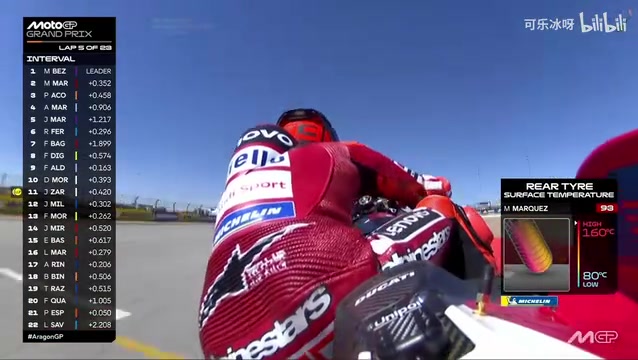
Commentators highlighted a subtle but critical detail that could easily be overlooked: sparks flew from beneath Márquez's bike as he exited Turn 2, the result of his rear ride height device (RHD) failing to fully disengage, leaving the rear spring in a permanently compressed state — a similar situation to what Raúl Fernández experienced at the previous round.
This malfunction directly disrupted his exit rhythm at Turn 2, backing up a train of riders behind him and giving Martín the opportunity to slip through into second place. Commentators estimated in post-race analysis that without the device issue, his race time could have been more than a second faster, and he would likely never have been entangled with Bezzecchi. This technical episode serves as a reminder that even a dominant home victory is shadowed by hardware-level uncertainties.
The Rear Ride Height Device (RHD) is one of the key active adjustment systems on modern MotoGP machines. Its core function is to temporarily lower the center of gravity during launch or corner exit acceleration via hydraulic or mechanical actuation, increasing rear-wheel load pressure to suppress wheelies caused by high power output and improve traction and acceleration efficiency. Under normal conditions, the device lowers the chassis on the straight and automatically disengages before the next braking zone, allowing the suspension to return to its full travel for braking and cornering. If the device locks in the compressed state and cannot release, the effective rear suspension travel is eliminated, significantly degrading attitude control and rear-wheel tracking through corners — the direct cause of the sparks and sudden pace drop Márquez experienced at Turn 2 exit. The MotoGP regulations committee has discussed restrictions on such devices on multiple occasions, as they occupy a gray area between active suspension systems, with each manufacturer implementing them differently and reliability issues surfacing periodically.
The Tire Game: Michelin's Farewell Season and the Asymmetric Rear
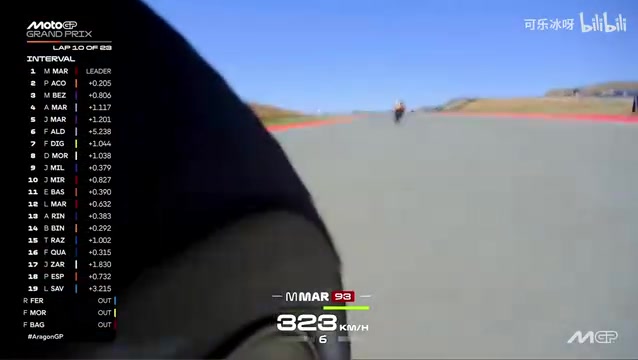
Aragon is a counter-clockwise circuit dominated by left-hand corners, so the left side of the rear tire absorbs higher temperatures. Michelin responded with a purpose-built asymmetric rear tire — harder on the left side than the right — while the front tire remained symmetric. Officials also updated the tire temperature display mid-season to show real-time readings across three zones of the rear tire: left, center, and right.
A notable industry shift is also at play: this is Michelin's final season as MotoGP's tire supplier, making this race the last MotoGP event to bear the Michelin name. From 2027 onward, Pirelli will take over tire supply across all classes, having accumulated substantial data through its supply of Moto2, Moto3, and the WorldSBK World Superbike Championship.
All riders today ran the same medium front / medium rear compound allocation, meaning race outcome depended more on rider rhythm and setup than tire-selection gambles. After Saturday's Sprint, Márquez had admitted the start was his only window and made clear he would not risk a soft tire the way he did at Silverstone — where he suffered severe blistering in the Sprint and had nothing left in the closing stages.
Michelin returned to MotoGP in 2016, replacing Bridgestone as the sole spec tire supplier, and has been deeply involved in the technical evolution of the championship for a decade. The asymmetric tire is not unique to Aragon — it is Michelin's standard solution for circuits with a significant imbalance in left-versus-right corners or varying surface grip levels: the outer edge (the side bearing greater lateral load) uses a harder compound to balance wear rates across both sides, extend usable tire life, and maintain consistent grip. For teams and riders, asymmetric tires must be fitted with strict attention to rotational direction; a reversed installation creates a serious safety hazard. Incoming supplier Pirelli also uses asymmetric tires extensively in WorldSBK, though its compound database differs fundamentally from Michelin's system. The first MotoGP season under Pirelli supply is expected to be a critical bedding-in period for all manufacturers.
Acosta's Chase and Aprilia's Mechanical Nightmare
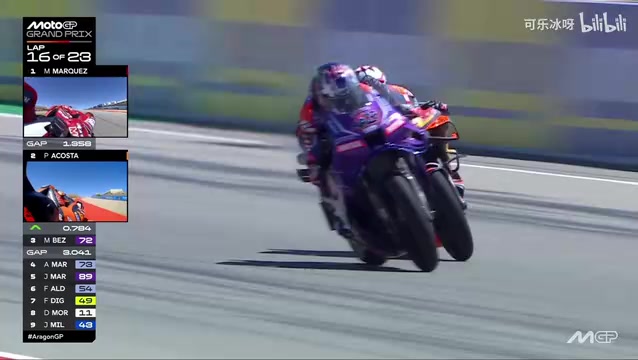
One of the genuine highlights was Pedro Acosta's performance. He held within 0.3 seconds of Márquez for an extended mid-race period, at times carrying stronger pace than the leader, and ultimately took second place. This was his 14th MotoGP podium, yet his maiden premier-class race victory remains elusive. Commentators noted that Acosta's strengths lie in the first half of a race and his tire management profile, but his rear tire degradation is structurally worse than other chassis configurations — a fundamental bottleneck that prevents him from sustaining pressure in the closing stages. He recently underwent carpal tunnel surgery, and his handlebar grips were specially shaped for this race.
The Aprilia camp endured a mechanical nightmare. Raúl Fernández, fresh off a win at the previous round and riding high on momentum, was forced to retire when his bike suffered a mechanical failure — suspected to be an inability to downshift — sending him off track. Commentators recalled two Aprilia engines failing within 45 minutes during last year's Aragon free practice sessions, hinting that heat and engine longevity may be lurking concerns. Additionally, several other riders including Martín's rivals and Pecco Bagnaia crashed out, resulting in a high attrition rate for the race.
Carpal Tunnel Syndrome is a fairly common occupational injury in motorsport. Prolonged high-intensity gripping of handlebars combined with vibration and braking reaction forces compresses the median nerve within the carpal tunnel of the wrist, causing numbness, reduced grip strength, and tingling in the hand. For MotoGP riders, the wrist absorbs enormous impact loads under braking, and symptoms worsen significantly under a heavy race schedule. During recovery from decompression surgery, both grip strength and fine motor control are compromised. Acosta's team designed a specially contoured grip cross-section specifically to minimize wrist loading while preserving as much feel as possible — which also explains the slight drop in his race pace in the final stages, as physical condition and injury management are variables alongside chassis behavior and tire degradation.
The Numbers Behind Márquez: Matching Rossi's Post-30 Record
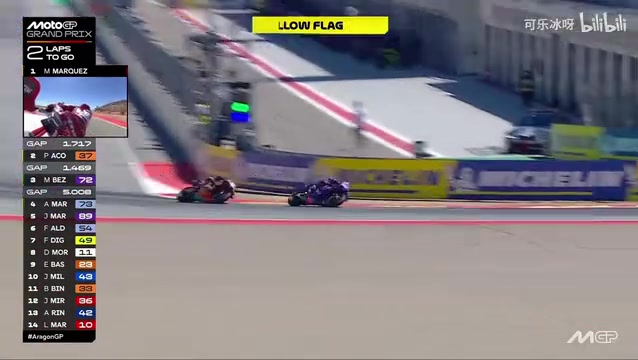
This victory pushed several of Márquez's historical statistics closer to legendary territory. His eight wins at Aragon trail only his ten victories at Sachsenring, making it his second most successful circuit. Since joining Ducati in 2024, he has been unbeaten at Aragon, having swept every Sprint and race win at this venue.
Of even greater weight: the number of race victories he has taken after turning 30 now equals Valentino Rossi's mark of 18. Rossi claimed his final world championship at age 30 in 2009 and never again topped the premier class; Márquez, meanwhile, became the oldest rider to win a MotoGP world title under the current format with last year's championship. On the all-time wins list, Rossi leads with 89 victories, with Márquez in pursuit at 77.
Today's race time was only 0.2 seconds slower than last year's, and during the mid-race phase Márquez strung together four consecutive laps in the 1m46s bracket, posting a fastest lap of 1:46.736 — just a whisker off his own outright lap record of 1:46.705 set here last year, and the only rider in the field able to consistently break into the 1m46s range.
Valentino Rossi's 89 premier-class victories (across the 500cc and MotoGP eras) spanning 25 seasons from 1996 to 2021 remain the uncontested historical benchmark. After his final championship in 2009, the central narrative of his later career became his rivalry with Márquez. Márquez burst onto the scene in 2013, winning the title in his debut season at just 20 years old with Repsol Honda, and accumulated victories with near-total dominance through to the end of 2023. His 2024 move to Ducati (with the Gresini satellite team) was widely viewed as the biggest gamble of his career — relinquishing full factory support from Honda to rebuild competitiveness as a satellite entry. His elevation to the official Ducati factory team this season, and his subsequent charge up the standings, validates that transformation and once again makes the pursuit of Rossi's 89-win record a quantifiable question.
The Real Battleground: The Midfield War
While the top five gradually pulled away into a race of their own, the genuine intensity lay behind them from eighth place onward. Bastianini ("The Beast," joining Trackhouse alongside Raúl Fernández next year) traded positions repeatedly with Moreira and Bulega between eighth and tenth; Miller and Binder (who may be stepping away from MotoGP, with a potential move to BMW's WorldSBK program next year) fought hard around tenth place. Multiple riders scrapped within fractions of a second in closely packed groups, making for far more entertaining viewing than the front row.
In the fan vote for best rider of the race, Márquez received over 58% of the vote — a clear reflection of the dominant nature of his home victory. After the race, he knelt on the ground to thank the grandstand fans, and his first words were directed to the Márquez grandstand rather than the official interview zone — a sea of red, the most moving postscript to this victory.
The title fight remains very much alive: with eight to nine races left in the season, a 19-point gap means the suspense will carry all the way to Misano and beyond.
Related articles

Amphibious Transforming Drone: Beyond 100x Power Savings, What Are the Real Needs?
Is the amphibious transforming drone just a gimmick? Starting from the 100x power difference of the M4 Morphobot, explore real application scenarios and thesis topic ideas, analyzing boundary conditions where pure drones and pure ground robots both fail.

Warhound Raises $200 Million: Genetically Engineered "War Dogs" Paired with Anduril Gear
Warhound raises $200M, backed by Ben Lamm and Palmer Luckey, to genetically engineer dogs for military and law enforcement use and equip them with Anduril gear. This article analyzes its technology direction, funding logic, and ethical controversy.

Claude API Comes to Google Cloud: IAM Integration and SDK Access Guide
Anthropic hosts the full Claude API on Google Cloud with IAM-controlled permissions and unified billing. This guide covers the Vertex AI and Anthropic-hosted entry points, IAM role configuration, and SDK access.