MotoGP San Marino GP: Marquez Claims Misano Crown, Brother Rivalry Steals the Show as Bezzecchi and Bagnaia Crash Out

Marquez wins at Misano and ties Martin atop the standings as crashes and paddock drama define the San Marino GP.
Marc Marquez claimed victory at the San Marino GP aboard his factory Ducati, his seventh win at Misano, drawing level with Jorge Martin at 274 points in the championship. The race was drama-filled, with Bezzecchi, Bagnaia, and Jack Miller all crashing out, while a brother-versus-brother duel between Marc and Alex Marquez headlined the closing laps. Off-track, Quartararo confirmed his Honda move, Rins announced his retirement, and the looming 850cc engine regulation plus Pirelli tyre switch cast a long shadow over what remains of the season.
The San Marino Grand Prix concluded with Ducati factory rider Marc Marquez (No. 93) taking victory at the Misano World Circuit. It was his seventh premier-class win on this clockwise layout, drawing him level with Jorge Martin at the top of the championship standings on 274 points — setting the stage for a powder-keg showdown at the Austrian Red Bull Ring. The race was packed with crashes, overtakes, and a genuine family war, making it one of the most compelling rounds of the season.
Start and Opening Laps: Bezzecchi's Special Livery Meets Its "Curse"
When the lights went out, Bezzecchi locked down Turn 1 with iron discipline, repelling Marquez's multiple attempts to cut back on the inside. Bezzecchi, Marquez, and Martin quickly pulled away from fourth-placed Fermin Aldeguer, forming a compact lead group.
The entertainment didn't last long, however. Bezzecchi suffered a low-side crash in the high-speed right-hander between Turns 12 and 13, his freshly liveried RSGP splitting nearly in two from the fuel tank to the front dashboard — a devastating write-off. Commentators noted that Bezzecchi had set a new Misano circuit record in qualifying with a 1:29.89 lap, and the special "Mars Rover" RSGP livery had shown strong chemistry with the smooth Misano surface, making the retirement all the more gutting.
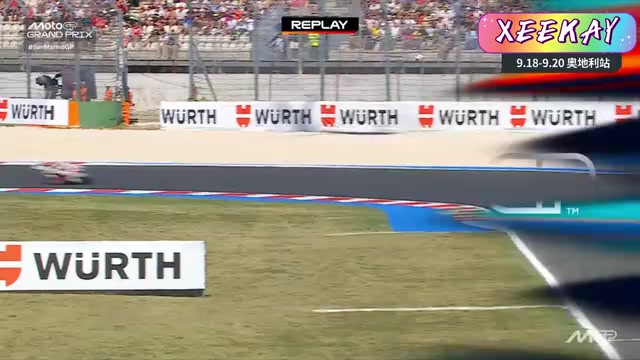
Bezzecchi climbed off the bike with the look of a sheepish schoolboy, leaving many fans in the grandstands stunned. Several other riders also failed to finish the early laps: Jack Miller crashed out on lap two — the Australian is in the final year of his GP career — while LCR Honda's Diogo Moreira also went down.
What is a low-side crash? A low-side (or low-side slide) is one of the most common crash types in motorcycle racing. It occurs when the tyre on the inside (lower side) of a corner loses grip, causing the bike to slide toward the inside of the bend. The opposite is a high-side, where the rear tyre suddenly regains traction and flings the rider over the top of the bike — generally far more dangerous. Even a low-side at high speed carries serious risk, as the bike slides along the ground and is often severely damaged. Misano's smooth asphalt and high cornering speeds make tyre temperature management critical — if front tyre temperature or pressure drifts outside the optimal window, a loss of control like this can happen in an instant.
Mid-Race Drama: Bagnaia DNFs Again on Home Soil
Yellow flags were a recurring theme throughout the race. On lap six, as Bagnaia (No. 63) swept through Turn 2 and began to flick into Turn 3, the front end of his GP26 suddenly stepped out, sending him into another low-side DNF.
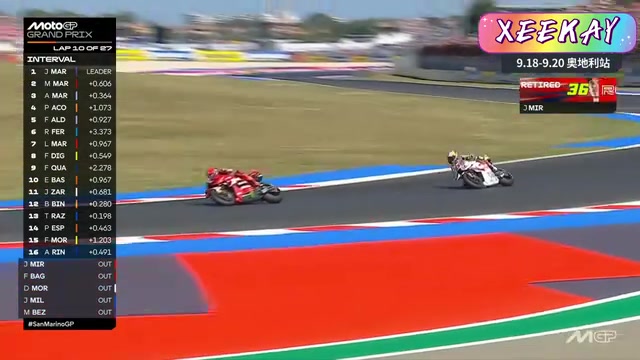
Notably, Bagnaia has now crashed out of both this year's and last year's San Marino GP — his home round continues to be a painful one. Commentators mentioned he will move to the Aprilia factory team next year, and there's genuine hope the Italian can rediscover his form and mental edge in new surroundings.
The Family War: The Marquez Brothers' Chess Match
The second half of the race belonged to one storyline above all: the duel between No. 93 Marc Marquez and his younger brother No. 73 Alex Marquez. Martin had said before the weekend that San Marino would be his "comeback race" — he prefers Misano's silky surface over Aragon's abrasive tarmac — and he backed that up by pulling a decisive move up the inside to briefly take the lead, converting a 0.129-second deficit into an advantage.
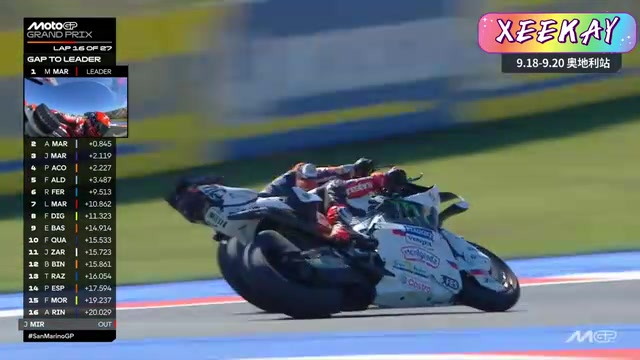
Marquez, however, was metronomic. When his pit board signalled that his brother was closing from behind, he immediately raised his pace. Through a left-hander, he slipped past Martin in what looked almost effortless — the kind of move that makes it seem only Marquez can beat Marquez. Commentators revealed a telling detail: Marquez had pushed the Ducati GP to 65 degrees of lean angle today — deep enough to grind the fairing on the ground.
Alex Marquez, so comfortable on this track, stalked his brother throughout the closing laps but ultimately chose consistency over aggression. The top three — Nos. 93, 73, and 37 — were all Spanish, a testament to Ducati's dominance. Marc Marquez took the win, Alex claimed second, and Pedro Acosta completed the podium, with Acosta on the RC16 showing fierce attacking instincts and making repeated passes on Martin.
Why 65 degrees of lean matters Lean angle is central to understanding Marquez's riding style. MotoGP bikes typically reach maximum lean angles of 62–64 degrees in corners, with elite riders briefly touching the upper limit at specific points. At extreme lean, the fairing, footpegs, and even exhaust pipes can contact the tarmac, generating visible sparks. Maintaining a stable throttle at this angle requires extraordinary muscle control and proprioception — the tyre contact patch has been compressed to a tiny strip of rubber, where the slightest throttle twitch or weight shift can trigger a crash. Marquez is renowned for his ability to hold control right at that edge, which is a core reason he was able to find his rhythm on the Ducati so quickly despite being new to the machinery.
Paddock Stories: Transfers and Farewells
The round also served as a backdrop for a string of paddock storylines. Yamaha's No. 20 Fabio Quartararo is running what will be his last configuration of the V4 M1 this season — the factory confirmed back in July it would provide no further development updates and would exclude him from mid-season testing.
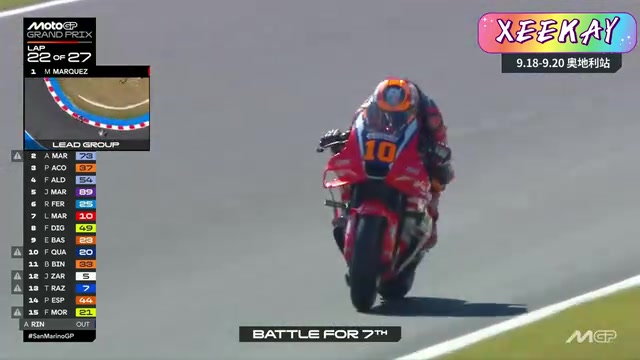
Quartararo has officially confirmed his move to Honda HRC, stating simply: "I just want to get through the remaining races and do my job." Commentators felt Yamaha's handling of the situation was a touch petty, though understandable — Quartararo, as one of the paddock's highest earners, hadn't delivered what the team expected, and communication between the two sides had broken down.
The bigger structural changes loom for next year: engines will be downsized from 1000cc to 850cc, Michelin will exit the MotoGP paddock, and Pirelli tyres — as used in Moto2 and Moto3 — will take over. Many riders who are switching teams will use pre-season testing to get an early feel for both new machinery and new tyre compounds, making those tests an extremely valuable "parting gift" from outgoing teams. Meanwhile, Alex Rins — who also retired from this race — announced he will leave the MotoGP paddock at the end of the year, with no plans to remain involved in any two-wheeled motorsport from 2027 onward.
Championship Standings and What's Next
With the final results in, Marquez and Martin are locked together at 274 points atop the championship. Both men will almost certainly carry identical tallies into the Austrian Red Bull Ring. The high-speed nature of that circuit, combined with a title fight this tight, guarantees a spectacular contest.
From a technical standpoint, Ducati's overall rhythm and corner-exit stability remained a class above the field, with the GP26's short-straight top-speed advantage paying off repeatedly in wheel-to-wheel battles. Aprilia's RSGP was blistering in qualifying, but Martin's pace visibly faded in the later stages of the race, hinting at potential issues with the medium tyre compound or setup. This Misano race was both a high-water mark for the Marquez family and a snapshot of an era nearing its end.
The 850cc regulation change in context The switch from 1000cc to 850cc is arguably the most significant technical regulation change in MotoGP history. The current 1000cc four-cylinder configuration has been in place since 2012, giving manufacturers over a decade of accumulated data and development knowledge. The core rationale is to reduce peak horsepower — expected to drop from roughly 280 bhp to around 240 bhp — in order to improve safety and control escalating R&D costs. The simultaneous switch from Michelin to Pirelli tyres means every manufacturer must relearn tyre thermal behaviour and suspension tuning logic from scratch. With both variables changing at once, the 2026 season is effectively a technical reset — which is precisely why early access to mid-season testing has taken on enormous strategic value for riders switching teams.
Related articles
iPhone Duo Review Controversy: Why Apple's First Foldable Is Said to 'Should Be Called an iPad'
The Vergecast debates the iPhone Duo review controversy: is a 7 fair? Why are apps struggling? Why critics say it 'should be called an iPad'? We unpack Apple's first foldable's positioning mismatch and first-gen compromises, plus AI security flaws and agentic shopping.

Meta vs. Publishers: The AI Data Battle Over Terms of Service Changes and the Future of the Internet
Meta changed its business account terms to allow AI training on linked website data, sparking backlash from publishers and creators. Industry groups demanded negotiations, forcing Meta to remove 'training' wording and delay the effective date. The dispute reveals the deeper battle over data authorization and the future of the internet in the AI era.
When Outside Xbox Meets Blood on the Clocktower: A Legion Match in Minecraft
Outside Xbox guests Ellen and Mike play Minecraft Blood on the Clocktower in a Legion game. How can three good players fight an evil majority amid information noise? This article breaks down Legion mechanics, information-role mind games, and the endgame reversal.