Motrix Downloader: A Complete Review and Usage Guide for the Open-Source All-in-One Download Manager

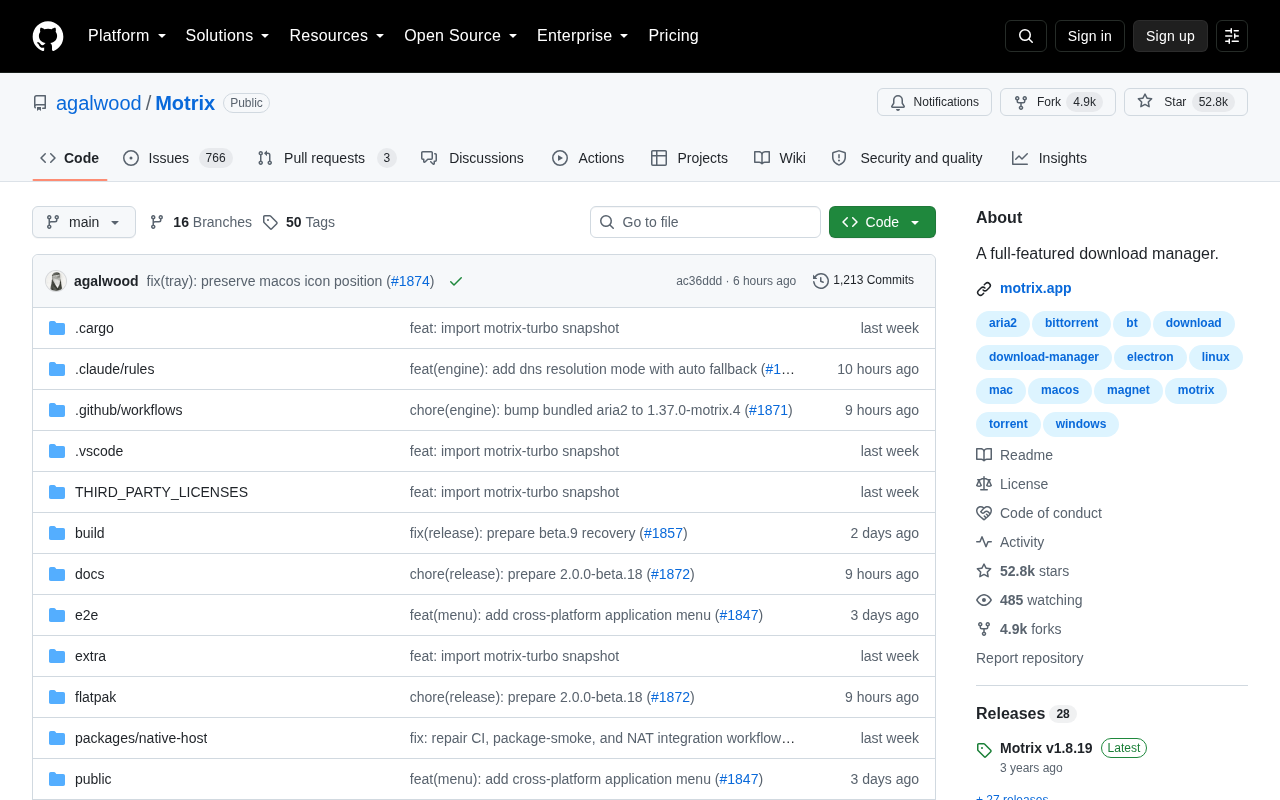
Motrix is a free, open-source, cross-platform download manager built on aria2 with a modern UI.
Motrix is an open-source, cross-platform download manager powered by the aria2 engine. It supports HTTP, FTP, BitTorrent, and Magnet link protocols with multi-threaded downloading, resume capability, and seeding management. Built with Electron + Vue + TypeScript, it offers a modern ad-free interface across Windows, macOS, and Linux, earning over 52,000 GitHub stars.
Introduction: Why Download Managers Still Matter
In an era dominated by streaming services and cloud storage, local download managers seem to be fading from the mainstream spotlight. However, for users who need batch downloading, resume capability, and multi-protocol compatibility, a powerful download tool remains essential. Motrix is exactly such an open-source project — with its clean interface and robust functionality, it has earned over 52,792 stars on GitHub and maintains an active momentum of 295 new stars per day.
As a desktop application built with TypeScript, Motrix positions itself as a "full-featured download manager," supporting HTTP, FTP, BitTorrent, Magnet links, and other download protocols, covering virtually all download scenarios.
What Is Motrix: Project Positioning and Core Capabilities
Project Positioning
Motrix is an open-source, cross-platform download management application built on top of the well-known download engine aria2. aria2 is an open-source command-line download tool initiated by Japanese developer Tatsuhiro Tsujikawa in 2006, written in C++, and renowned for its extremely low memory footprint (typically only 4-9MB). It supports HTTP/HTTPS, FTP, SFTP, BitTorrent, and Metalink protocols, and implements the segmented download mechanism defined in RFC standards. aria2's core advantage lies in its multi-source download capability — it can simultaneously fetch different parts of the same file from multiple mirror servers, maximizing bandwidth utilization. Technically, aria2 uses asynchronous I/O (based on epoll/kqueue) and an event-driven architecture, making it excellent at handling large numbers of concurrent connections. Since aria2 itself is a pure command-line tool with a relatively high barrier to entry for ordinary users, it has spawned numerous GUI frontend projects, and Motrix is one of the most successful among them.
Developer agalwood built a modern, user-friendly graphical interface (GUI) on top of aria2's powerful backend capabilities, enabling ordinary users to easily access advanced download features that would otherwise require command-line operations.
The project is developed using the Electron + Vue technology stack, primarily in TypeScript, and runs on Windows, macOS, and Linux — the three major operating systems — delivering a truly cross-platform experience. Electron is an open-source framework developed by GitHub that bundles the Chromium browser engine and the Node.js runtime together, allowing developers to build desktop applications using web technologies — well-known applications like VS Code, Slack, and Discord are all built on this framework. Vue.js is known for its reactive data binding and component-based development model, while TypeScript, as a superset of JavaScript, catches type errors at compile time through its static type system, improving code maintainability for large projects. The advantage of this tech stack is high development efficiency and low cross-platform costs, though it also brings the higher memory usage commonly associated with Electron applications.
Core Features
From a functional standpoint, Motrix primarily addresses the following needs:
- Multi-protocol support: Beyond standard HTTP/FTP downloads, it natively supports BitTorrent torrent files and Magnet link downloads. BitTorrent is a peer-to-peer file sharing protocol designed by Bram Cohen in 2001. Unlike the traditional client-server model, in the BT protocol every downloader is simultaneously an uploader — files are split into multiple small pieces, and nodes exchange missing pieces with each other, distributing the bandwidth burden away from centralized servers. Magnet links are a decentralized resource location method based on DHT (Distributed Hash Table), identifying resources through content hash values without relying on centralized Tracker servers, making resource sharing more censorship-resistant and resilient to single points of failure.
- Multi-task concurrency: Supports multiple simultaneous download tasks, with each task splittable into multiple connection threads for acceleration
- Resume capability: Downloads can continue from the breakpoint after network interruptions, avoiding redundant bandwidth consumption. Resume capability relies on the Range request header mechanism in HTTP/1.1 (RFC 7233), where the client sends a specific byte range request, and the server responds with a 206 Partial Content status code and the corresponding data segment. In BT downloads, since files are inherently divided into independent blocks, resume capability is natively supported at the protocol level. aria2 also uses control files (.aria2 files) to record the download progress of each segment, ensuring data integrity upon resumption.
- BT seeding management: Complete torrent upload and seeding functionality
Motrix Technical Architecture Analysis
Powered by the aria2 Download Engine
The key to Motrix's outstanding performance lies in its choice of aria2 as the download engine. aria2 is a mature, lightweight download tool that supports multi-source, multi-connection downloads, capable of opening up to 10 threads for a single task, significantly boosting download speeds.
The core principle of multi-threaded downloading (also called segmented or parallel downloading) is dividing a single file into multiple ranges, establishing multiple TCP connections to download each range simultaneously, and finally merging all segments into a complete file. This approach accelerates downloads for two main reasons: first, it overcomes the bandwidth limitation of a single TCP connection — some servers or ISPs throttle individual connections; second, it leverages the characteristics of TCP slow start, where multiple connections can reach the available bandwidth ceiling of the link more quickly. It's worth noting that more threads aren't always better — too many connections may cause server refusal or CDN throttling. aria2 supports up to 16 connections per task by default, and Motrix's 10-thread configuration represents a reasonable balance.
Motrix wraps this powerful core within a friendly interface, achieving a balance of "professional performance + consumer-grade ease of use."
Modern Interface Design
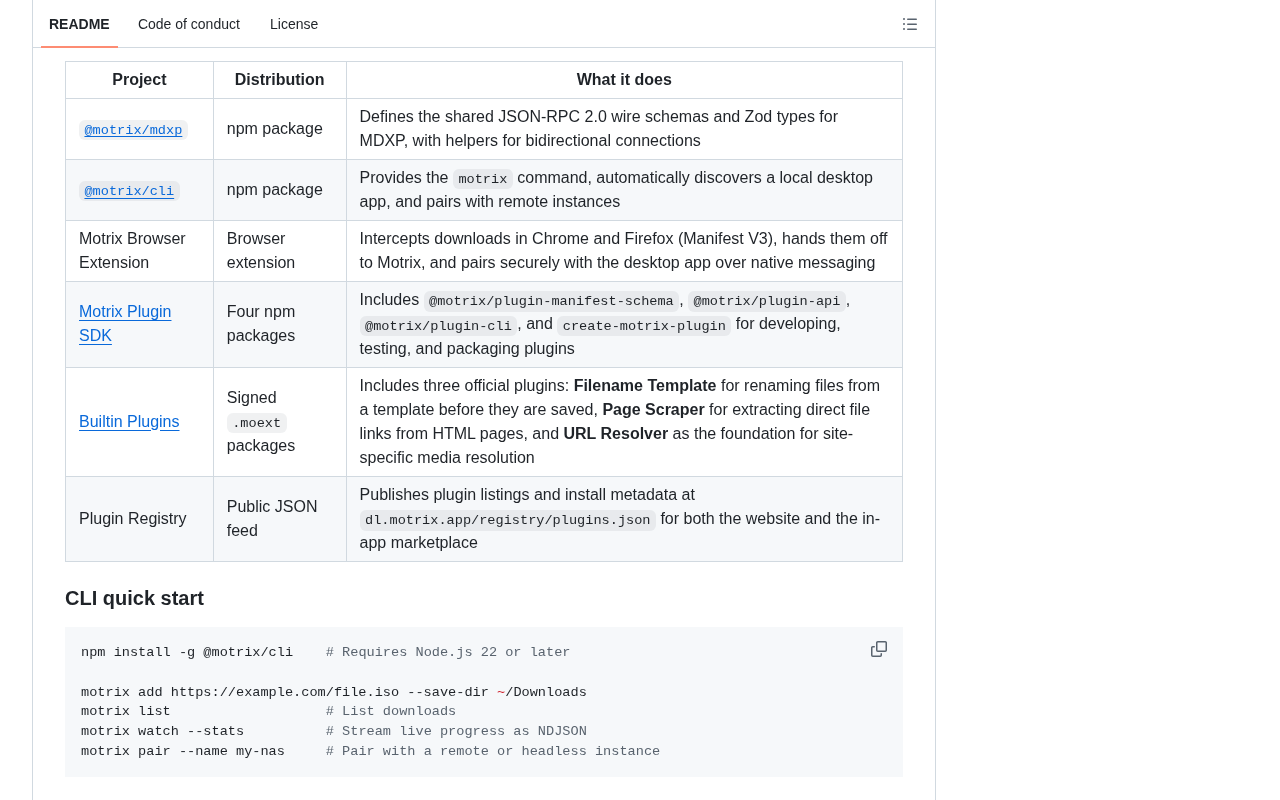
Compared to many outdated download tools, Motrix's interface follows a modern flat design style with clear operational logic. The task list, download speed, and progress status are all visible at a glance, with personalization options like dark mode. This emphasis on user experience is an important reason why it stands out among similar download tools.
Privacy, Security, and Open-Source Transparency
As a fully open-source application, all of Motrix's code is available for review on GitHub. It contains no ads, no bundled software, and doesn't upload user data — a stark contrast to some commercial download tools. For users who value privacy and a clean experience, this is a significant advantage.
Motrix Use Cases and Target Users
Typical Use Cases
Motrix is suitable for the following types of users:
- Heavy downloaders: Users who need to batch download large files and manage numerous download tasks
- BT/Magnet link users: Users who frequently download resources via torrents and magnet links, eliminating the need for a separate BT client
- Privacy-conscious users: Those who prefer not to use commercial download software with ads or bundled behavior
- Cross-platform users: Those who switch between multiple operating systems and desire a consistent download experience
Motrix vs. IDM and Other Tools
Compared to built-in browser download functionality, Motrix offers stronger concurrency and task management capabilities. Compared to commercial software like IDM, Motrix is free and open-source — while it may be slightly less polished in browser sniffing integration, it holds clear advantages in multi-protocol support and software purity.
Internet Download Manager (IDM) is a commercial download accelerator developed by the American company Tonec Inc. Since its release in 1999, it has been the most popular paid download tool on the Windows platform, with a single-user lifetime license priced at approximately $25. IDM's core advantage lies in the depth of its browser integration — through browser extensions, it can automatically detect media resources (videos, audio, etc.) on pages and take over downloads. Among open-source alternatives, besides Motrix, there are Free Download Manager (FDM), XDM (Xtreme Download Manager), Persepolis, and others. Among these competitors, Motrix is known for its attractive interface and out-of-the-box BT support, though its browser sniffing capability is indeed less mature than IDM's, requiring third-party extensions to achieve some functionality.
Community Ecosystem and Project Activity
With over 52,000 stars and nearly 5,000 forks, Motrix's popularity in the open-source community is well established. The data showing 295 new stars per day also indicates that the project continues to attract new user attention. An active community means more comprehensive documentation, timelier issue feedback, and richer third-party extensions.
However, open-source projects commonly face the challenge of limited maintainer bandwidth. When adopting the tool, users should still monitor the project's update frequency and issue response patterns to assess its long-term viability.
Conclusion: Is Motrix Worth Using?
Motrix is an excellent open-source project that "stands on the shoulders of giants" — built on aria2's powerful download core and paired with a modern, user-friendly interface, it successfully brings professional-grade download capabilities to ordinary users. Multi-protocol support, cross-platform compatibility, an ad-free clean experience, and full open-source transparency constitute its core competitive advantages.
For users seeking an efficient download experience without the annoyance of ads and bundled software, Motrix is undoubtedly an open-source download manager worth prioritizing. Its continued popularity once again proves the powerful vitality of "excellent user experience + open-source spirit" in the software world.
Related articles

Gaussian Process Bandit Optimization: Exploration Strategies and Inference Regret Guarantees
Cumulative regret guarantees in Bayesian optimization fail to reflect final recommendation quality. This article examines a new study that provides inference regret guarantees for Gaussian process bandit optimization through exploration query strategies and fill distance analysis, validated on hyperparameter optimization and control tasks.
The Most Detailed Codex Guide on Bilibili: From Installation to Real-World Practice
The most detailed Codex guide on Bilibili: from app store installation to daily work mode configuration, with a real coffee shop project demonstrating file organization, data extraction, dashboard creation, and other practical tasks. Learn to use Plan Mode and desktop pets to leverage Codex efficiently.

Appearance Compensation in Volume Rendering: Why RGB Accuracy Cannot Guarantee Density Correctness
Volume rendering research reveals that volumetric data perfectly reproducing external RGB views may still contain density errors: appearance compensation can double central density and keep external rays unchanged even when L2 error exceeds 14.52%. Density recovery depends on appearance capacity, spatial resolution, and measurement design.