Mozy: An App Blocker That Trades Steps for Screen Time

Mozy converts walking steps into screen time, using exercise to unlock phone apps.
Mozy is a digital wellness app featured on Product Hunt whose core mechanism converts walking steps into screen time: users select distracting apps and set a daily allowance that must be earned by walking, with apps automatically locking once the allowance runs out. Categorized under both Health & Fitness and Productivity, it targets sedentary office workers, heavy phone users, and potentially parents. Its highlight is replacing forced-lock "punishment" with "reward" while combining step counting and screen management; its limitations include undisclosed step accuracy, anti-cheating mechanisms, and exchange ratios. Compared to products like Forest and StayFree, Mozy's differentiation is using physical activity as an unlock condition, and it currently resembles an MVP whose long-term effectiveness depends on rule design and anti-cheating capability.
In the digital wellness space, tools for limiting screen time are plentiful, but most solutions either rely on forced device locking or require users to manually configure complex rules. A recently launched app on Product Hunt called Mozy attempts to solve this problem in a more positive way: linking walking to screen time, making physical activity the condition for unlocking apps.
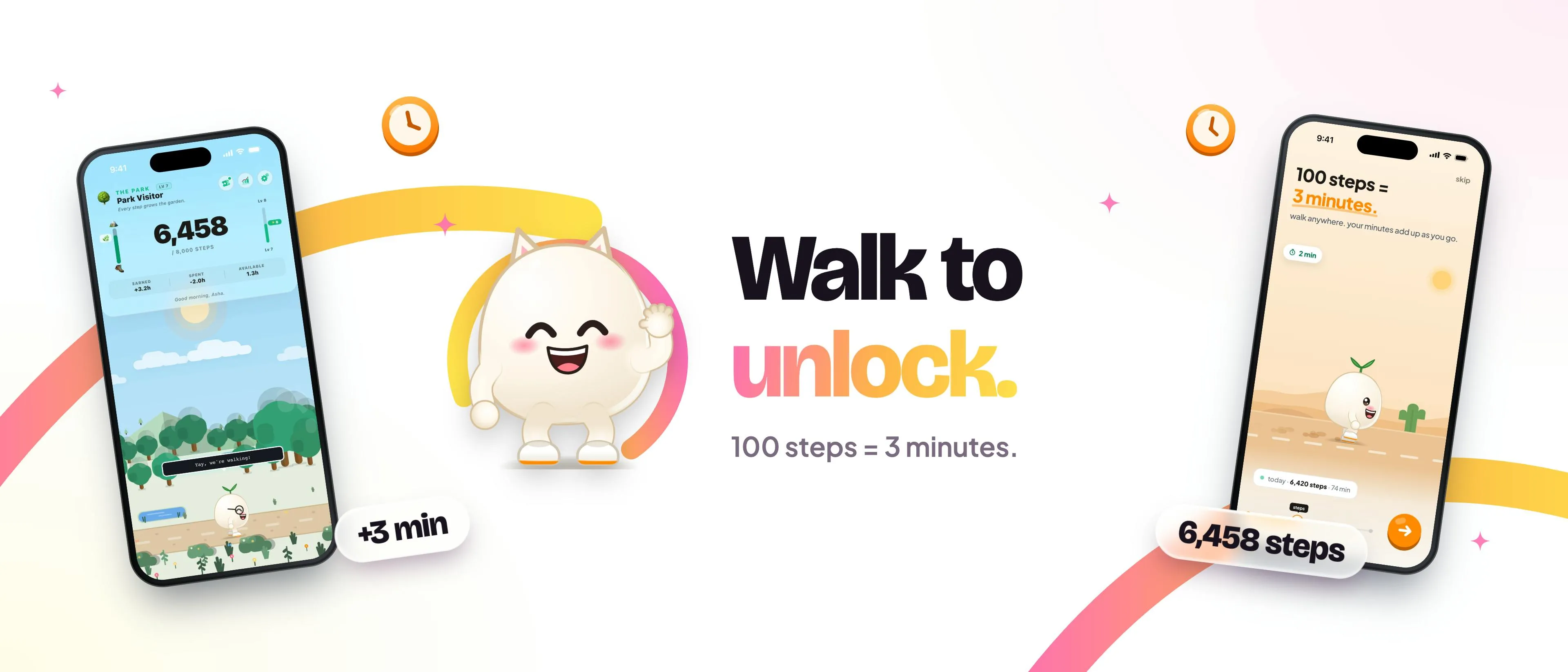
Core Mechanism: Steps as "Currency"
Mozy's logic is straightforward. Users first select the apps that tend to distract them (social media, video platforms, or games), then set a daily screen time allowance. This allowance isn't free—users must earn minutes by walking. When the earned minutes run out, the selected apps automatically lock.
This design directly binds a healthy behavior (walking) to digital consumption (screen time), forming what is essentially a "token economy" from behavioral economics. For people who want to reduce phone dependency while increasing daily activity, Mozy offers an integrated solution without needing to switch between two separate apps.
Token Economy is a classic concept in behavioral economics and behavioral psychology, referring to systematically giving or withdrawing certain "tokens" to reinforce target behaviors. Tokens themselves have no intrinsic value but can be exchanged for rewards users actually want (such as screen time, privileges, or physical items). Token economies are widely used in education, rehabilitation therapy, and habit-forming products because they break long-term benefits into immediate feedback, lowering the psychological barrier to behavior change. Mozy treats steps as tokens and screen minutes as rewards—essentially a token economy design tailored for digital self-discipline. Its effectiveness depends on the reasonableness of the exchange ratio and the immediacy of token acquisition.
Product Positioning and Target Audience
Judging from its Product Hunt categorization, Mozy is listed under both Health & Fitness and Productivity, which perfectly reflects its dual nature. It is both a fitness motivation tool and a digital self-discipline tool.
The target user profile is quite clear:
- Sedentary office workers: those who want to increase daily step counts but lack motivation;
- Heavy phone users: those who recognize their screen time is excessive but find willpower alone insufficient to control it;
- Parents: who might use Mozy as a way to encourage their children to exercise (though the product does not currently emphasize parental control features).
You may not have noticed that Mozy is currently only available on Android and iPhone, covering the major mobile platforms. According to its Product Hunt page, the product received 74 votes and 9 comments, ranking 15th for the day—indicating it has attracted interest from early users within a certain scope but has yet to generate large-scale discussion.
Design Highlights and Potential Limitations
On the highlights side, Mozy's creativity lies in converting "punishment" into "reward." Traditional app blockers typically employ restrictive strategies (such as force-quitting at a set time), which easily trigger user resistance; Mozy instead lets users exchange proactive behavior (walking) for usage permissions, which is more psychologically palatable. Additionally, combining step counting with screen time management in one app reduces the burden of installing multiple apps.
On the limitations side, it remains unclear how Mozy handles step data accuracy (whether it relies on built-in phone sensors or requires connection to a wearable device), and whether there is any anti-cheating mechanism (such as shaking the phone to simulate steps). Moreover, this model may not be suitable for users with limited mobility. The number of comments on Product Hunt is limited, and no in-depth feedback on these details has appeared yet.
Anti-cheating mechanisms are a common technical challenge for health apps. Built-in accelerometers and gyroscopes in phones can identify gait characteristics, but simply shaking the phone, using a step shaker, or an emulator can still forge step counts. Common industry countermeasures include: combining GPS trajectory with step frequency consistency checks, using raw data from the phone's motion coprocessor, introducing machine learning models to distinguish real walking from mechanical vibration, and cross-verifying with encrypted data from wearable devices. For apps like Mozy that use step counts as unlock conditions, anti-cheating capability directly determines whether the product will be gamed by users and lose its constraining significance—but such mechanisms are typically not publicly disclosed on product pages.
Market Outlook and Competitive Comparison
The app blocker and screen time management space already has established products like Forest, StayFree, and AppBlock. Mozy's differentiation lies in using physical activity as an unlock condition, which is uncommon among existing products. Forest uses a tree-planting metaphor, StayFree focuses on data statistics, while Mozy turns "exercise volume" directly into hard currency.
However, whether this model can sustainably attract users depends on the reasonableness of the step-to-screen-time exchange ratio. If the ratio is too harsh (e.g., walking 1,000 steps to earn only 5 minutes), users may quickly give up; if too lenient, it loses its purpose of limiting screen time. The Product Hunt page does not disclose specific exchange rules, which is likely a key parameter the team will need to continuously tune through real-world usage.
In terms of product maturity, Mozy currently looks more like an MVP (minimum viable product)—focused in features but with an incomplete ecosystem. If social leaderboards, family sharing, or deep integration with health platforms (such as Apple Health or Google Fit) could be added in the future, its value would increase further.
Conclusion
With its simple mechanism of "steps for screen time," Mozy carves out an interesting angle in digital wellness tools. It doesn't pursue feature bloat but does one thing thoroughly: getting you to walk a few more steps so you can use your phone. For users who care about both health and productivity, this may be a small tool worth trying. But its long-term effectiveness depends on the design wisdom of its exchange rules and its anti-cheating capability—two aspects for which public information is currently lacking.
Related articles
Three New Metapunk Skills: Building a Closed Loop for AI Software Development
Metapunk's new version adds Implement Spec, PR, and Retro skills to complete the AI software development loop. This article analyzes each skill's features and workflow to help improve AI Agent development efficiency and code quality.

6 Dark Tales of Terror: TED-Ed Uses Animation to Illustrate Fables of Human Nature
TED-Ed's six horror stories collection includes The Monkey's Paw, the Japanese tale of Oiwa, Death's Godfather, Beowulf, Poe's The Masque of the Red Death, and Hoichi the Earless. This article analyzes how these animated shorts use cross-cultural fables to explore desire, betrayal, and the price of death—and why they suit classroom discussion.

A Practical Guide to Calling Lightweight Ollama Models from Python
A complete hands-on guide to installing Ollama, pulling a 0.8B lightweight model, and calling it from Python—covering service startup, model name matching, first-load delays, and other pitfalls, with a measured 0.23s per call.