MTP Multi-Token Prediction: The Hidden Switch Behind Qwen3's 3x Performance Boost
Qwen3's hidden MTP flag can triple inference speed for free — if you know how to enable and tune it.
Qwen3 ships with a trained MTP (Multi-Token Prediction) head that enables speculative decoding — generating multiple tokens per forward pass at no quality cost. Despite being baked into the model weights, this capability is off by default across all major runtimes due to inconsistent naming and a silent flag rename. When properly enabled and tuned (speculation count ~5, lower temperature), users report 2-3x throughput gains across NVIDIA, AMD, and Apple hardware, though benefits depend on memory bandwidth headroom.
A Free Acceleration Switch That's Off by Default
Same GPU, same model file, same prompt — one machine generates 60 tokens per second, the other hits 167. There's no hardware difference between them, no more aggressive quantization, and no sacrifice in output quality. The only thing that changed was a single configuration flag.
It's called MTP (Multi-Token Prediction). According to deep dives from the tech community, this capability has been baked into the model files sitting on your disk all along, yet it's turned off by default in virtually every mainstream inference tool. The Qwen team trained the MTP head into the weights before release, meaning this speedup is "free" — no extra downloads, no trade-offs, and output remains identical to the original.
This creates an awkward situation: the throughput numbers you see in your terminal may be far below what the model is actually capable of. The so-called "3x speedup" originally came from a single row in a developer's benchmark spreadsheet on launch day.
What Problem Does MTP Actually Solve?
To understand the value of this switch, you need to see the bottleneck it fixes. Text generation is fundamentally a queue: a model produces just one token per forward pass, then re-runs the entire multi-billion-parameter computation pipeline for the next word.
The key insight is that this process isn't limited by arithmetic capability — it's limited by memory bandwidth. During each forward pass, your GPU spends most of its time dragging weights across the memory bus so that each weight participates in exactly one multiplication. A GPU outputting 80 tokens per second isn't "thinking" 80 times — it's reading the same 18GB of weight data from memory 80 separate times for 80 words.
This touches on a core concept in GPU computing — Arithmetic Intensity. Modern GPUs have far more floating-point compute power than their memory bandwidth can feed. Take the NVIDIA RTX 4090: its FP16 throughput reaches 330 TFLOPS, but its memory bandwidth is only about 1 TB/s. During model inference, each parameter performs just one multiply-add operation, resulting in extremely low arithmetic intensity (~1 FLOP/byte). The vast majority of GPU compute units sit idle, waiting for data to arrive. This scenario is called "memory-bound," in sharp contrast to the "compute-bound" scenario of training with large batch sizes. This also explains why HBM (High Bandwidth Memory) specs often matter more than CUDA core counts for inference speed — buying more compute can't solve the "data can't get there fast enough" problem.
Speculative Decoding: Trading Cheap Predictions for Speed
Speculative Decoding targets precisely this waste. The logic is simple: let a lightweight component guess the next several tokens ahead of time, then have the full model batch-verify all draft tokens in a single forward pass — at roughly the cost of generating a single token the old way.
This method was first systematically proposed by Yaniv Leviathan et al. from Google DeepMind in their 2022 paper Fast Inference from Transformers via Speculative Decoding, with Stern et al. independently publishing a similar approach around the same time. Its mathematical guarantee rests on an elegant rejection sampling scheme: during verification, the large model computes the true probability distribution for each draft token. If the draft model's assigned probability exceeds the large model's, it's randomly rejected proportionally, ensuring the final sampling distribution is exactly identical to sampling directly from the large model. This means speculative decoding isn't an approximation — it's mathematically equivalent to original decoding.
- Guess right: 4 tokens arrive at the price of 1
- Guess wrong: the bad draft is discarded, and you're back to square one
The most critical point — the full model verifies every draft token before it's emitted, so speculation can never change the final answer. Enabling MTP costs you nothing in quality.
Typically, speculation requires you to download and keep an additional "draft model" resident in memory. Qwen's clever approach trains the draft head directly into the model file. This approach originates from Meta's 2024 Multi-Token Prediction research. The core idea is to train several lightweight prediction heads on top of the final layers of the main Transformer. Each MTP head shares the main model's hidden state representations and contains only a small feed-forward network and output projection layer, typically less than 1% of the main model's parameter count. These heads are jointly trained with the main model during pre-training, learning to predict the 2nd, 3rd, and up to Nth future token. Because they share the main model's deep semantic representations, MTP heads achieve prediction accuracy far above random guessing by an independent small model, while adding almost no model file size.
For example, in a quantized version, the tag with MTP heads is 18GB and the one without is also 18GB — the draft heads take up virtually no extra space (roughly 2.5GB of additional memory for draft computation at runtime).
Why So Few Tools Show Ideal Speeds
One Capability, Four Names
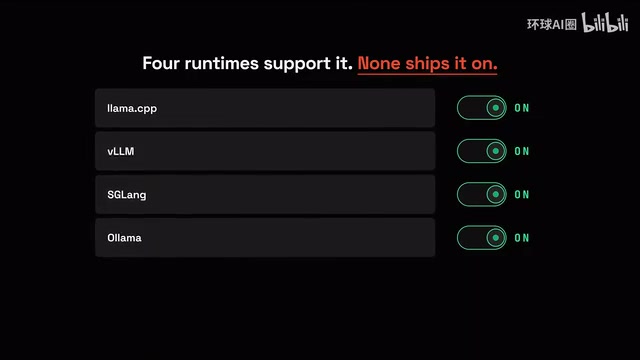
The first reason is mundane but real: the four major runtimes each "spell" this feature differently, and none enable it by default.
- In llama.cpp, it's a
spec-type parameter - In vLLM, it's buried in a JSON blob within the serving configuration
- In SGLang, it's a speculative algorithm option
- In Ollama, you don't set a flag at all — you pull a different tag
One capability, four names, four entry points.
A Silent Rename
The sharper reason is "rename rot." Three months before this model's release, the llama.cpp project changed the spelling of this flag, and MTP support landed in the main branch just three days later. The old spelling wasn't removed — it was still "accepted" but silently ignored.
The result: generation runs normally, but speculation stops, your throughput collapses to half, and neither the command line nor the logs give you any indication. One reported measurement showed throughput dropping from ~140 tokens/second back to ~70. Every tutorial written before that "rename day" still carries the now-defunct old spelling — this is the real reason it "feels like a secret." It's not that the capability itself is obscure; it's that the instructions went stale.
The Tuning Knobs Hidden Behind the Flag
Once you use the correct spelling and enable it, you encounter the real tuning knob — the flag takes a number indicating how many tokens to speculate at once.
On launch day, a developer swept this number from 2 to 8 on a Blackwell workstation GPU and published the full curve:
| Draft Tokens | Acceptance Rate |
|---|---|
| 2 | 81% |
| 5 | 56% |
| 8 | 40% |
But throughput doesn't change linearly with acceptance rate. It climbed to a peak of ~115 tokens/second around step 5, then fell off. Most online recipes ship with a default of 2 to 3 — leaving up to 27% of available performance on the table. The default values the community copies are often not what the hardware actually wants.
There's an interesting trade-off here: speculating more tokens means larger batch verification overhead (verifying N draft tokens costs slightly more than verifying 1), but as long as the acceptance rate is high enough, the bandwidth savings from "passing multiple tokens through a single verification" still far outweigh the extra compute cost. However, as the speculation window lengthens, prediction difficulty for later tokens rises exponentially (the conditional probability of the 5th token is far lower than the 2nd), leading to diminishing marginal returns. The optimal speculation count is therefore highly dependent on the specific hardware's compute/bandwidth ratio and the model's inherent predictability — there is no universally optimal value.
It's the Quality Setting That Determines Speed
Another developer discovered something more subtle: draft acceptance rate dropped from ~85% in the previous version to ~65% in this one. The reason had nothing to do with the model — it was temperature. It was running the sampler at 1.0 by default, because that's what the model authors themselves recommended. Higher temperature "flattens" the probability distribution of the next token, making it easier for the draft head to guess wrong.
Temperature is the core sampling parameter that controls output randomness in language models. In the softmax computation, temperature is applied as a divisor to the logits: at T=0.1, the probability distribution becomes extremely sharp and the model almost deterministically selects the highest-probability token; at T=1.0, the original training distribution is preserved; at T>1.0, the distribution tends toward uniform, giving low-probability tokens a greater chance of being selected. Speculative decoding efficiency depends directly on the overlap between the draft model's and the main model's probability distributions. At low temperatures, both models will most likely "agree" on selecting the highest-probability tokens, naturally yielding high acceptance rates. At higher temperatures, the main model may sample "surprise" tokens from the distribution's long tail, and the draft head — with its limited capacity — can rarely predict these low-probability choices, causing acceptance rates to plummet.
In other words, a "quality setting" written in the config three lines above the speculation parameters actually determines your speed. You can even go against the author's recommendation and lower the temperature to "buy" extra throughput. The temperature parameter fundamentally controls "predictability," and predictability is the acceleration engine of speculative decoding.
Real-World Performance Across Hardware
Blackwell's Ceiling and the Format Trap
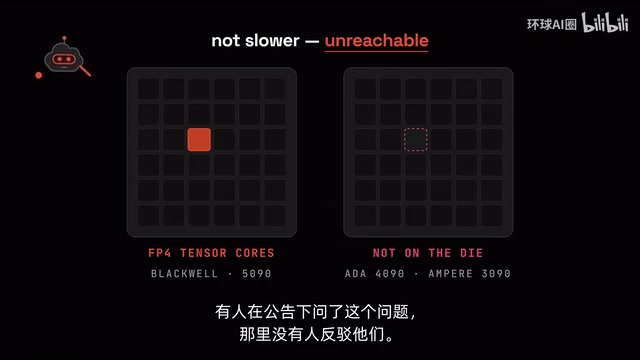
Vendors reported a stunning 206 tokens/second on launch day (one user claimed 216 on Windows). But note: this headline number isn't thanks to MTP — it's thanks to a 4-bit format called NVFP4 running with a separate drafter in parallel — and that format only exists on Blackwell chips.
NVFP4 is a native 4-bit floating-point format designed by NVIDIA specifically for the Blackwell architecture (GB100/GB200 series chips). Unlike traditional INT4 quantization that maps floating-point weights to integers, NVFP4 retains the exponent bits of floating-point numbers, better representing long-tail values in parameter distributions and maintaining higher model accuracy at extremely low bit widths. Blackwell's fifth-generation Tensor Cores natively support FP4 operations at the hardware level, processing twice as many elements per clock cycle as FP8. This means that at the same memory bandwidth, FP4 can effectively double throughput — not only because each weight occupies fewer bytes (reducing memory reads), but also because the hardware can directly execute multiply-add operations on this format without dequantization overhead.
On a 3090 or 4090, this number isn't "slower" — it's simply unachievable, because Ampere and Ada Lovelace Tensor Cores only support hardware acceleration down to INT8/FP8 precision. Running 4-bit models requires software-level dequantization steps and cannot achieve equivalent throughput gains.
AMD and Apple: Portable but at a Cost
- AMD side: Independent sweeps show the Vulkan backend leads ROCm by ~20%-30% in generation speed, while ROCm leads in prompt processing. A 16GB Radeon user measured ~30 tokens/second at 128K context, reaching 51 at half context with the flag enabled — nearly 60% faster.
- Apple side: A 48GB laptop went from 8.3 tokens/second at 4-bit to 20.3 after porting the draft head — an average 2.45x improvement. Even more interesting, 4-bit with draft (20 tok/s) actually beat 8-bit without draft (14.6 tok/s) — better answers + faster speed, a trade you normally can't get from quantization alone. This result seems counterintuitive, but the logic is simple: 8-bit model weights are twice the size of 4-bit, making Apple Silicon's unified memory bandwidth an even more severe bottleneck. The 4-bit model with MTP speculative decoding achieves a double acceleration by reducing both the total number of memory reads and the amount of data per read.
A Sharp Objection
However, the loudest reply in the discussion wasn't buying it. The question raised: has the entire stack implemented prefix caching for this hybrid architecture? Because agentic tasks re-read the entire history every turn — without prefix caching, once conversations grow long, "3x" degrades to "0.5x."
Prefix caching is a KV Cache reuse technique. When multi-turn conversations or multiple requests share the same prefix text (such as system prompts, tool definitions, or conversation history), the server can save previously computed Key-Value caches and reuse them for subsequent requests without recomputation. In agent workflows, the model needs to re-read the complete task description and all historical interactions at every step — these prefixes can account for over 90% of total input. Without prefix caching, the prefill phase of every inference round must process thousands or even tens of thousands of tokens from scratch, and this prefill time can far exceed the generation phase itself — while speculative decoding only accelerates generation, doing nothing for prefill. Currently, vLLM's Automatic Prefix Caching and SGLang's RadixAttention both implement prefix caching, but enabling it simultaneously with speculative decoding still faces complex engineering challenges around cache invalidation policies and memory management.
The claim was that no server currently offers both prefix caching and speculation together. This is an argument rather than a benchmark, but it asks exactly the right question.
When to Enable It, and When Not to Expect Much
Putting it all together, several clear action items emerge:
- On any machine where the model already fits in VRAM, enable it immediately — it's lossless, and it's already in the files you downloaded.
- Don't buy more VRAM just for this flag. On machines that can't fit the model and are forced to use system memory, the real bottleneck is that PCIe cable. PCIe 4.0 x16 has a theoretical bandwidth of ~32 GB/s, while even consumer-grade GDDR6X memory bandwidth is in the 1 TB/s range — a 30x+ difference. Tests show speculation only hid 7.5% of memory latency — it can hide latency on transfers already in progress, but it can't hide transfers that haven't started yet. When weights must travel from system memory through PCIe, that narrow pipe is the real ceiling, and speculative decoding can't help.
- Tune the "speculation count" knob — around 5 is typically near the sweet spot, rather than the default of 2-3. But the optimal value varies by hardware and use case, and it's worth spending a few minutes on a simple sweep test.
- Be aware of the hidden coupling between temperature and speed — if you're willing, lower the temperature to trade for throughput. For high-determinism tasks like code generation and data extraction, lower temperature also benefits output quality, creating a positive feedback loop with speculative decoding.
The single most important takeaway: MTP is a "multiplier," not a "creator." It doubles the speed you already have, but it can't conjure speed from nothing. Every number cited here is real — each measured by someone under specific, curated optimal conditions. Understanding those conditions is what lets this switch — one that has been "lying free in the file" since release day yet defaulting to off everywhere — actually work for you.
Key Takeaways
Related articles

WeatherNext 3 Achieves 5km Precision — Breakthroughs in AI Weather Models and Inference Costs
Google DeepMind's WeatherNext 3 achieves 5km AI weather forecasting, Meta launches low-cost Muse transcription, Microsoft reports 300x inference cost drop, OpenAI declares AGI era.

Multi-Agent Collaboration with Coze: A Complete Guide to Building AI Agent Teams
A deep dive into Coze's multi-Agent collaboration, covering agent types, RAG knowledge bases, and workflow orchestration with a complete practice guide from basics to enterprise deployment.

WAS Node Suite v3: A Comprehensive ComfyUI Node Pack Upgrade That Eliminates Dependency Hell
WAS Node Suite v3 overhauls the ComfyUI node pack with zero external dependencies, native PyTorch conversion, doubled node count, and flexible feature gating to eliminate dependency hell.