Multiple Claude Models Hit by Sudden Errors, Official Fix Deployed
Multiple Claude models saw ~24 minutes of elevated errors from shared infrastructure issues; officially fixed.
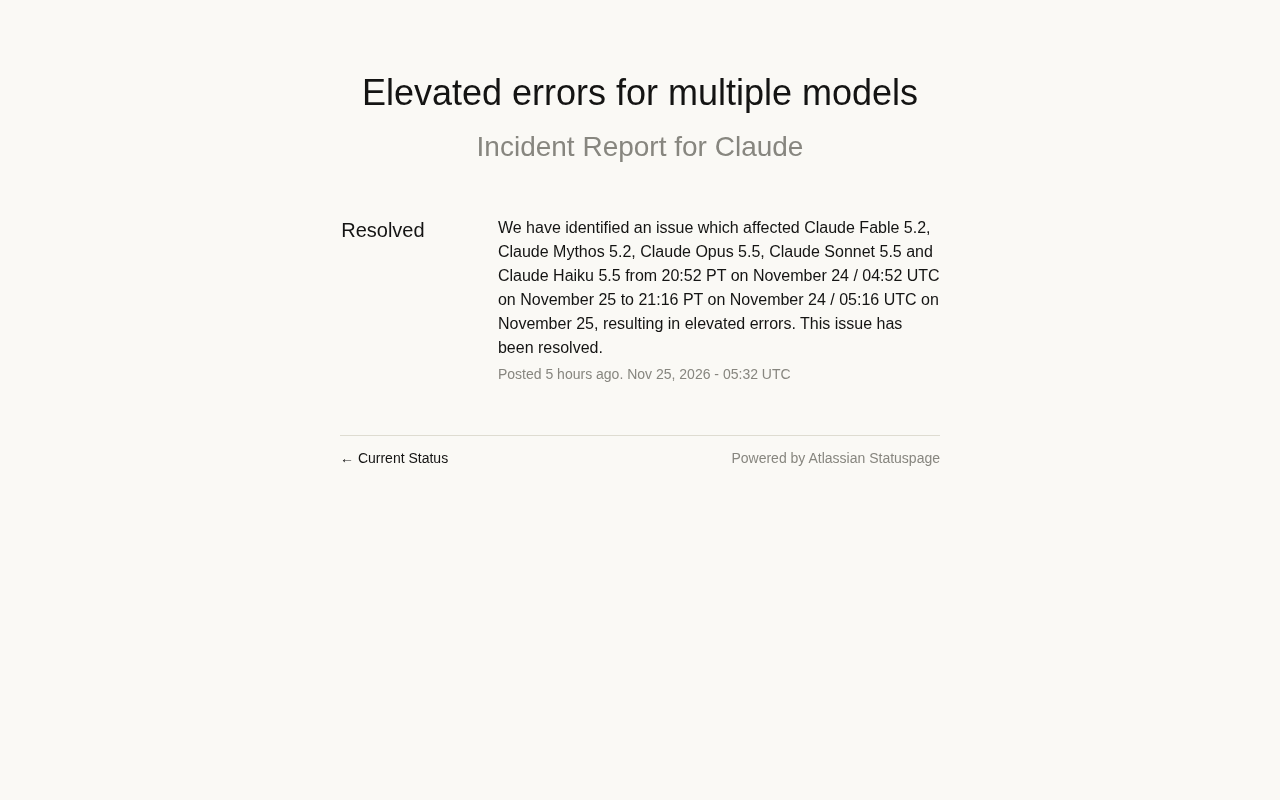
Anthropic's official status page shows that Claude Fable 5.2, Mythos 5.2, Opus 5.5, Sonnet 5.5, and Haiku 5.5 experienced elevated error rates from 20:52 to 21:16 Pacific Time on November 24, and were marked resolved after about 24 minutes. Multiple models fluctuating simultaneously indicates the problem originated in shared infrastructure rather than any single model's inference logic, and it involved partial request failures rather than a complete outage. The article notes that developers relying on the Claude API without retry and fallback mechanisms will see user-perceived sluggishness or errors; multiple models from the same vendor being affected simultaneously also shows that cross-provider backups remain necessary. The official announcement did not disclose the root cause or specific remediation measures, so enterprise users need to strengthen their own stability safeguards.
According to an official status page announcement, several Claude models under Anthropic experienced a spike in error rates within a short window, affecting versions ranging from lightweight to flagship tiers. The issue has now been identified and resolved.
Incident Overview: Which Models Were Affected
According to status page records, the affected models include Claude Fable 5.2, Claude Mythos 5.2, Claude Opus 5.5, Claude Sonnet 5.5, and Claude Haiku 5.5. Judging by the naming, this covers nearly all major models in the product line—from the Opus series targeting high-complexity tasks to the Haiku series focused on response speed.
Multiple models erroring simultaneously usually indicates the problem lies in the shared infrastructure layer rather than the inference logic of any single model. The official announcement describes the phenomenon as "elevated errors," meaning it was not a complete service outage but rather a notably higher-than-normal probability of request failures.
Status Page Mechanism: Cloud services and API providers typically maintain a status page separate from the main site to publicly report the availability, performance degradation, and maintenance events of each service in real time. These pages generally label status by component (e.g., different models, different regions) and describe the incident lifecycle using a fixed flow: "Investigating — Identified — Monitoring — Resolved." For developers, the status page is the primary source of information for determining the scope of an outage and deciding whether to trigger fallback strategies, and it can also be subscribed to via RSS or Webhook for automated alerting.
The Difference Between "Elevated Error Rates" and "Service Outage": The elevated errors mentioned in the announcement refer to a higher-than-baseline proportion of request failures, while the service as a whole remained responsive—distinct from a complete outage. Such partial failures often manifest as specific requests returning 5xx errors, timeouts, or streaming interruptions, are random and uneven in nature, are harder for monitoring to catch than a total outage, and rely more heavily on client-side retries and idempotent design as a safety net.
Timeline and Resolution
The announcement provided a clear time window: the issue began on November 24 at 20:52 Pacific Time (November 25, 04:52 UTC) and lasted until November 24 at 21:16 Pacific Time (November 25, 05:16 UTC). That translates to a duration of approximately 24 minutes.
The official status was marked as "Resolved," with a note that "the issue affecting the above models has been identified and is now resolved." Judging by the pace from detection to fix, the response was relatively fast, but the announcement itself did not disclose root cause details or specify whether measures such as rollback, rate limiting, or traffic switching were taken.
Practical Impact on Developers
For teams building applications on the Claude API, the most direct manifestation of such a brief error rate spike is failed or timed-out requests. If the application lacks retry mechanisms and fallback handling, users may perceive it as sluggish functionality or errors.
From an engineering practice perspective, this incident once again demonstrates the value of multi-model redundancy: when the primary model fluctuates, being able to switch to another model in the same series or a backup provider can significantly reduce the impact on end-user experience. However, it's worth noting that multiple models were affected simultaneously this time, showing that switching among models from the same vendor cannot fully mitigate risk—cross-provider backup strategies remain necessary.
Retry and Exponential Backoff: When facing brief error rate spikes, the most common client-side safeguard is retrying, but uncontrolled retries can amplify traffic during an outage and worsen cascading failures. The industry typically adopts a strategy of exponential backoff with random jitter—each retry's wait time grows multiplicatively with a random offset added, along with a maximum retry count and total timeout budget. For LLM calls, idempotency also matters: retries may cause duplicate billing or duplicate side effects, so write operations should use idempotency keys, and streaming responses need to handle resumption or regeneration after mid-stream interruptions.
Fallback & Circuit Breaking: Fallback means switching to a backup model, returning cached results, or providing a simplified response when the primary model is unavailable; circuit breaking means proactively pausing calls to a service for a period when error rates exceed a threshold, avoiding persistent futile requests. Combined, these two approaches keep applications basically available during vendor fluctuations—which is also why the article emphasizes cross-provider backup: multiple models from the same vendor may share underlying infrastructure and cannot form true isolation.
Signals Worth Noting
The status page announcement contains limited information, but two details are worth noting. First, the affected list includes the relatively uncommon model names Fable and Mythos, indicating the product line continues to expand and the model matrix is growing more complex—making the scope of troubleshooting harder to predict. Second, the announcement did not mention whether the issue was related to recent capacity expansion or version updates; this information gap is regrettable for enterprise users who need to assess service stability.
For ordinary users, such brief outages require essentially no extra action; for developers, it's advisable to check your service's retry and timeout configurations and keep an eye on further updates to the official status page.
Summary
This incident of elevated error rates across multiple Claude models was short in duration, broad in impact, and promptly fixed—a typical brief fluctuation at the infrastructure layer. It reminds us that even for leading AI service providers, model service stability requires engineering safeguards rather than assuming constant availability.
Related articles
GLM-5.4 vs. Opus and Neon: How Far From the Top?
No official benchmarks for GLM-5.4. Based on a YouTube deep test and developer trials, we analyze its gap vs. Claude Opus 5.5 and Gemini Neon, the speed bottleneck from marathon-style thinking, and its real position in enterprise agent scenarios.

From Gobbler to Sloppy Joe: The Hit-Making Playbook of a New Jersey Deli Institution
NYT Cooking visits Milburn Deli in New Jersey to break down the hit logic behind the Gobbler turkey sandwich and the local Sloppy Joe: bread sliced to order, house-made sauces, a group shout culture, and customer co-creation behind six locations.
In the Age of AI Programming, When Do You Still Need to Write Code by Hand?
Is handwritten code still valuable once AI programming agents are widespread? This article outlines three scenarios where handwriting is essential—learning, style development, and prototype validation—and provides a division-of-labor framework between AI and humans to help developers balance efficiency and skill growth.