Multiple Security Vulnerabilities Discovered in Linux Kernel: Impact Analysis and Response Strategies

Multiple Linux kernel vulnerabilities disclosed — here's why they matter and how to respond.
LWN.net recently disclosed multiple Linux kernel security vulnerabilities, sparking discussion on Hacker News. This article explains why kernel vulnerabilities are especially dangerous — the kernel runs at Ring 0, enabling privilege escalation, DoS, information leakage, and even cross-tenant breaches in cloud environments. It also covers the open-source coordinated disclosure process (CVE assignment, distro coordination) and practical response strategies: timely system updates, live kernel patching for zero-downtime fixes, and using CVSS scores to prioritize. The key takeaway: ongoing vulnerability discovery signals a healthy security ecosystem — the real risk lies in delayed patching.
Overview
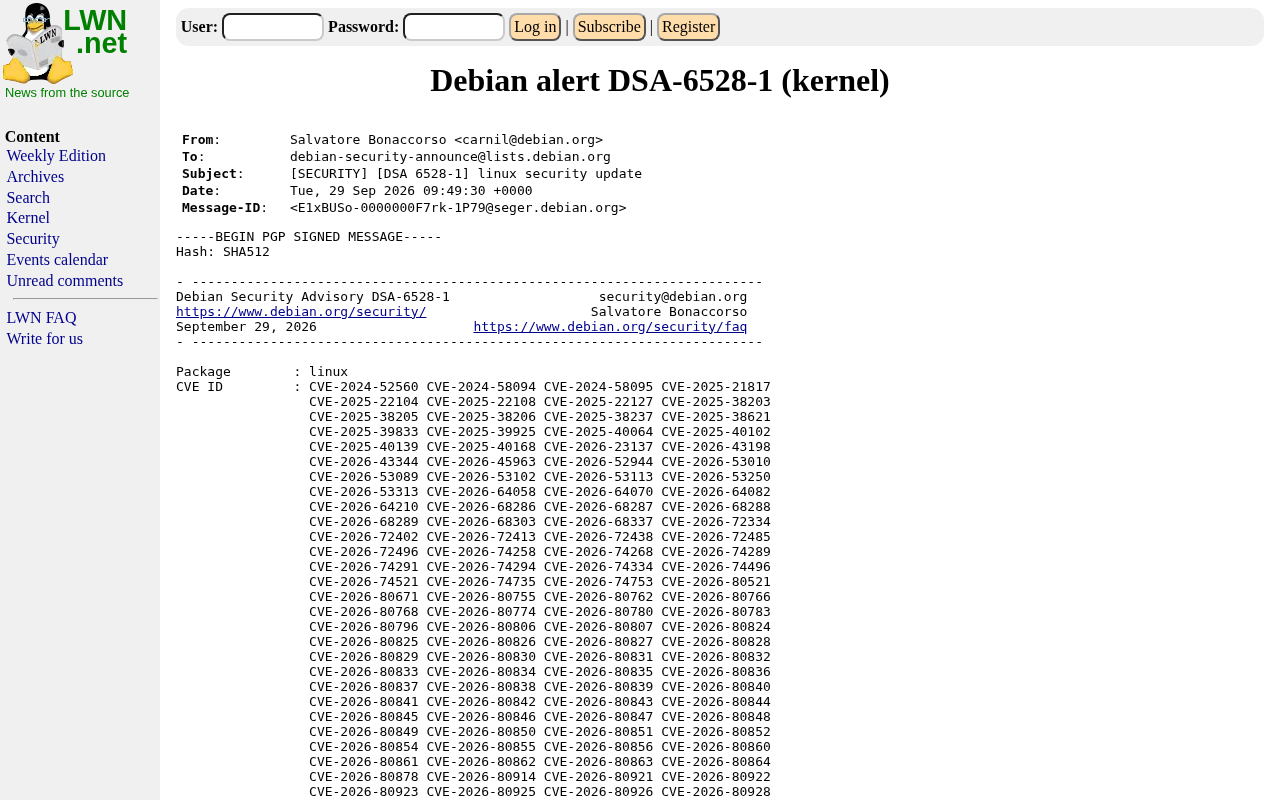
Multiple security vulnerabilities have recently been discovered in the Linux kernel. After being reported by the authoritative tech publication LWN.net (Linux Weekly News), they quickly sparked widespread discussion on Hacker News, drawing 236 upvotes and 161 comments. As the most widely deployed operating system kernel in the open-source world, any security issue in Linux has ripple effects across a vast ecosystem — from servers and cloud computing to embedded devices and mobile terminals.
It's worth noting that the original source material was a brief link announcement without detailed technical disclosure of specific vulnerabilities. This article draws on publicly available information to analyze the nature, scope, and general response strategies for this type of event, helping readers build a foundational understanding of kernel security issues.
Why Kernel Vulnerabilities Demand Special Attention
The Linux kernel runs at the highest privilege level of the operating system (ring 0), responsible for managing memory, process scheduling, the filesystem, the network protocol stack, and device drivers. Because it sits at the very bottom of the system's trust chain, vulnerabilities in the kernel tend to carry far more severe consequences than those at the application layer.
Typical kernel vulnerabilities can lead to several categories of risk: local privilege escalation (ordinary users gaining root access), denial of service (system crashes or hangs), information disclosure (reading kernel memory that should be inaccessible), and in extreme cases, remote code execution. For cloud providers hosting large numbers of virtual machines or containers, a breach of kernel-level isolation could trigger lateral movement across tenant boundaries.
This is precisely why such announcements rapidly trend on technical communities like Hacker News — developers and operations teams need to assess whether their systems are affected as quickly as possible.
Ring 0 is the highest-privilege level in the CPU Protection Ring model of the x86 architecture. This model divides program execution privileges into four layers from 0 to 3: Ring 0 is reserved for the OS kernel and can directly execute privileged instructions, access arbitrary memory addresses, and interact with I/O ports; Ring 3 is where ordinary user programs run, subject to strict restrictions. When a process can "escape" from Ring 3 to Ring 0 — which is the core mechanism behind local privilege escalation vulnerabilities — it can bypass all of the operating system's security boundaries, reading and writing arbitrary memory, terminating any process, or even modifying kernel code itself. Virtualized environments also include a deeper layer called Ring -1 (the Hypervisor layer). If a kernel vulnerability is exploited and then used to attack the Hypervisor, every virtual machine on that physical host is put at risk — which is the fundamental reason cloud providers are so acutely sensitive to this class of vulnerability.
Vulnerability Disclosure in the Open-Source Ecosystem
LWN.net has long tracked Linux kernel development and security, serving as a key information source for the kernel community. Its publication of this vulnerability summary reflects a mature security governance process that open-source projects have developed over time.
Typically, kernel security vulnerabilities follow a complete chain: discovery, private reporting, patch development, coordinated disclosure (CVE number assignment), and public announcement. The kernel community maintains a coordination mechanism with major Linux distribution maintainers (such as Debian, Ubuntu, Red Hat, SUSE, etc.) to ensure patches are ready before public disclosure, minimizing the "zero-day" window of exposure.
The advantage of the open-source model is transparency: vulnerability details, fix code, and impact analysis can all be publicly reviewed. But this also means attackers have access to the same information, making timely patch deployment critically important.
CVE (Common Vulnerabilities and Exposures) is a public vulnerability identification system maintained by MITRE. Each registered vulnerability receives a unique identifier (e.g., CVE-2024-XXXXX), enabling consistent reference across different organizations, tools, and databases. The companion CVSS (Common Vulnerability Scoring System) provides a quantitative score from 0 to 10, factoring in attack vector (local/network), attack complexity, required privileges, user interaction requirements, and impact on confidentiality, integrity, and availability. A CVSS score of 9.0 or above is typically labeled "Critical," indicating an immediate response is required. In the coordinated disclosure process, the Linux kernel security team (security@kernel.org) grants reporters an "Embargo Period" — typically 7 days — after receiving a report, allowing time to complete patch development and coordinate with distributions before public disclosure, minimizing the exploitable zero-day window.
Practical Impact and Response Recommendations
For the vast majority of users and organizations, the most practical response to a kernel vulnerability is not panic, but establishing a disciplined update process.
Keeping systems updated is the top priority. Major Linux distributions typically push kernel update packages shortly after a vulnerability is publicly disclosed. Users can upgrade via their package manager (apt, dnf, zypper, etc.) and reboot. For scenarios requiring uninterrupted service, consider enabling live kernel patching technologies (such as kpatch or livepatch) to apply security fixes without a reboot.
Assessing your attack surface is equally important. Determine whether the vulnerability requires local access or can be triggered remotely — the former requires an attacker to already have system access and is relatively contained; the latter demands immediate action. Tracking CVE identifiers and CVSS scores helps quantify and prioritize your response.
For enterprise operations teams, it's advisable to integrate vulnerability management tools for regular scanning and to define tiered response strategies for critical systems. Container and cloud environment users should also pay close attention to the update status of the underlying host kernel — since containers share the host kernel, container-level isolation alone cannot protect against kernel vulnerabilities.
Live Kernel Patching is a technology worth understanding in more depth. Traditional kernel upgrades require a system reboot, which is often unacceptable for high-availability scenarios like databases or financial trading platforms. Live Patching dynamically replaces the memory addresses of affected functions while the kernel is running (using hook mechanisms like ftrace), applying security fixes without downtime. The Linux kernel has included a built-in livepatch framework since version 4.0. On the commercial side, Red Hat provides kpatch, Canonical offers the Livepatch Service, and SUSE provides kGraft. It's important to note that Live Patching isn't a universal solution — some deep fixes involving data structure changes still require a reboot, and this feature typically requires an enterprise support subscription. For teams with limited resources, prioritizing Live Patching for vulnerabilities with a CVSS score of 9.0 or above is a reasonable approach.
Conclusion
The ongoing discovery of kernel vulnerabilities is a sign that the open-source software security ecosystem is functioning correctly — not an indicator that the system is unreliable. A healthy security process means problems are found, disclosed, and fixed. For users, the real risk usually isn't the vulnerability itself, but the failure to deploy patches in a timely manner.
Since this announcement has not yet disclosed specific technical details about the vulnerabilities, it's recommended to follow the original LWN.net report and the official security advisories from your Linux distribution to get accurate information about affected and patched versions.
Related articles

Random Pruning of the DPO Computation Graph: 1.4x Training Speedup and Lower Peak Memory
DPO training too slow and memory-hungry? This paper proposes a random pruning framework for the DPO computation graph, sampling independently across position, sequence, and branch dimensions; branch pruning achieves a 1.426x step-time speedup and cuts training time by about 30%, with in-depth attribution of memory and time gains.

Why Does JEPA Underperform MLM in Longitudinal EHR Representation Learning?
New study compares JEPA and MLM for longitudinal EHR representation learning on MIMIC-IV: three JEPA variants train stably without collapse but underperform MLM; target size, not heterogeneity, drives prediction error.

Transfer Learning + Visible Light Communication: A New Approach to Energy-Efficient Indoor Positioning
A study proposes a transfer learning-based visible light communication indoor positioning method, achieving 47% accuracy improvement on the BOSCH factory dataset, 67.5% model efficiency under high noise, and introducing the ME composite metric for energy-efficient positioning in energy-constrained industrial IoT scenarios.