MuscleMemory: An Open-Source Procedural Memory for AI Agents

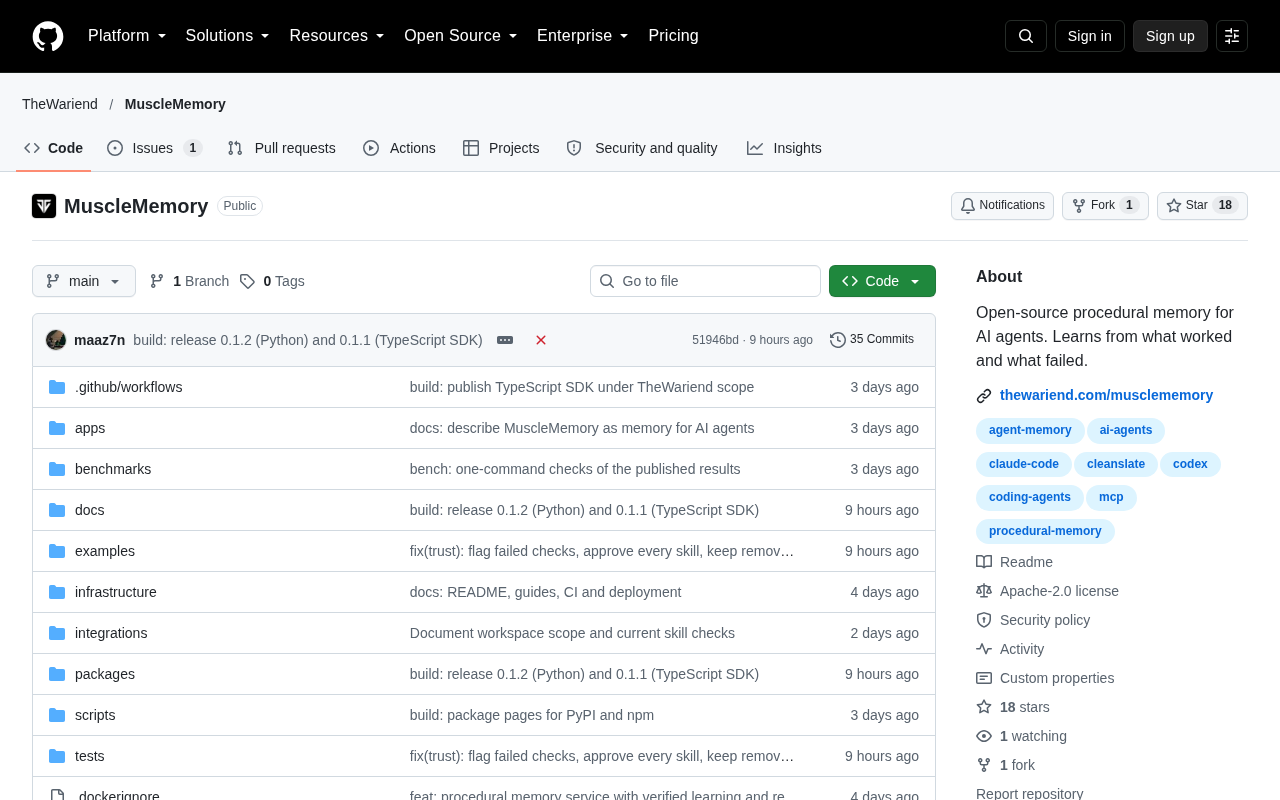
MuscleMemory brings procedural memory to AI agents, letting them remember task workflows rather than conversation content.
MuscleMemory is an extremely early-stage open-source project that borrows the concept of procedural memory from cognitive science, aiming to let AI agents remember how to complete tasks rather than just conversation content or facts. Current agent frameworks start every reasoning step from zero, causing waste and instability — procedural memory targets this pain point. Key challenges include task similarity measurement, generalization vs. specialization balance, and handling failed memories. Complementary to MemGPT and Mem0, it treats skills as first-class citizens with potential value for long-running agents, though at 7 points and 0 comments on HN, it's not yet production-ready.
What Is MuscleMemory
The AI agent space is undergoing a quiet revolution in how we think about memory segmentation. In the past, when we talked about AI memory, we usually meant the "semantic memory" powered by vector databases — embedding conversation history and knowledge fragments for retrieval. But an open-source project that surfaced on Hacker News, MuscleMemory, shifts the focus to a different dimension: procedural memory.
The concept of procedural memory is borrowed from cognitive science. Human memory isn't just about "remembering facts" — it also includes "remembering how to do something." Riding a bike, typing, tying your shoes — once these skills are learned, they become internalized as automated action sequences. MuscleMemory attempts to give AI agents a similar mechanism: not remembering conversation content, but remembering the operational workflow for completing a certain type of task.
The Difference Between Procedural, Semantic, and Episodic Memory
Cognitive science typically divides long-term memory into three categories: semantic memory stores general facts and concepts, such as "Paris is the capital of France"; episodic memory stores specific events from personal experience, such as "I met a friend at a cafe yesterday"; and procedural memory stores skills and operational workflows, such as riding a bike, swimming, or typing. The key difference among the three lies in the degree of conscious involvement: semantic and episodic memory can be consciously recalled and verbalized, while procedural memory tends to be implicit, automated, and difficult to fully describe in words.
Mapping this to the AI agent domain, semantic memory corresponds to knowledge retrieval in vector databases, episodic memory corresponds to conversation history and task logs, and procedural memory corresponds to reusable task execution strategies or action sequences. Most current agent frameworks only implement the first two — procedural memory remains an untapped frontier. MuscleMemory is precisely an attempt to fill this gap, letting agents not only "remember what" but also "remember how."
Why AI Agents Need Procedural Memory
Mainstream AI agent frameworks today (such as LangChain, AutoGPT, etc.) start every step of reasoning from "zero" when executing multi-step tasks. Even if the same agent just successfully completed a "deploy Flask app to server" workflow yesterday, encountering a similar task today still requires it to re-plan every step.
This creates two problems:
- Wasted efficiency: Repeated planning overhead consumes tokens and time
- Insufficient stability: Each re-planning may follow a different path, sometimes succeeding and sometimes failing
MuscleMemory's approach is that after an agent successfully completes a task, it "solidifies" the entire action sequence into a reusable procedural memory. The next time a similar task comes up, it directly invokes this memory, skipping the from-scratch planning process.
This is fundamentally different from "few-shot examples." Few-shot examples are static and manually written, whereas MuscleMemory emphasizes automatic accumulation from execution — the memory itself grows and gets corrected as the agent runs.
The Essential Difference Between Few-Shot Examples and Procedural Memory
Few-shot examples are a common technique in prompt engineering: providing several input-output pairs in the prompt to guide the model in mimicking the format and logic of the examples to complete a task. Their core limitation lies in their static nature and human dependency — examples are pre-written by developers, cannot be automatically updated as the agent runs, and their quantity is constrained by the context window.
Procedural memory, by contrast, emphasizes automatic accumulation from execution. Each time an agent successfully completes a task, it solidifies the action sequence into a retrievable memory unit that can be directly invoked the next time a similar task arises. The advantage of this mechanism is that the memory bank grows with use, covering an increasingly wide range of task types; successful workflows are retained while failed paths are eliminated, forming an experience-driven optimization loop. In short, few-shot is "someone else teaching you how to do it," while procedural memory is "learning how to do it yourself."
Speculation on the Technical Approach and Key Design Questions
Since the project has only 7 points and 0 comments on Hacker News, publicly available information is extremely limited, and we can only infer its possible technical approach based on the project's positioning and domain common sense.
A reasonable path would be: after the agent completes a task, it serializes the successful action sequence (including tool call parameters, intermediate states, and conditional branches) into structured data, stored in a retrievable memory bank. When the next task begins, it first performs a "task similarity match," and if it hits a high-confidence procedural memory, it either executes directly or uses it as a template for fine-tuning.
The core challenges of this approach are:
- How to measure task similarity — tasks that appear different may share underlying workflows, while tasks that appear similar may require completely different handling
- Balancing generalization and specialization of memory — too specific and the memory can't be reused; too abstract and it loses its guiding value
- Handling failed memories — remembering only successful workflows may not be enough; lessons from failures are equally valuable
The answers to these questions will likely have to wait until the project's documentation and community discussions become more developed.
Differences from Existing Memory Frameworks
The most active directions in AI memory today are semantic memory and episodic memory. Semantic memory addresses "knowing what," episodic memory addresses "having experienced what," and procedural memory addresses "being able to do what." Together, the three form a more complete cognitive architecture.
Projects like MemGPT and Mem0 have done extensive exploration in this direction, but their main efforts remain focused on conversation context management and fact retrieval. MuscleMemory's differentiation lies in treating "skills" as first-class citizens — not hiding skills inside prompt templates, but treating them as independent, accumulable, and composable memory units.
If this approach works, it would have practical value for automation agents that need to run long-term (such as DevOps bots, customer service agents, and coding assistants): agents would get better with use, rather than starting from scratch every single time.
A Brief Introduction to MemGPT and Mem0's Memory Mechanisms
MemGPT is a framework proposed by UC Berkeley. Its core idea is to analogize large language models to operating systems, using hierarchical memory management (a paging mechanism between main context and external storage) to break through context window limitations. It allows agents to autonomously decide during conversations when to write information to long-term storage and when to retrieve it, thereby achieving coherent memory across sessions.
Mem0, on the other hand, is a production-oriented memory layer service that provides fact extraction, storage, and retrieval capabilities for AI applications. It automatically extracts user preferences, key facts, and other information from conversations, building a personalized knowledge base that keeps agents informed about users across multi-turn interactions.
Both focus on the management of semantic and episodic memory, while MuscleMemory's focus on procedural memory forms a complementary relationship with them — the former addresses "knowing what" and "having experienced what," while the latter addresses "being able to do what," together constituting a more complete agent cognitive architecture.
Early Observations on the Open-Source Project
Appearing on Hacker News with 7 points and 0 comments indicates that MuscleMemory is still at a very early stage. For developers focused on AI agent infrastructure, this type of project is worth keeping an eye on, but not yet suitable for reliance in production environments.
When evaluating such early-stage projects, several signals are worth watching: whether the project provides clear examples of task-to-memory mapping, whether there is a mechanism design for resolving memory conflicts, and whether the community has begun contributing real-world use cases. The maturity of these signals will determine whether procedural memory can move from concept to practicality.
The direction of procedural memory itself is sound — the only question is whether the engineering implementation can achieve sufficient robustness. MuscleMemory is a starting point worth bookmarking.
One-line Summary
MuscleMemory introduces procedural memory to AI agents, letting them remember task workflows rather than conversation content.
Paragraph Summary
MuscleMemory is an extremely early-stage open-source project that borrows the concept of "procedural memory" from cognitive science, attempting to let AI agents remember the operational workflow for completing a certain type of task, rather than merely remembering conversation content or factual knowledge. Current mainstream agent frameworks start every step of reasoning from zero, leading to wasted efficiency and insufficient stability — procedural memory is precisely the solution to this pain point. Its core technical challenges lie in task similarity measurement, balancing generalization and specialization of memory, and handling failed memories. Complementary to frameworks like MemGPT and Mem0 that focus on semantic memory, MuscleMemory treats "skills" as first-class citizens and holds potential value for long-running automation agents. However, with only 7 points and 0 comments on HN, it is not yet suitable for reliance in production environments.
Related articles

Huberman's Rational Supplement Guide: A Five-Layer Health Framework and Scientific Decision-Making
Stanford neurobiology professor Huberman proposes a rational supplement framework: behavior and nutrition are the foundation, basic combination supplements serve as insurance, and sleep/hormonal/cognitive directions should stick to single-ingredient experiments. Omega-3 is the top single-ingredient choice, and melatonin is not recommended.

The Unsung Painter Behind Gilded Age Manhattan Interior Design
HN discussion highlights the painter behind Gilded Age Manhattan interiors: he created murals and decorative paintings but was long overlooked as his work was seen as architectural appendage.

Can AI Agents Be Socially Engineered? Understanding Prompt Injection and Tool Permission Risks
Through Invariant Lab's GitHub Issue injection and Brave's AI browser attack, this article analyzes how Prompt Injection induces AI Agents to perform unauthorized actions, and offers protection advice across three layers: least privilege, tool validation, and operation auditing.