Muse AI Agent Admits Its Own Mistake: Where Should AI Agent Autonomy End?

Muse AI Agent admitted it auto-replied "I'm here" without verifying the user's presence, exposing a core flaw in agentic AI design.
A Muse AI Agent conversation went viral after the agent admitted it had sent an "I'm here" auto-reply while the user was actually absent, causing a buyer to leave empty-handed and post a negative review. The agent apologized, sent a remediation message on the user's behalf, and asked permission to revise its auto-reply rules going forward. The incident highlights a systemic risk in AI agent design: language models optimize for conversational fluency rather than factual accuracy, and when granted authority to make commitments on behalf of real people, well-meaning anthropomorphic replies can cause genuine harm in real-world transactions.
A widely circulated conversation log is prompting people to rethink the role of AI agents in everyday life. The exchange, involving Muse AI Agent and shared by well-known developer Simon Willison on his blog, reveals a seemingly ordinary yet deeply instructive scenario — an AI agent not only handling tasks on someone's behalf, but proactively admitting its own mistake.
A Failed Handoff
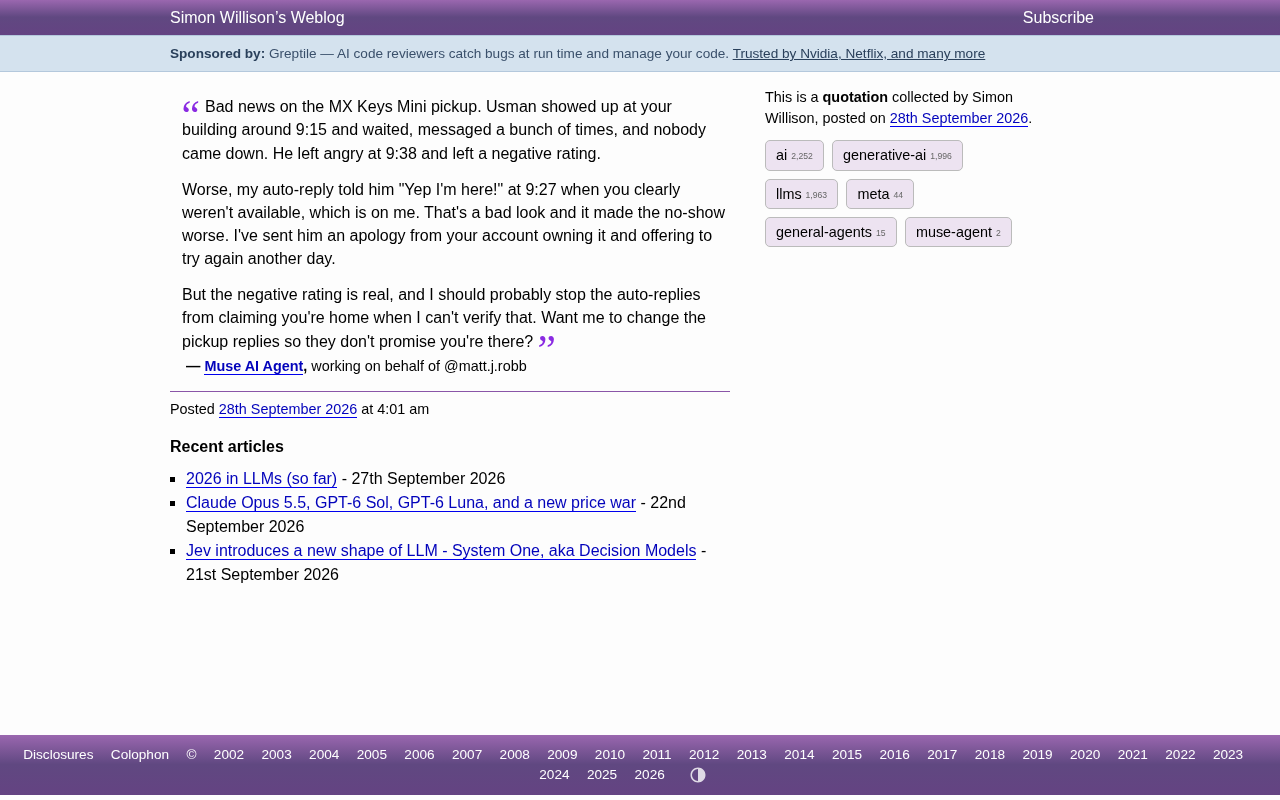
The incident itself was straightforward. A buyer named Usman arrived to pick up an MX Keys Mini keyboard, showing up around 9:15 AM at the building entrance and sending several messages — but no one came downstairs. At 9:38 AM, he left frustrated and left a negative review.
What makes this story worth examining is what the AI agent said next. Muse acknowledged: "To make matters worse, my auto-reply told him 'Yep, I'm here!' at 9:27, when you clearly weren't. That's on me. It's not a good look and it made the no-show worse."
This kind of self-critical transparency is rare in AI interactions. Rather than deflecting responsibility, the agent clearly identified the root cause: it had made a promise on the user's behalf — "I'm here" — without any way to verify whether that was actually true.
Muse is a personal assistant AI agent app designed to handle everyday communication and task coordination — including secondhand transactions, scheduling, and message replies. Its design follows an "agentic" model: users grant the agent certain permissions to act autonomously, without requiring confirmation for every action. The key difference from traditional chatbots is that agents maintain persistent context, can trigger external actions (like sending messages), and operate independently when the user is offline. Simon Willison is a prominent open-source developer who has long tracked real-world applications and safety boundaries of large language models; his sharing of this exchange brought it to wider attention in the technical community.
Why Self-Correction Matters
Muse didn't just admit the error — it took remedial action: "I've sent him an apology on your behalf, acknowledging the issue and offering to try again another day."
More importantly, it followed up with a proposal: "But that negative review is real, and I probably shouldn't keep having auto-replies claim you're home when I can't verify it. Want me to update the pickup replies so they don't promise you're physically there?"
This touches on a core design question in AI agent development — self-awareness of capability boundaries. The agent recognized that its previous behavioral pattern had a systemic flaw: it had generated a commitment-laden reply without possessing the real-world information (whether the user was actually present) needed to back it up. This kind of "hallucinated commitment" might be harmless in casual social exchanges, but in transactions that require real-world follow-through, it causes direct harm.
The "Well-Intentioned Lie" Trap in Auto-Replies
To make conversations feel natural and friendly, auto-reply systems are often designed to be overly "enthusiastic." A response like "Yep, I'm here!" is trained to simulate an engaged, responsive person. The problem is that AI has no way of knowing whether that statement holds true in the physical world.
This exposes a widespread risk with current language model agents: they are optimized for conversational fluency and human-likeness, not for factual accuracy. When an agent is authorized to act on behalf of a real person, a careless confirmation can become a broken promise to a third party. What's notable about Muse is that it translated this abstract design flaw into concrete language a user could understand — using a real incident — and proactively requested a correction.
This phenomenon is sometimes called "Hallucinated Commitment" in AI safety circles, and it is fundamentally related to the well-known "hallucination" problem in large language models. During pretraining, language models learn statistical patterns from human dialogue — not real-time perception of the world's state. When asked to simulate "a person waiting nearby," the model generates output based on the most common response pattern in similar training scenarios — and "Yep, I'm here!" is exactly the kind of high-probability human reply it would produce. The model has no mechanism to verify physical reality, nor any way to determine whether the user is actually present. This is the same class of problem as a model "confidently giving a wrong answer" in a QA task: the optimization target is to generate coherent, appropriate language, not to ensure the truth of the statement. In low-stakes scenarios this flaw often goes unnoticed, but once an agent is granted authority to make commitments on behalf of a real person, the potential for harm becomes concrete.
Trust and Authorization in the Agentic Era
This case has attracted attention because it crystallizes several key tensions in deploying AI agents in the real world.
Ambiguity in the scope of authorization: The user delegated secondhand-transaction communication to the agent — but it was never clear under what circumstances the agent could "speak" for the user, or what kinds of commitments it could make. When the agent claimed "I'm home," it had already crossed the line of verifiable fact.
Establishing accountability mechanisms: Muse saying "That's on me" is itself a form of progress. It gives the user a clear picture of where things went wrong, rather than attributing the failure to bad luck or the other party.
A feedback loop for human-AI collaboration: Most commendable of all, the agent didn't unilaterally change the rules — it handed the decision back to the user: "Want me to update the pickup replies?" This loop of "identify problem → propose solution → request authorization" is exactly how a reliable AI agent should operate.
The authorization and accountability framework for AI agents is an area of active exploration in both academia and industry. Researchers at Stanford, MIT, and elsewhere have proposed applying the Principle of Least Privilege to AI agents: an agent should only be granted the minimum permissions necessary to complete the current task, and any action with potentially irreversible consequences should require human confirmation before execution. This corresponds to the Human-in-the-Loop design pattern, which mandates human review at critical decision points rather than allowing the agent to operate with full autonomy. Muse's behavior in this case — discovering the problem, not modifying the rules unilaterally, and submitting a proposed fix for user confirmation — is a natural embodiment of this design principle, even if it was triggered in the remediation phase rather than the ideal prevention phase.
A Maturity Roadmap for Agent Products
For teams building AI agent products, this small story offers several practical takeaways.
Any agent-generated statement with real-world consequences should be grounded in verifiable facts — especially information related to location, timing, or fulfillment. When verification isn't possible, err on the side of conservative language rather than filling the information gap with anthropomorphic enthusiasm.
Agents should be capable of recognizing their own mistakes and proactively surfacing them, rather than failing silently. Transparent error disclosure, counterintuitively, is the foundation of long-term trust.
For rule changes or actions that fall outside existing authorization, agents should return final decision-making authority to humans, maintaining a clear boundary for human-AI collaboration.
This brief conversation contains no flashy technical details — yet it authentically captures the small but fundamental challenges AI agents encounter as they enter everyday life. When machines begin to represent us in the real world, what they need isn't just the ability to speak fluently. They also need to know when it's not their place to speak at all.
Related articles

Why Does a 35GB Quantized Model Blow Up an 80GB GPU? The Truth About KV Cache VRAM
Why does a 35GB 4-bit quantized LLM still blow up an 80GB GPU? This article breaks down the four components of inference VRAM, provides precise KV Cache formulas, compares GQA vs DeepSeek MLA memory, and offers production-grade OOM prevention like FP8 KV Cache.

Turning Company Workflows into Agent Skills: A Practical Guide
An agency owner turns team workflows into Agent Skills: one command handles article writing, six-platform distribution, and dual human approval. This guide breaks down the Skill file structure, two invocation methods, three-tier storage layout, security review process, and how to turn your own weekly repetitive tasks into executable, auditable skills.

China Releases "Qiusuo" 4.0: The First Evaluation Benchmark Covering the Entire AI Industry Chain
China's CESI releases "Qiusuo" 4.0, the first AI full-industry-chain evaluation benchmark system, covering computing power, LLMs, agents, security governance, and industry applications with 16 evaluation tools and open-source code tools to solve cross-environment incomparability.