Muse Product Update Roundup: Connectors, Phone Call Beta, and Mac App Launch

Muse rolls out connectors, phone call beta, and Mac computer use as it pushes toward a full AI Agent platform.
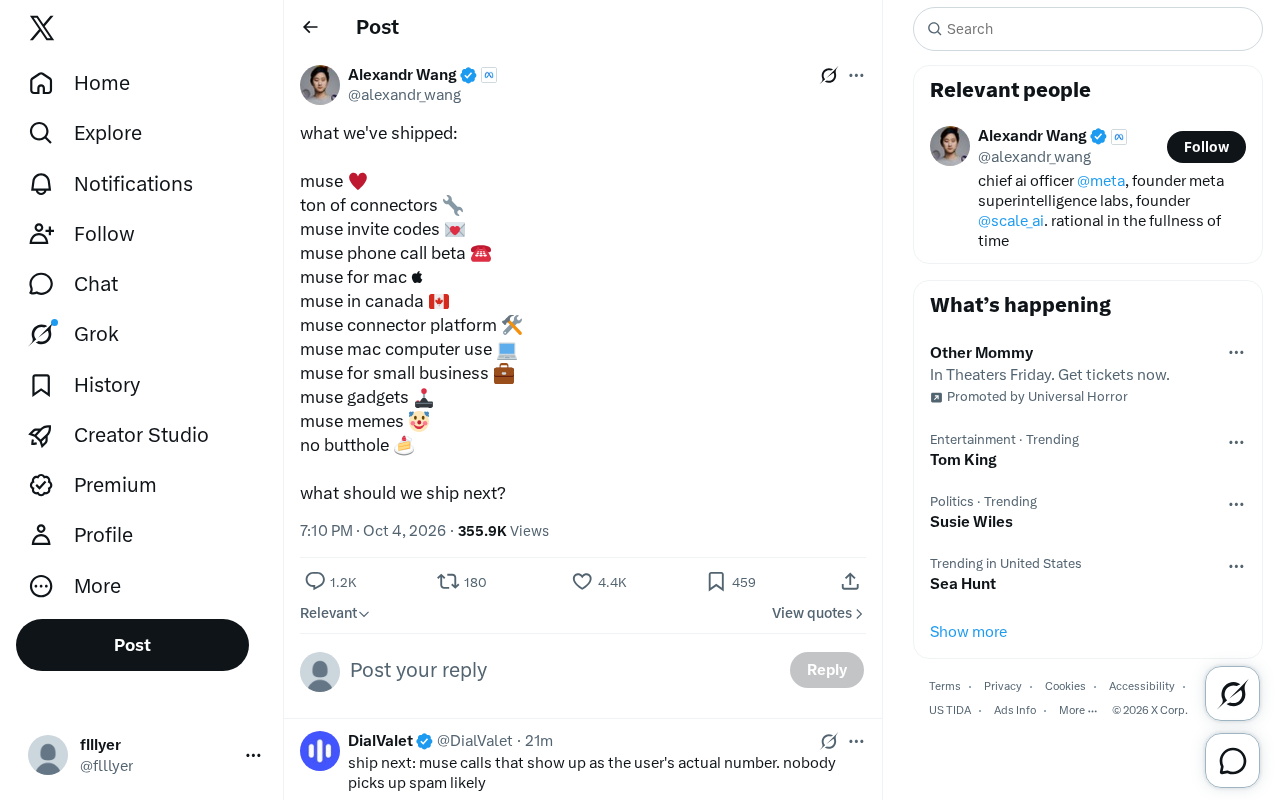
Muse AI assistant recently published a product update list covering feature enhancements, platform expansion, and ecosystem development. Key highlights include a large batch of connectors and a standalone connector platform to enable open integrations, a phone call beta for real-world task delegation, and Mac computer use capabilities pointing toward GUI Agent functionality. Platform-wise, Muse launched a Mac client, entered Canada, and released a small business edition, while using invite codes to manage growth. Overall, the update reflects a dual-track strategy: deepening Agent capabilities while broadening its connector ecosystem — though the maturity of each feature still awaits further verification.
AI assistant Muse recently published a product update list on social media, covering everything from new feature launches to platform expansions. Though presented in a lighthearted and playful tone, the list reveals the product's continued push toward broader functionality and wider platform coverage.
What New Capabilities Has Muse Released?
Based on the official update list, Muse's latest round of updates focuses on three areas: feature enhancements, platform expansion, and ecosystem development.
The most attention-grabbing items are the large number of connectors being added and the accompanying connector platform. Connectors typically allow an AI assistant to integrate with more third-party services and data sources, enabling users to perform cross-application tasks from a single entry point. For an AI assistant positioned as a productivity tool, the breadth of connector support often directly determines its practical value. Launching a standalone connector platform signals that Muse aims to build a scalable integration ecosystem rather than relying on the team to manually support each service one by one.
Another noteworthy addition is the Muse phone call beta. Giving an AI assistant the ability to make phone calls is a hot direction in the current AI Agent space — it means the assistant can handle real-world interactions like scheduling appointments or making inquiries on behalf of the user, moving beyond pure text conversation into genuine task delegation.
Connectors are a key architectural concept in the AI assistant ecosystem, similar to the "integration modules" found in automation tools like Zapier or Make. Each connector encapsulates the logic for authenticating and exchanging data with a specific third-party service (such as Google Calendar, Slack, or Salesforce), allowing the AI assistant to read from or write to external systems without requiring the user to manually relay information. Launching a standalone connector platform typically means opening up integration standards to third-party developers, allowing external teams to build connectors for their own products and list them on the platform — a classic transition from a "closed tool" to an "open ecosystem." OpenAI's GPT Actions and Salesforce's MuleSoft both follow similar models. The number and quality of connectors are often key benchmarks for enterprise AI assistant competitiveness.
A Broad Expansion in Platform Coverage
Beyond feature updates, Muse has also taken significant steps to expand its platform footprint.
The launch of Muse for Mac marks the product's extension from mobile or web into desktop operating systems. Going further, Mac computer use — the ability for AI to directly control the desktop environment, click through interfaces, and execute cross-application tasks — is one of the most talked-about directions in AI today. If this capability is as described, it means Muse is positioning itself as an agent capable of autonomously completing tasks on the desktop.
On the regional front, Muse is officially entering the Canadian market, indicating a gradual expansion of its service territory. On the user segment front, the team has also launched Muse for small business, signaling that the product is beginning to move beyond individual users into B2B scenarios.
"Mac computer use" corresponds to a technical direction known as GUI Agent or Computer Use. Unlike traditional integrations that rely on API calls, this capability allows AI to perceive the screen state via screenshots and simulate mouse clicks and keyboard inputs to control any desktop application — even if the target app exposes no programmatic interface. Anthropic was among the first to demonstrate this capability in Claude in late 2024, coining the term "Computer Use," and the industry quickly followed. The core value of this approach lies in its universality: the AI doesn't need to be customized for each application and can theoretically control any interface a human can. However, current challenges include high operation latency, elevated error rates, and significant risks around security and permission management, which is why most products in this space remain in testing stages.
Growth and Community Signals
The update list also includes several signals related to growth and community building.
The introduction of Muse invite codes is a classic strategy for growth management and user filtering. Controlling registration pace through invite codes creates a sense of scarcity and buzz, while also helping manage server load during a period of product refinement.
Items like Muse gadgets (branded merchandise), Muse memes, and the clearly tongue-in-cheek closing line "no butthole 🍰" reflect the team's preference for a youthful, community-oriented brand tone. This type of content is generally designed for social sharing and building rapport with users, rather than serving as a serious feature announcement.
How to Read This Update List
It's worth noting objectively that this list comes from a brief social media post, with most entries presented only as keywords and emoji, lacking specific feature details, release timelines, or real-world test data. As a result, we can only interpret the general direction at this stage — the maturity and actual user experience of each feature remains to be seen.
Looking at the overall strategy, Muse's update direction closely aligns with the prevailing trends in the AI assistant industry:
- Evolving toward Agent capabilities: Phone calling and Mac computer use both point toward having AI execute real-world tasks on behalf of users.
- Building an open ecosystem: The connector and connector platform initiatives are essential to breaking down data silos and increasing practical utility.
- Expanding the user base: Extending to desktop, new regions, and small business scenarios suggests the product is moving from early-adopter territory toward scale.
The closing question "what should we ship next?" is a classic community engagement move, inviting users to participate in product roadmap discussions. This open approach to operations helps surface genuine user needs while maintaining the involvement of early adopters.
For those following the AI assistant space, the most noteworthy takeaway from this Muse update isn't any single feature — it's the product strategy it reveals: a dual-track push toward greater depth in Agent capabilities and broader reach through a connector-driven, multi-platform ecosystem. Whether these capabilities deliver in practice will require more detailed official documentation and hands-on user testing to confirm.
Related articles

ChatGPT Space Launches: Team Collaboration and New Pages Features Explained
ChatGPT Space is OpenAI's new team collaboration feature with Pages, real-time collaboration, and Slack/Google Drive sync. We break down its privacy design, multi-platform integration, and the full workflow from conversation to document.

Migrating Apache Spark UDFs to GPU Acceleration with AI Agents
NVIDIA developer blog explains how AI Agents rewrite Apache Spark UDFs for GPU acceleration, covering migration criteria, agent rewriting and verification workflows, plus pitfalls like result consistency and CPU-GPU transfer overhead.

Zed Editor v0.40.4-rc2 Released: Usage Credits Now Available Without Upgrading
Zed editor releases v0.40.4-rc2, allowing users to use usage credits for AI features without upgrading to a paid plan, lowering the trial barrier.