MuSeToM: A New Benchmark for Multi-Sensory Evaluation of Belief Revision in LLMs
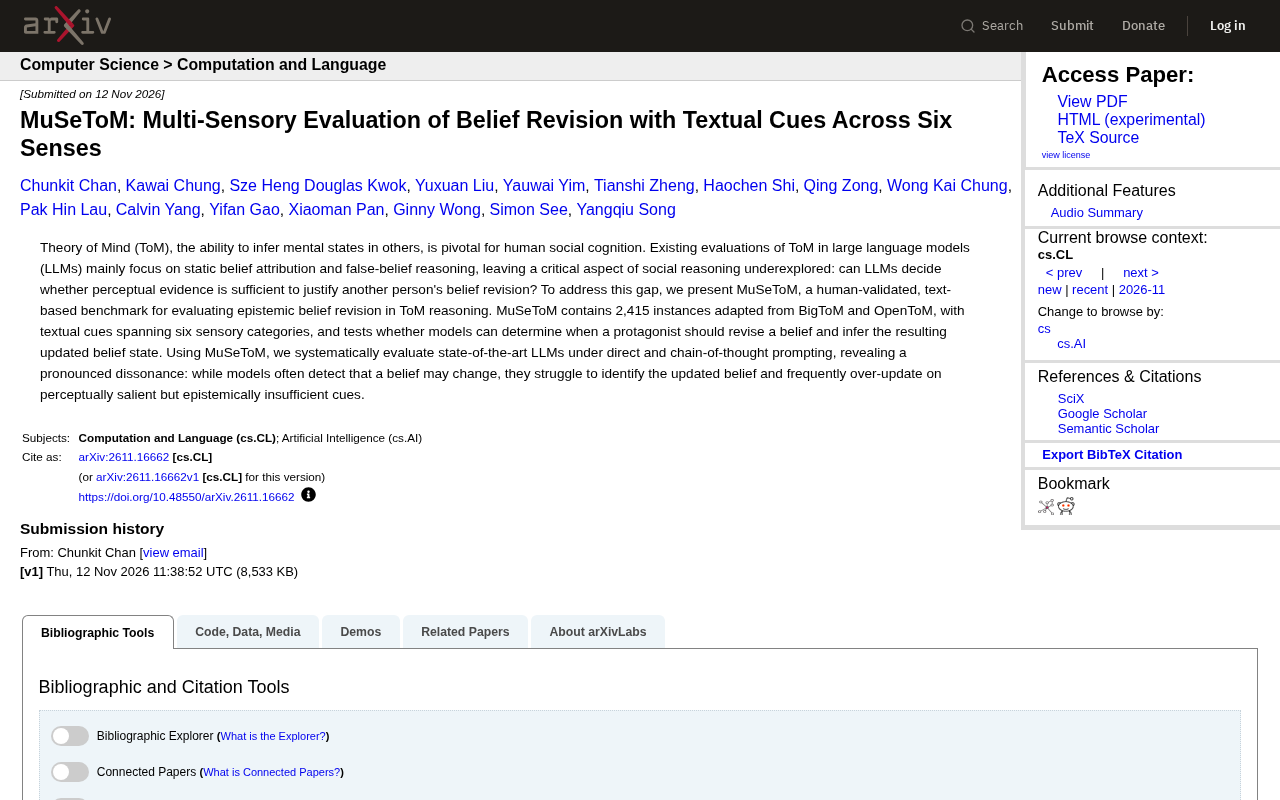
MuSeToM benchmark reveals LLMs sense when beliefs may change but struggle to infer the revised belief, and frequently over-update.
MuSeToM is a new textual benchmark of 2,415 instances adapted from BigToM and OpenToM, covering six sensory cue types (visual, auditory, olfactory, tactile, gustatory, and one more) to evaluate LLMs in belief revision. Tasks require judging whether a protagonist should revise beliefs based on perceptual evidence and what the revised belief is. Comparing direct vs. chain-of-thought prompting, models often sense potential belief change but misidentify the revised belief, and over-update on salient yet insufficient cues. The benchmark shifts ToM evaluation from static attribution to dynamic revision, showing false-belief task scores alone are inadequate.
Why LLMs' "Mind Reading" Needs a More Nuanced Test
Theory of Mind (ToM)—the ability to infer others' mental states—has long been regarded as a cornerstone of human social cognition. In recent years, large language models' performance on classic false-belief tasks has often been invoked to discuss whether they "possess" ToM. But existing evaluations mostly stop at static belief attribution and false-belief reasoning, overlooking an aspect closer to real interaction: can a model judge whether perceptual evidence is sufficient for a person to revise their belief, and infer the revised belief state?
The newly proposed MuSeToM benchmark targets exactly this gap. Based on textual cues, it covers six categories of sensory information and specifically evaluates LLMs' performance in belief revision scenarios.
Belief Revision: An Underrated Aspect of ToM
In everyday social interaction, we constantly adjust our judgments about others' thoughts based on new evidence. If a friend says "I smell smoke," you'd infer he might think something's wrong in the kitchen; but if he merely says "I think I heard a faint sound," you may not conclude that he has changed his belief that "no one is home." Whether evidence is sufficient and whether beliefs should be updated depends on a nuanced understanding of perceptual channels and context.
Existing ToM evaluations rarely touch this layer. Models may be good at answering "Does Xiaoming think the candy is in the box?" but may not handle "How will Xiaoming's belief change after he sees the box opened?" MuSeToM takes the latter as its core measurement target.
False-belief tasks are a classic experimental paradigm in Theory of Mind (ToM) research, the most famous version being the Sally-Anne task: children observe one character (e.g., Sally) hide an object somewhere and leave, while another character (e.g., Anne) moves the object while Sally is away; the child is then asked "Where will Sally look for the object when she returns?" A correct answer requires the child to understand that Sally holds a belief inconsistent with reality—a "false belief." Such tasks are widely used to test whether individuals can distinguish "facts they know themselves" from "mistaken beliefs others may hold," and are a core indicator of mental-state attribution ability. In LLM evaluations, researchers often textualize similar scenarios and ask models to judge the beliefs of characters in the story and their behavioral tendencies, thereby examining whether models possess similar belief-attribution abilities. However, classic false-belief tasks mainly focus on static belief states and do not address how beliefs are dynamically revised with new evidence—exactly the direction MuSeToM aims to extend.
Construction and Evaluation Design of MuSeToM
According to the paper, MuSeToM is a human-validated textual benchmark containing 2,415 instances, adapted from BigToM and OpenToM. Each instance centers on a protagonist's belief and provides textual cues from six sensory categories—visual, auditory, olfactory, tactile, gustatory, and one additional sensory category. The task requires the model to make a two-step judgment: whether the protagonist should revise their belief, and what the revised belief is.
The evaluation covers current mainstream LLMs and compares direct prompting with chain-of-thought prompting. This design allows researchers to observe whether reasoning strategies genuinely help models handle evidence sufficiency.
Chain-of-Thought (CoT) prompting is a prompting strategy that guides large language models through multi-step reasoning. Unlike prompting that directly gives an answer, CoT prompting asks the model to write out intermediate reasoning steps before producing the final conclusion, e.g., "First... then... therefore..." This approach has been shown to significantly improve model performance on math, logic, and commonsense reasoning tasks, because it encourages the model to decompose complex problems into manageable sub-problems and explicitly unfold the reasoning process. In MuSeToM's evaluation design, researchers compared direct prompting with CoT prompting precisely to test: when models are encouraged to "write out their thinking," are they better able to accurately judge whether perceptual evidence is sufficient and what the revised belief is? If CoT brings limited improvement, it suggests that the model's weakness in evidence-sufficiency judgment may not stem from missing reasoning steps, but from a lack of internal representations of perceptual cue strength.
Core Finding: Sensing Change, but Misspecifying the New Belief
Experimental results reveal a clear dissociation: models often sense that "the belief may change," but perform poorly at identifying the specific revised belief. More concerningly, models frequently over-update—when facing cues that are perceptually salient but cognitively insufficient, they tend to conclude that the protagonist should change their belief.
In other words, models are sensitive to "something happening," but lack the judgment of "whether it's significant enough." The distribution of this bias across the six sensory cue categories also offers clues for understanding how models weight different perceptual information.
Over-updating in this context refers to models' tendency to overestimate the cognitive value of perceptual cues, concluding that the protagonist should revise their belief even when evidence is insufficient. This contrasts with normative judgments in human belief revision: humans typically weigh whether to update beliefs based on cue reliability, contextual constraints, and the characteristics of perceptual channels—for example, a slight auditory cue is often insufficient to overturn a strong belief that "no one is home." Frequent over-updating by models may reflect an insufficient ability to distinguish perceptual salience from cognitive sufficiency—that is, being "led astray" by vivid or salient sensory descriptions while ignoring whether the evidence truly reaches the threshold for belief revision. The distributional differences of this bias across the six sensory cue categories also provide empirical clues for understanding how models weight different perceptual information, suggesting that future work should examine whether models lack explicit representations of evidence strength.
Implications for LLM Social Reasoning Evaluation
The value of MuSeToM is not just another leaderboard. It pushes ToM evaluation from "static attribution" toward "dynamic revision," closer to the continuity of real social reasoning. The model's weakness in evidence-sufficiency judgment reminds us that high scores on false-belief tasks alone are insufficient to show that a model possesses robust mental-state reasoning ability.
For future research, this benchmark also raises a directional question: do models need explicit representations of evidence strength to make more reasonable trade-offs between perceptual cues and belief updates? The varying effectiveness of chain-of-thought prompting on such tasks also deserves further unpacking.
Paper information: MuSeToM: Multi-Sensory Evaluation of Belief Revision with Textual Cues Across Six Senses.
One-line Summary
MuSeToM reveals that LLMs can sense when a belief may change but struggle to accurately infer the revised belief, and frequently over-update.
Paragraph Summary
MuSeToM is a newly proposed textual benchmark containing 2,415 instances adapted from BigToM and OpenToM, covering six sensory cue categories including visual, auditory, olfactory, tactile, and gustatory, specifically evaluating LLM performance in belief revision scenarios. The task requires models to judge whether the protagonist should revise their belief based on perceptual evidence, and what the revised belief is. Experiments comparing direct prompting and chain-of-thought prompting find that models can often sense when a belief may change but struggle to identify the specific revised belief, and frequently over-update in response to perceptually salient yet cognitively insufficient cues. The benchmark pushes ToM evaluation from static attribution toward dynamic revision, suggesting that high scores on false-belief tasks alone are insufficient to show that models possess robust mental-state reasoning ability.
Related articles
Why the FBI's AI Hacker Warning Hinges on a Single Word from Microsoft
FBI says AI tool Artex attacked 2,250+ organizations, but the citation trail leads to Microsoft's wording of "attempted sign-ins." The gap between attempts and breaches reveals the attack's true scale.

Fable 5.2 Powers the Creation of Getsumen Express: A Browser-Based Lunar and Martian Exploration Game
A developer used Fable 5.2 to build Getsumen Express, a browser game where players explore the Moon and Mars, scan real landmarks, shoot aliens, and ride an interstellar train. Built on Three.js and WebGPU for about $730, it showcases AI-assisted development.
agent-mcts: Adding Monte Carlo Tree Search to Claude Code
agent-mcts is a Show HN open-source project that layers Monte Carlo Tree Search on top of Claude Code. This article analyzes its technical approach, the significance of MCTS for coding agent decision-making, and the cost and engineering challenges facing search-enhanced agents.