Music Dawn: One-Tap Recording That Makes Every Musical Idea Sound Finished

Music Dawn is an inspiration recorder for musicians — one-tap recording delivers a finished sound, with three-device sync.
Music Dawn is a music inspiration recording app that debuted on Product Hunt with 79 upvotes, positioned as "a musician's recorder." Its core value proposition: one-tap recording instantly delivers a "finished-sounding" result, reducing the psychological friction of listening back to rough demos and preventing ideas from being dismissed by murky audio quality. It covers iPhone, iPad, and Apple Watch, with all takes synced to a unified library; Apple Watch's raise-wrist recording solves the pain of not having a device at hand when inspiration strikes. The business model is free download with optional Pro, with the free entry preserving an inspiration tool's core attribute of "available anytime." Strategically, it deliberately avoids DAWs, collaboration platforms, and pro recording tracks, focusing on the overlooked "recorder" category, differentiated by the finished-ness of its sound processing. The risk: if the sound processing isn't impressive enough, it can easily be seen as a voice memo replacement.
The Pain Point of Capturing Inspiration: The Gap Between a Phone Recording and a "Finished" Sound
Every musician has been there: walking down the street, in the shower, or half-asleep, when a melody suddenly pops into your head. You frantically pull out your phone, open Voice Memos, and hum a few bars — then on playback all you hear is a vague "hmm-hmm-ah-ah" and a murky rhythm. You caught the idea, but you lost the feeling.
Music Dawn wants to solve exactly this disconnect. The app, which launched on Product Hunt with 79 upvotes and a #19 ranking, has a very clear positioning: a recorder built for musicians — one-tap recording, instantly hear a "finished" sound, with all takes synced across devices in one library. It supports iPhone, iPad, and Apple Watch, is free to use, with Pro available as an option.
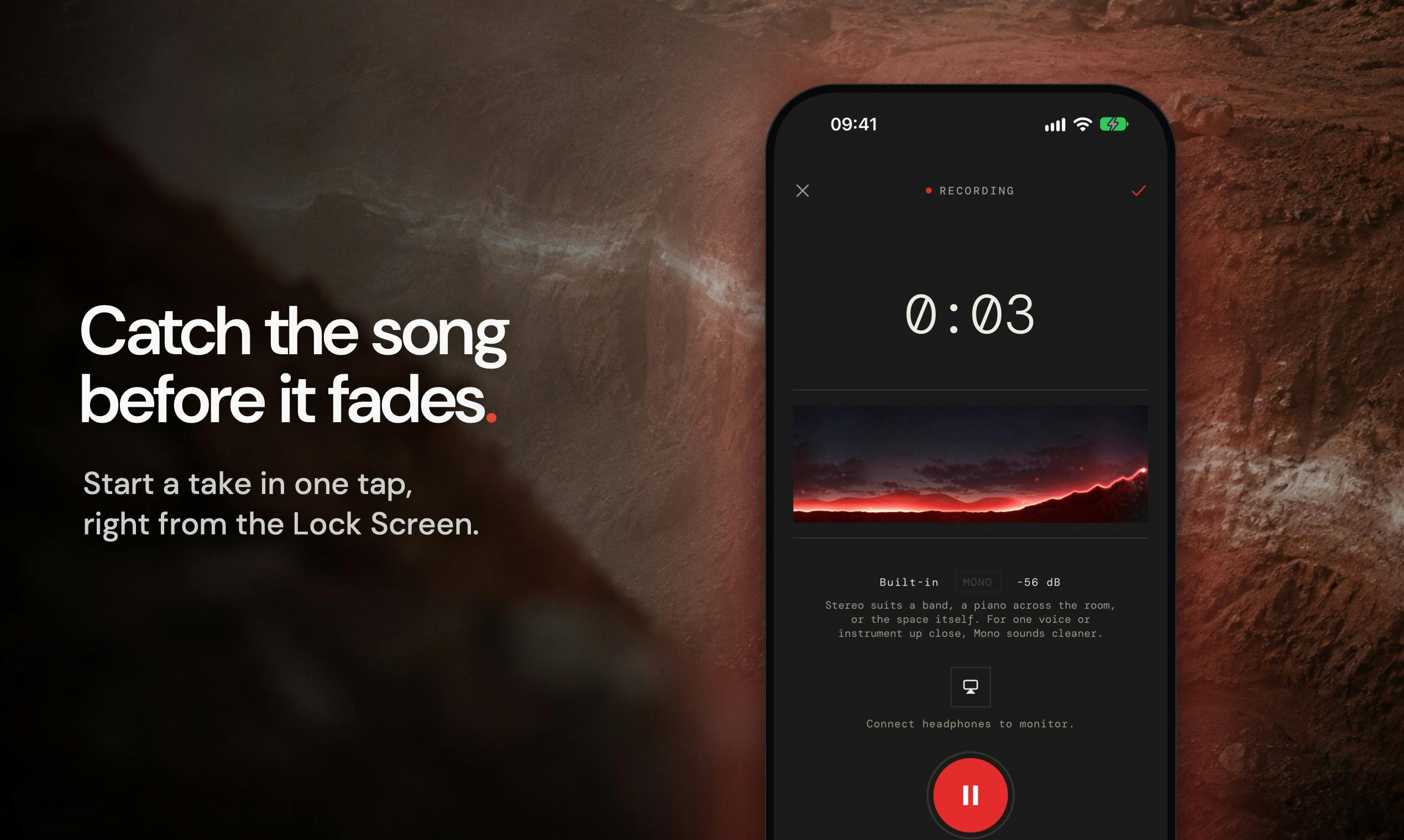
The cleverness of this positioning is that it doesn't try to be a DAW (Digital Audio Workstation) or a social sharing platform. It cuts into the extremely narrow entry point of "idea capture," but differentiates itself from ordinary voice memos with the value proposition of "sounds like a finished track."
The limitations of Voice Memos: The built-in voice memo apps on phones are essentially designed for "recording information." Sampling rates are typically 22.05kHz or 44.1kHz, but they lack gain control, noise reduction, and frequency response processing optimized for music recording. The low-frequency resonance and breath details of a vocal hum are easily lost in compressed encoding, especially when ambient noise mixes in. The playback result is worlds apart from the melody in your head. This "recording distortion" is one of the main technical reasons musicians lose their inspiration, and it's the core gap Music Dawn tries to fill with a preset sound processing chain.
The barrier of DAWs: DAWs like Logic Pro and Ableton Live are the core tools of professional music production, but starting them up requires choosing a project template, setting up input/output, and loading tracks — there are a dozen or so steps between "wanting to record" and "being able to record." For capturing a fleeting inspiration, this process itself is the biggest enemy. Music Dawn's "one-tap recording" targets exactly this friction point, compressing the operation of recording music down to a single click.
What Does "Sounds Like a Finished Track" Actually Mean?
This is Music Dawn's most core yet most ambiguous statement. From the product description, it's most likely not adding effects in real time during recording — that would introduce latency and break the "one-tap" experience. A more likely approach: after recording is complete, automatically apply a preset sound processing chain so the dry vocal immediately has a certain "release-grade" quality.
For musicians, the value of this feature isn't about replacing post-production — it's about reducing the psychological friction when listening back. A rough demo recording and a recording with basic spatial depth and dynamic processing give completely different levels of creative confidence. Many ideas are rejected in the very moment of hearing back that murky audio.
This also explains why it emphasizes "every idea sounds finished" rather than "sounds professional." Finished-ness is a subjective judgment, not a technical metric.
Common components of a sound processing chain: A preset processing chain that makes a dry vocal "sound finished" typically includes several stages: noise reduction/de-essing (reducing ambient and lip/teeth noise), compression (narrowing dynamic range for more consistent volume), EQ (cutting muddy low frequencies, boosting clarity), and reverb or delay (creating a sense of space). In professional post-production, these require manual parameter tuning, but if Music Dawn packages them into automatic presets, it can complete the perceptual leap "from demo to release" without the user noticing. The technical challenge: different vocals and different humming styles require different processing parameters, and a fixed preset may actually have negative effects on certain voices.
Cross-Device Sync: The Reality of a Musician's Workflow
Music Dawn's choice to cover iPhone, iPad, and Apple Watch is the result of understanding how musicians actually work.
When inspiration strikes, you use whatever device is at hand. The inclusion of Apple Watch is especially noteworthy — while running, walking, or doing chores, you can raise your wrist and tap to record without pulling out your phone. This extremely low-friction capture method is precisely what inspiration tools should solve. According to developer Ted Broberg on the Product Hunt page, all takes sync to a unified library, meaning devices are just entry points and the work is continuous.
{iPad is suitable for organizing and listening back when you sit down, iPhone is the daily workhorse, and Watch handles the moments when "there's no time to pull out your phone." The three each serve their own role, rather than being simple feature duplication.
Audio recording capability on Apple Watch: Apple Watch has had a built-in microphone since Series 4, supporting recording through watchOS's AVAudioRecorder API, but limited by device size and power consumption, its recording quality is typically lower than iPhone, and early versions had strict limits on recording duration and background operation for third-party apps. If Music Dawn can achieve "raise wrist and record" on Watch and sync to a unified library, it needs to solve issues like Bluetooth transmission bandwidth, local caching, and iCloud sync conflicts. How smooth this experience is directly determines whether it's truly usable in "no time to pull out your phone" scenarios.
Free + Pro Model: Restraint or Risk?
Music Dawn adopts a business model of free download with optional Pro. In the music tools space, this is a choice that requires courage. Audio processing itself has computational costs, especially if Pro involves more advanced sound processing or cloud sync storage.
But a free entry point is crucial for this kind of tool. The value of inspiration capture apps lies in "being there when you want to use it," and a paywall would directly kill that on-demand quality. The 79-vote Product Hunt momentum shows it has already reached a group of early musician users. The next question is: what incremental value does the Pro version offer to make free users willing to convert, without harming the completeness of the core experience?
Competitive Positioning: Who It Doesn't Compete With
Music Dawn's cleverness lies in avoiding several red oceans.
Not a DAW — no head-on competition with Logic or GarageBand; not collaboration — no fighting Splice or BandLab for social; not professional recording — no competing on audio quality specs with various audio interface apps. It targets the recorder — a category forgotten in the smartphone era — and then adds "finished-ness" as its one differentiator.
The risk is right there too: if the "finished-ness" processing isn't impressive enough, it can easily be categorized as "yet another voice memo replacement." But if that sound processing chain can genuinely make musicians feel the urge to say "this is usable" when listening back, it could become a fixed part of the inspiration workflow.
For independent musicians and beatmakers, it's worth downloading and trying — it's free, and it only takes a minute to judge whether it understands your sound.
One-line Summary
Music Dawn is an inspiration recorder built for musicians — one-tap recording delivers a finished-sounding result, with three-device sync.
Paragraph Summary
Music Dawn is a music inspiration recording app that launched on Product Hunt with 79 upvotes, positioned as "a musician's recorder." Its core value proposition: after one-tap recording, instantly hear a sound with "finished-ness," reducing the psychological friction when musicians listen back to rough demos and preventing ideas from being dismissed by murky recording quality. The product covers iPhone, iPad, and Apple Watch, with all takes synced to a unified library. Apple Watch's raise-wrist-and-record solves the pain point of not having a device at hand when inspiration strikes. The business model is free download with optional Pro; the free entry preserves the core attribute of an inspiration tool — "available anytime." In terms of competitive strategy, it deliberately avoids DAWs, collaboration platforms, and professional recording tracks, focusing on the neglected "recorder" category, differentiated by the finished-ness of its sound processing. The risk: if the sound processing isn't impressive enough, it can easily be seen as a voice memo replacement.
Related articles
Python Visitor Pattern and Better Alternatives Explained
A deep dive into Python's visitor pattern and four alternatives: method pattern, pattern matching, dictionary mapping, and functools.singledispatch. Choose the best decoupling design by change frequency.

357 Days of Deep Experience: Why Omarchy Made Me Stop Distro-Hopping
A 357-day deep dive into Omarchy: 59-second install, out-of-the-box audio and GPU support, the Quattro QuickShell rewrite migration pains, and why Arch users should try it.
uGAP: An AI Platform Unifying 100+ African Geospatial Datasets
uGAP is an African geospatial AI platform by a University of Cape Town team, unifying 120+ African datasets with a Python SDK for discovery, processing, and model training, already used in cyclone flood mapping.