Musk Says Ukraine's Military Violated Starlink Terms of Service, Sparking Controversy

Musk says Ukraine violated Starlink terms by using it for offensive drones; Ukraine denies it, sparking debate over militarization of commercial technology.
Elon Musk claims Ukraine's military violated Starlink's terms of service before the service slowdown by using Starlink for offensive drone strikes, and says the relevant loophole has been closed. Ukrainian officials deny violating the terms or conducting offensive strikes, arguing that Starlink use for defense and communications is reasonable and necessary. The incident highlights the gray area of commercial satellite services in military conflict: Musk seeks to draw a line between civilian and military use, while Ukraine faces real combat needs. With both sides at odds, determining the facts requires more independent information, and the details of Starlink's adjustments and their battlefield impact remain to be seen.
Elon Musk recently claimed that Ukraine's military violated the terms of service by using Starlink for offensive drone strikes before the service was slowed down. Ukrainian officials have denied the claim, and the two sides are at odds, triggering a new round of discussion about Starlink's role in the conflict.
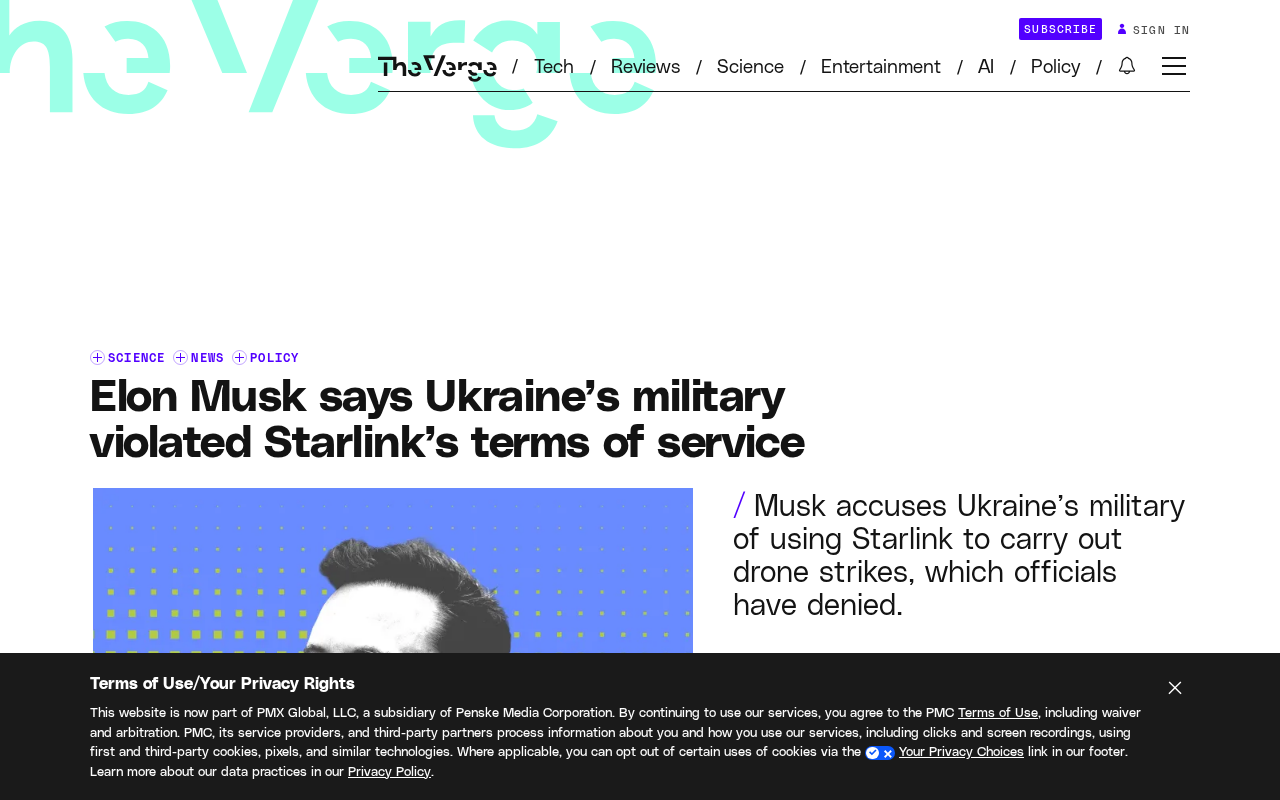
Background: Starlink Slowdown and the Terms Dispute
According to an earlier Ars Technica report, Starlink service in Ukraine experienced slowdowns. In response, Musk later said: "The Ukrainian military violated Starlink's terms of service by using it for offensive drone strikes to kill people. That loophole was closed last week." He did not provide specific evidence, but stressed that the adjustment was intended to limit militarized use of Starlink.
Starlink initially provided communications support to Ukraine, but Musk has repeatedly said the service is "for civilian use only." The slowdown is seen as part of enforcing the terms.
Starlink is a low-Earth-orbit satellite internet constellation operated by SpaceX. By deploying thousands of small satellites in low Earth orbit, it provides broadband connectivity to remote regions around the world. Its terminals are small and quick to deploy, offering significant advantages in scenarios where traditional communications infrastructure has been destroyed. After the Russia-Ukraine conflict broke out, Starlink terminals quickly entered Ukraine and became an important supplement to the Ukrainian military's command communications. However, Starlink's terms of service explicitly limit its use to consumer or commercial civilian purposes and prohibit use in weapons systems or direct participation in combat operations. The clause was originally designed to avoid liability and export-control risks, but it also laid the groundwork for later controversies over "militarization." Understanding Starlink's technical architecture and contractual constraints is a key prerequisite for analyzing this incident.
Positions of Both Sides: Musk's Allegation and Ukraine's Denial
Ukrainian officials denied Musk's allegations, denying both that they violated the terms of service and that they used Starlink for offensive strikes. Ukraine argues that using Starlink for defense and communications in the conflict is reasonable and necessary.
The disagreement highlights the gray area of commercial satellite services in military conflicts. Musk, as SpaceX's leader, is trying to draw a line between civilian and military use, while Ukraine faces real combat needs.
Offensive drone strikes generally refer to using drones to carry out direct fire attacks on enemy personnel or equipment, rather than only performing defensive tasks such as reconnaissance and communications relay. On the Russia-Ukraine battlefield, the coordination between drones and Starlink mainly manifests in: operators transmitting high-definition video back through Starlink, receiving target coordinates, and remotely controlling drones to drop bombs or carry out suicide attacks. The "loophole" Musk referred to may mean the Starlink network's speed-limiting strategy for certain high-speed mobile terminals or specific geofences, intended to prevent terminals from maintaining a stable connection when moving at high speed on drones. But Ukraine believes that using Starlink for defensive communications and battlefield situational awareness is legitimate self-defense and does not constitute a breach. This disagreement over how to define "offensive" and "defensive" is the technical root of the two sides' conflicting accounts.
Impact and Implications: The Dilemma of Militarizing Commercial Technology
Starlink's role in Ukraine has long been controversial. This incident has once again sparked discussion about the responsibilities of commercial technology companies in war. Musk's move to close the "loophole" may affect Ukraine's combat capability, but it also reflects the company's insistence on its terms of service.
From a broader perspective, the use of commercial satellite internet in conflicts lacks clear international norms. The Starlink case may provide a reference for similar situations in the future, but the fact that the two sides disagree also shows that determining the facts requires more independent information.
At present, the incident is still developing, and the specific details of the Starlink service adjustments and their impact on the battlefield remain to be seen.
Related articles

Self-Hosting LangGraph: Multi-Worker Coordination and Crash Recovery Challenges
How to design leases, heartbeats, fencing tokens, and crash recovery for self-hosted LangGraph multi-worker setups to prevent stale checkpoint writes.

Liquid AI Releases LFM3: Six 2B-Class Open-Source Multimodal Models
Liquid AI releases the LFM3 series with six 2B-class open-weight multimodal models covering text, vision, audio, omni, and decisions. LFM3-1.7B uses a tri-hybrid backbone, supports 256K context, and is about 1GB at 4-bit.

Who Holds Power After Anthropic's IPO? Decoding a Complex Governance Structure
Who really holds power after Anthropic's IPO? This article analyzes its famously complex governance structure, exploring control vs. equity, post-IPO power redistribution, and the tension between safety commitments and commercial pressure.