Self-Hosting LangGraph: Multi-Worker Coordination and Crash Recovery Challenges
Self-hosted LangGraph multi-worker needs leases plus fencing to prevent stale writes; no turnkey solution exists.
The article addresses coordination and crash recovery challenges in multi-worker self-hosted LangGraph and Deep Agents. Session exclusivity requires leases plus heartbeats, but an expired lease does not mean a worker is dead—GC pauses or network partitions can make healthy workers unreachable, letting old workers overwrite checkpoints with stale state. The author proposes fencing tokens plus checkpoint versions for conditional writes rejected at the database layer. Graceful shutdown needs cooperative cancellation and safe-point checkpoints, complicated by non-interruptible tool calls. No turnkey LangGraph-integrated framework exists; common practice is a self-built PostgreSQL lease + fencing + task queue coordination layer, or adapting Temporal. Robust design requires leases, fencing, idempotency, and cooperative cancellation together.
Title
Self-Hosting LangGraph: Multi-Worker Coordination and Crash Recovery Challenges
Meta Description
When self-hosting LangGraph and Deep Agents, how should leases, heartbeats, fencing tokens, and crash recovery be designed in a multi-worker environment? This article analyzes the core challenges raised by a Reddit developer, exploring engineering solutions to prevent stale checkpoint writes and the current state of open-source frameworks.
Article Content
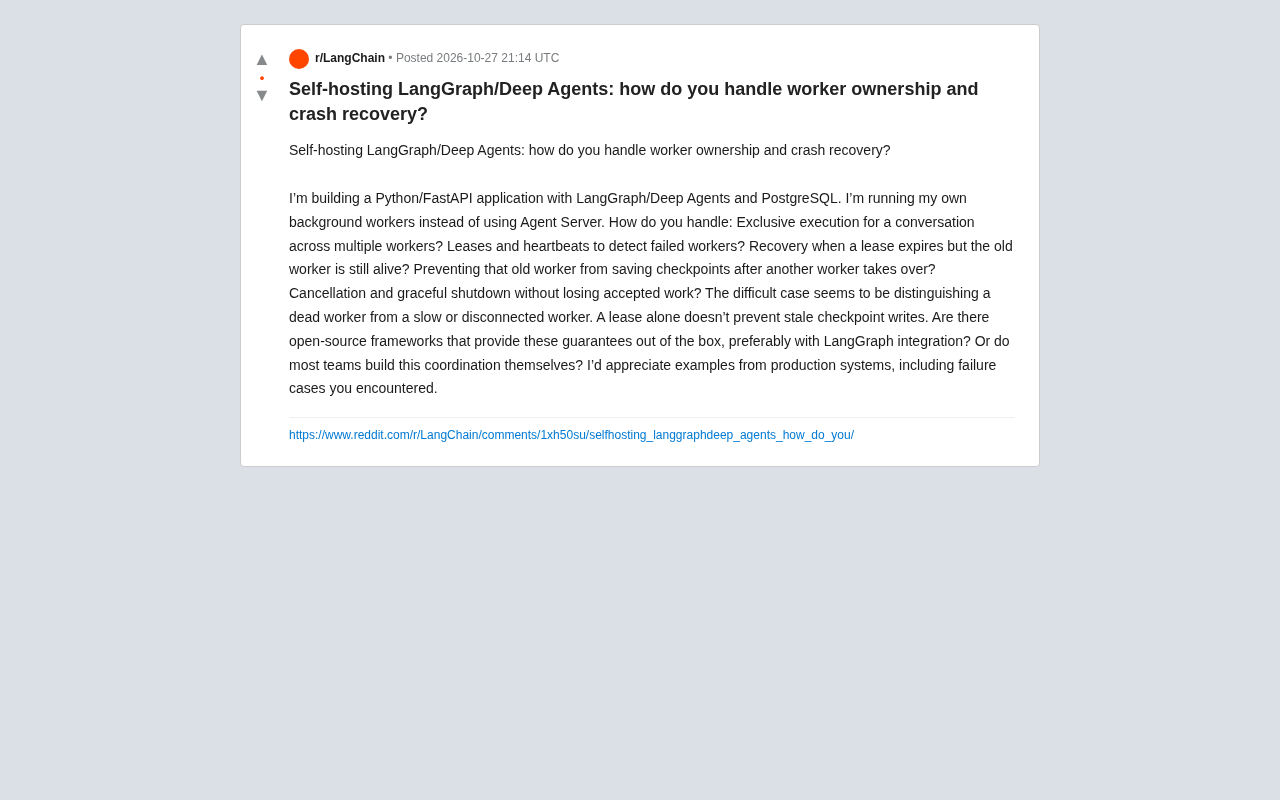
When self-hosting LangGraph and Deep Agents, coordination and crash recovery in multi-worker environments are unavoidable engineering challenges. Recently, a Reddit developer described his predicament in detail: he built background workers using FastAPI + LangGraph + PostgreSQL to replace the Agent Server, but got stuck on several key issues—how do multiple workers enforce mutually exclusive execution on the same session? How should leases and heartbeats be designed to reliably detect failed workers? When a lease expires but the old worker is still alive, how do you prevent it from writing stale checkpoints? How do you avoid losing accepted work during cancellation and graceful shutdown?
The developer pointed out the trickiest part: distinguishing a "dead worker" from a "slow or disconnected worker" is extremely difficult. Leases alone cannot prevent stale checkpoint writes. He asked whether any open-source framework provides these guarantees out of the box, preferably integrated with LangGraph, or whether most teams simply have to build their own wheel.
Core Challenge: Worker Ownership and Lease Mechanisms
Session exclusivity in a multi-worker environment is essentially a distributed lock problem. In the LangGraph context, a conversation thread can only be processed by one worker at a time; otherwise, state becomes inconsistent. Common approaches include PostgreSQL advisory locks or a lease table, where a worker acquires the lock before processing, periodically renews it (heartbeat) during processing, and releases it upon completion.
But the difficulty the developer highlighted is this: an expired lease does not mean the worker is actually dead. GC pauses, network partitions, and event loop blocking can all cause a healthy worker to be temporarily unreachable. If another worker takes over after the lease expires, the old worker may resume and continue writing checkpoints, causing data corruption. This is the "stale checkpoint write" problem, and leases alone cannot solve it.
PostgreSQL advisory lock is an application-level explicit locking mechanism provided by PostgreSQL. It is unrelated to table or row data and is entirely acquired and released by business code through functions such as pg_advisory_lock(key) / pg_try_advisory_lock(key). It comes in two types: session-level and transaction-level. Session-level locks are automatically released when the connection is dropped, while transaction-level locks are released when the transaction ends. In a LangGraph multi-worker scenario, developers often hash the thread ID into a 64-bit integer as the lock key. A worker attempts to acquire the advisory lock before processing a thread; success means it exclusively owns that session, while failure means another worker is already processing it. The advantage of advisory locks is that no extra table is needed and fault release is naturally achieved through the database connection lifecycle. The downside is that they are bound to the database connection; connection pool reuse or transient network failures can cause unexpected lock release, and they cannot directly express the semantics of a "lease with a timeout," so in practice they are often used together with a lease table.
Preventing Stale Writes: Fencing Tokens and Checkpoint Versions
To prevent old workers from writing checkpoints after losing ownership, a fencing mechanism must be introduced. The idea is: each time ownership transfers, the lease version number increments (the fencing token). When a worker writes a checkpoint, it must include the version number it holds, and the database layer performs a conditional update—writes are allowed only if the version number matches. This way, even if the old worker is still alive, its writes will be rejected.
Another approach is to add owner_id and lease_epoch fields to the checkpoint table, using WHERE owner_id = ? AND lease_epoch = ? for optimistic concurrency control during writes. LangGraph's checkpoint storage is pluggable, so implementing a custom Saver with fencing validation is feasible—but you have to build it yourself.
Fencing token originates from the classic paper on distributed locks. The core idea is: the lock service returns a monotonically increasing token each time it grants a lock; the client carries this token when accessing downstream resources, and downstream resources only accept requests whose token is no less than the maximum value seen so far. This way, even if the old holder "comes back to life" after its lease expires, the old token it carries will be rejected by the storage layer, physically cutting off stale writes. In the LangGraph scenario, the fencing token is typically implemented as a lease_epoch or version column in the lease table, atomically incremented on each ownership transfer. It is paired with optimistic concurrency control: the checkpoint write statement looks like UPDATE checkpoints SET ... WHERE thread_id = ? AND lease_epoch = ?; if the affected row count is zero, ownership has been lost, and the worker should immediately abort the current task. The value of fencing lies in the fact that it does not rely on the worker believing it is "still alive"; instead, it delegates the decision to the only trusted database, which is why it is more reliable than heartbeats alone.
Cancellation and Graceful Shutdown: Don't Lose Accepted Work
Graceful shutdown requires a worker to finish its current work before exiting, or at least requeue unfinished tasks. For long-running agent tasks, cooperative cancellation must be supported: the worker periodically checks a cancellation flag, exits at a safe point, and persists intermediate state. After a shutdown signal (SIGTERM) is triggered, the worker should stop accepting new tasks, wait for the current task to reach a checkpoint, and then release the lease.
The difficulty lies in the non-interruptibility of agent tasks—some tool calls may have already started and cannot be rolled back. In this case, compensation logic must be defined at the business layer, or the task must be split into smaller recoverable units.
Cooperative cancellation means the task itself is not forcibly killed; instead, a shared flag, cancellation token, or asynchronous cancellation signal notifies the task that it "should stop as soon as possible," and the task actively checks and exits at a safe point. In the Python async ecosystem, asyncio.Task.cancel() is a more aggressive form of cancellation that throws CancelledError at the next await point and may interrupt tool calls; cooperative cancellation requires the agent loop to check the flag on each iteration and before and after each tool call, ensuring it exits only at a state-consistent point. A safe point is a position where the task is in a consistent state that can be persisted and recovered, such as after an LLM call returns, or after a tool finishes execution and writes back its result. When designing graceful shutdown, you should chain together "stop accepting new tasks—notify the current task to cancel—wait for it to reach a safe point and write a checkpoint—release the lease" as an ordered process, set an upper bound on the wait, and after timeout forcibly terminate and rely on checkpoint recovery, avoiding a worker hanging indefinitely.
Current State of Open-Source Frameworks and Community Practices
According to the Reddit developer's observation, there is currently no out-of-the-box open-source framework that both integrates with LangGraph and solves all of the above problems. LangGraph itself provides checkpoint mechanisms and thread management, but distributed worker coordination relies on external systems (such as PostgreSQL locks, Redis leases, or workflow engines like Temporal).
A common approach in the community is to build a coordination layer yourself: use PostgreSQL for lease storage and fencing validation, a heartbeat table to monitor worker health, and a task queue (such as Celery, RQ, or a custom one) for work distribution. Some teams also turn to frameworks like Temporal or Restate, which provide durable execution and activity leases out of the box, but integrating them with LangGraph requires additional adaptation.
Temporal is a durable execution platform that persists the execution history of workflow code on the server side. After a worker crashes, other workers can replay the event history to automatically recover, and it has built-in heartbeat and timeout retry mechanisms at the Activity level. Restate has a similar positioning, offering stateful services with serialization guarantees through a lightweight single binary and Virtual Objects. Both can alleviate the "worker ownership and crash recovery" problem, but their workflow models do not naturally align with LangGraph's graph execution model: wrapping LangGraph node execution as Temporal Activities introduces additional serialization constraints and determinism requirements, and checkpoint semantics need to be mapped between two state machines. Therefore, community practice is mostly to "borrow their lease and retry capabilities and build a custom LangGraph adaptation layer" rather than replacing them directly. This also explains why the Reddit developer lamented the lack of an out-of-the-box solution—general-purpose workflow engines solve execution reliability, whereas LangGraph needs ownership semantics tightly bound to thread checkpoints.
Lessons from Production Failure Cases
Although the original post did not provide specific production cases, the failure scenarios the developer mentioned are very representative: after a lease expires, the old worker recovers and overwrites the new worker's checkpoint, causing the conversation state to regress; the heartbeat thread is blocked by GC, leading to a false death determination; tasks are lost during graceful shutdown. The common root cause of these problems is treating the "lease" as the sole proof of "ownership."
A more robust design requires multiple safeguards: lease + fencing token + checkpoint version + idempotent writes. At the same time, monitor lease renewal latency and alert in advance for workers approaching expiration. When a worker's state cannot be determined, it is better to conservatively wait longer than to take over rashly.
There is no silver bullet for the coordination layer of self-hosted LangGraph, but doing the fundamentals of distributed systems well—fencing, idempotency, cooperative cancellation—can help avoid most pitfalls.
One-line Summary
Self-hosted LangGraph multi-worker setups need leases plus fencing to prevent stale writes; there is no out-of-the-box solution.
Paragraph Summary
The article centers on the coordination and crash recovery challenges of multi-worker environments when self-hosting LangGraph and Deep Agents. The core issue is that session exclusivity requires leases plus heartbeats, but an expired lease does not mean the worker is dead—GC pauses and network partitions can make a healthy worker temporarily unreachable, causing the old worker, upon recovery, to write stale checkpoints and overwrite new state. The author proposes using fencing tokens plus checkpoint versions for conditional writes, rejecting expired writes at the database layer. For graceful shutdown, cooperative cancellation and safe-point checkpoints are needed, with the difficulty being the non-interruptibility of tool calls. The current community state is that there is no out-of-the-box framework integrated with LangGraph; common practice is to build a coordination layer with PostgreSQL leases, fencing, and a task queue, or to turn to workflow engines like Temporal with additional adaptation. The conclusion is that a robust design requires multiple safeguards: leases, fencing, idempotency, and cooperative cancellation.
Related articles
One Year of Dioxus Fullstack in Production: Gains and Pain Points
A developer shares a year of real-world experience running the Dioxus fullstack framework in production, covering type-safety gains in fullstack Rust, plus pain points like compile times and ecosystem maturity, as a reference for technology selection.

The Hidden Faith of AGI Leaders: Humans Are Nothing Special?
Vergecast podcast reveals the hidden belief within AGI leadership circles: humans are nothing special, consciousness is just computation. Exploring how computational functionalism shapes the worldview of tech elites and the future of AI.
GM Shifts Toward Hybrids: From an All-Electric Bet to a Pragmatic Parallel Strategy
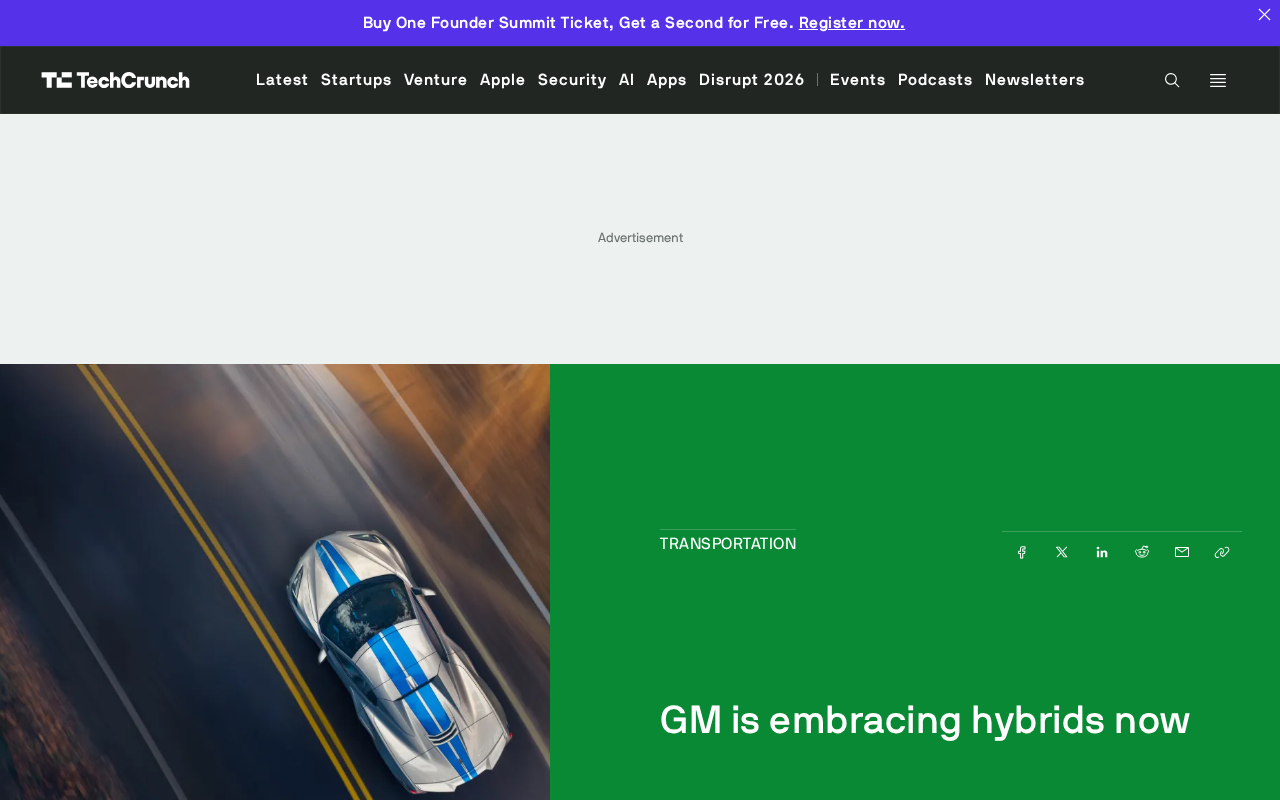
GM once skipped hybrids to bet on pure EVs; now it plans hybrid SUV versions. This article analyzes the strategic shift, its significance for SUVs, and consumer impact.