My Experience with AI Agents: The 'Oh My God' Moment from Chat to Agent

From chat to AI Agent: a $20 experiment that transformed curiosity into creation while preserving critical thinking.
A Reddit user shares their transformative experience after spending just $20 to access an AI Agent powered by DeepSeek's MoE architecture. The shift from passive chatbot interactions to an Agent that actively executes multi-step tasks triggered recurring 'Oh my god moments.' The post highlights AI's remarkable generality, the importance of guarding against cognitive outsourcing through deliberate practices like daily AI-free writing, and how Agents can reignite curiosity and accelerate learning — all while maintaining a healthy 'trust but verify' philosophy.
From Bystander to Practitioner: A Twenty-Dollar Transformation
In the AI world, there's a group of "armchair observers" who've been following the news closely but haven't had the chance to try things firsthand due to budget constraints. A Reddit user's post perfectly captures this group's journey — when he finally spent twenty dollars to top up his account and connect to the DeepSeekAd v4 0731 model's Agent, his experience changed fundamentally.
DeepSeek is a Chinese AI company known for its open-source approach and cost-effective strategy. Its model series uses a Mixture of Experts (MoE) architecture, where the core idea is that although the model has a massive total parameter count, only a subset of "expert" sub-networks is activated during each inference step. This achieves an excellent balance between computational efficiency and model capability. It also explains how users can complete a huge volume of tasks at extremely low cost — compared to dense models of equivalent performance, API calls on MoE architectures typically cost an order of magnitude less.
"I've experienced frontier models before through chat window subscriptions, but having an Agent that can actually execute tasks is a completely different thing," he wrote. In just a few hours, he built a wide array of practical tools at a cost of mere cents. This "Oh my god moment" wasn't a one-time shock — it's a recurring experience that resurfaces every few weeks.
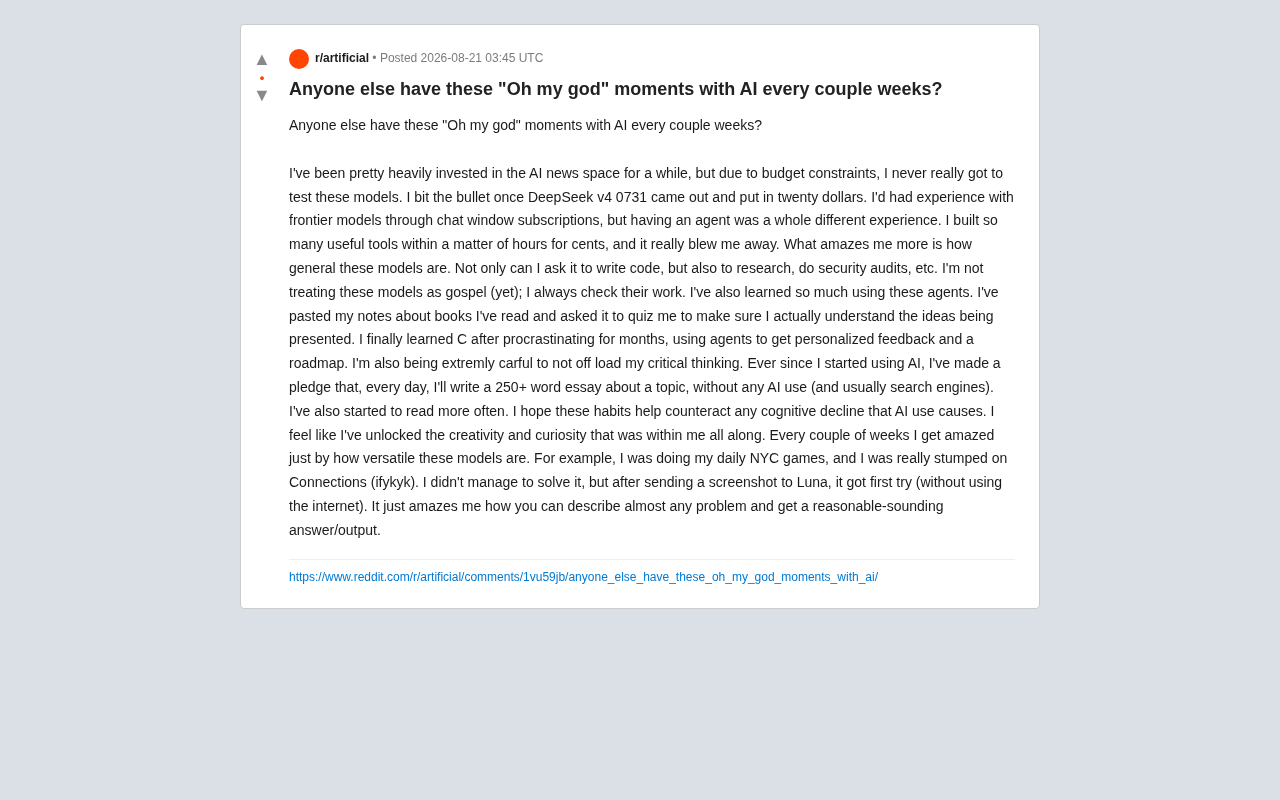
This leap from chat to Agent is a microcosm of the current paradigm shift in AI applications. A traditional chat window is essentially a single-turn or multi-turn text generation interface — the user inputs a prompt, the model returns a text response, and the interaction ends there. An Agent, on the other hand, introduces critical capabilities like Tool Use/Function Calling, code execution environments (such as sandboxed Python interpreters), file system access, and network requests. The core architecture of an Agent typically includes a Plan-Act-Observe Loop: the model first analyzes the task and formulates a plan, then calls external tools to perform specific operations, observes the execution results, and decides on the next action. This enables AI to complete multi-step compound tasks like "read a CSV file, analyze data anomalies, generate visualizations, and output a report" — rather than merely offering text-based suggestions. For ordinary users, the psychological impact of this shift from "answering questions" to "getting work done" is often far more visceral than any technical specification.
The Core Advantage of AI Agents: Generality
What truly stunned this user wasn't the power of any single feature — it was the model's generality.
"You can not only have it write code, but also do research, security audits, and more," he described. This Swiss Army knife-like capability is the defining characteristic that sets large language models apart from traditional specialized software. In the past, code analysis, literature research, and security auditing each required different professional tools and domain expertise. Now, a single general-purpose Agent can cover these vastly different fields.
The technical foundation of this generality lies in the pre-training paradigm of large language models. Models like GPT, Claude, and DeepSeek are pre-trained on trillions of tokens across multiple languages and domains, spanning code repositories, academic papers, books, web pages, and other data sources. This large-scale multi-task learning gives rise to cross-domain "Emergent Abilities" — the ability to perform well on tasks the model was never explicitly trained for.
He also shared a vivid example: while stuck on the New York Times' Connections puzzle game, he sent a screenshot to his AI assistant Luna, which gave the correct answer on the first try — without internet access. "You can describe almost any problem and get a reasonable-sounding answer or output — that truly amazes me." The model likely never received specific training on this game, but its generalized capabilities in semantic association and categorical reasoning enabled it to solve this novel problem.
It's worth noting, however, that this generality has its limits. In highly specialized vertical domains (such as the latest legal case analysis or cutting-edge scientific research), the model may exhibit Hallucination — confidently producing content that sounds plausible and authoritative but is actually incorrect. While it may not be a top expert in every field, its characteristics as an "all-around assistant" with extremely low marginal cost and broad coverage are reshaping how ordinary people tackle complex tasks.
Beware of Cognitive Outsourcing: A Self-Discipline Checklist
You might not have noticed, but this user didn't lose himself in the convenience AI provides. Instead, he maintained a rare clarity and self-discipline.
He explicitly stated: "I don't treat these models as gospel (yet). I always check their work." This "trust but verify" attitude is key to responsible AI use. Going further, he established a set of mechanisms to combat "cognitive degradation":
- Daily writing: Writing an article of 250+ words every day without any AI assistance (usually without even using a search engine);
- Active reading: Reading books more frequently;
- Active learning: Pasting reading notes into AI and having it quiz him, ensuring genuine understanding of the material;
- Skill breakthroughs: Finally learning C — a language he'd procrastinated on for months — with the help of the Agent's personalized feedback and learning roadmaps.
"I'm very careful not to outsource my critical thinking," he emphasized. This statement pinpoints the most noteworthy risk in current AI usage — when tools become too convenient, humans may gradually lose the ability to think independently.
This concern is far from unfounded. It echoes longstanding research in cognitive science on "Cognitive Offloading." Columbia University psychologist Betsy Sparrow and colleagues discovered the "Google Effect" as early as 2011 — when people know information is easily accessible through a search engine, the brain tends to remember "where to find information" rather than "the information itself." In the AI era, this effect may intensify further: as users grow accustomed to having AI analyze, summarize, and even make decisions for them, their capacity for independent reasoning and deep thinking may gradually weaken. This is precisely why the mechanisms this user established — such as "daily AI-free writing" and "active reading quizzes" — carry significant importance. They are essentially a form of deliberate practice designed to maintain core cognitive functions against degradation from tool convenience.
He positioned AI as "an accelerator for learning" rather than "a substitute for thinking" — a distinction that is absolutely crucial.
How AI Reignites the Curiosity to Learn
Perhaps the most moving part is this user's redefinition of AI's value.
"I feel like I've unlocked creativity and curiosity that have always existed inside me," he wrote. For him, AI's significance lies not in completing tasks on his behalf, but in lowering the barrier to exploring new fields — releasing curiosity that had been shelved due to difficulty or time costs.
Learning C, doing security audits, building small tools — things that once required a lengthy learning curve now come with a patient, always-available "tutor." From an educational science perspective, the learning approach he describes aligns with several well-validated theories. Pasting reading notes into AI for quizzing actually applies the principle of "Retrieval Practice" — research shows that actively retrieving information from memory produces deeper learning effects than passively re-reading material. AI serves here as an adaptive testing system that can generate targeted questions based on note content and adjust difficulty according to responses.
AI's role as a programming "tutor" that helped the user learn C reflects educational psychologist Vygotsky's "Zone of Proximal Development" theory: with guidance from a more capable assistant, learners can accomplish tasks they couldn't complete independently, gradually internalizing the relevant knowledge and skills in the process. AI's unique advantage is that it's a "tutor" that never loses patience, can explain the same concept an unlimited number of times, and instantly adapts to the learner's pace.
This sense of empowerment is the core value that many AI optimists cherish most.
Rationally Embracing the Agent Era
This ordinary user's account provides a vivid lens through which to observe AI's widespread adoption. It reveals several trends already underway:
First, Agents are becoming the watershed moment of the AI experience. From passive chat to active execution, Agents deliver a qualitative leap in AI's practical value. Currently, major AI companies including OpenAI, Anthropic, and Google are all accelerating their Agent ecosystem strategies — from coding assistants (like Cursor and GitHub Copilot) to general-purpose automation platforms, Agents are transitioning from technical demos to everyday productivity tools.
Second, low costs are breaking down barriers to entry. Twenty dollars, a few cents per API call — these price points are enabling former "armchair observers" to truly participate. This is driven by the convergence of MoE architecture optimization, scaling of inference infrastructure, and fierce competition among open-source models pushing costs downward.
Third, generality is currently the most captivating quality of large models — and the source of their disruptive power. It means the beneficiaries of AI are no longer limited to programmers or tech professionals, but extend to anyone willing to interact with it.
Equally important, however, is the usage philosophy this user demonstrated: fully leveraging AI's capabilities while actively maintaining one's own core cognitive abilities. As AI grows increasingly powerful, this art of balancing "making good use of it without becoming dependent" may be the essential lesson every user needs to learn. The true "Oh my god moment" should go beyond marveling at the technology — it should also encompass aspirations for personal growth.
Related articles

Workbuddy for Absolute Beginners: How a Desktop AI Agent Fits Into Real Workflows
A beginner's guide to the Workbuddy desktop AI agent: installation, claiming credits, file management, and building automated workflows—compared with CodeX for fit and cost, helping professionals shift from AI question-askers to AI managers.

OpenAI's New Agent Stack: Computer Use, Decisions API, and Ultra-Fast Workflows
OpenAI Dev Day unveiled a new agent stack: Computer Use outperforms humans, Decisions API delivers ultra-low-latency classification via Luna, Agents API opens the same Computer Use capabilities, and GPT-6.1 Sol costs only one-seventh of Astra. Core updates, benchmark data, and developer insights.

Liang Wenfeng Open-Sources DeepInfo Inference Framework, Takes On U.S. Ban
DeepSeek open-sources its DeepInfo inference framework after its models, featuring GPU/CPU cross-pipelining, small-model prediction with large-model verification, and full Huawei Ascend and NVIDIA chip support—facing the U.S. federal ban head-on. This article analyzes its significance for AI deployment and open-source strategy.