n8n AI Agents Deep Review: How It Compares to Orbit Agents

n8n launches AI Agents: a detailed comparison with Orbit Agents on memory management, usability, and cross-tool collaboration.
n8n has officially introduced AI Agent functionality on top of its mature workflow automation platform, supporting custom API keys, skill configuration, triggers, and nested tool/sub-Agent calls — marking a shift from manual orchestration to delegated agent execution. However, n8n leaves memory and knowledge base management entirely to users, making maintenance costs grow significantly as Agent count increases. This review, conducted by Orbit Agents co-founder Jonathan, carries an inherent product bias — Orbit emphasizes pre-built tools, a shared memory layer, and cross-Agent collaboration for an out-of-the-box experience. Objectively, the two represent distinct paths: n8n excels in integration breadth, controllability, and self-hosting for developers; Orbit targets business teams wanting low-maintenance, unified memory, and rapid deployment.
n8n Moves from Workflows to AI Agents
n8n has long been regarded as a powerful workflow automation tool, but it has now officially introduced AI Agent functionality — a change many users see as a fundamental shift in the platform's identity. According to a review by Jonathan, co-founder of Orbit Agents, published on YouTube, n8n is no longer purely a "building-block workflow" platform at its core; Agents have become an integral part of how the platform operates.
As Jonathan — a longtime n8n user himself — points out, traditional workflows are powerful but not exactly maintenance-friendly: nodes pile up and logic branches get complex. The introduction of Agents means that previously cumbersome workflows can be encapsulated as callable tools, with the Agent autonomously orchestrating task execution. It's a conceptual shift from "manually choreographing a process" to "delegating execution to an intelligent agent."
Breaking Down n8n's Core Agent Features
n8n's newly launched Agent functionality is prominently accessible via a dedicated tab, with a clear "Create Agent" button as the entry point. The creation flow is straightforward: select a model in the configuration panel. The platform includes some pre-loaded credits, but primarily relies on users bringing their own API keys to bill against their own token usage.
In the Agent configuration, users can write instructions, add skills, and set up triggers. Triggers support connecting to channel platforms, configuring scheduled wake-up schedules, and attaching tools, workflows, and sub-Agents. This means a single Agent can call multiple tools and nest sub-Agents, forming relatively complex collaborative structures.
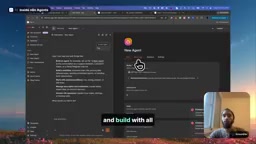
Tool connectivity is the most critical capability of n8n Agents. Users can connect a large number of tool nodes to an Agent, which can then invoke those connections to complete tasks — compared to building an entire workflow from scratch, you simply aggregate tools together and the Agent can autonomously handle "almost anything you want to do." You can also view Gateway credits, MCP, and other resource configurations.
During hands-on testing, the reviewer created a sample Agent and tested its web search capability. The Agent successfully read pages, scraped websites, and performed a comparative analysis of two products, demonstrating basic tool orchestration and autonomous execution.
How Memory and Knowledge Base Management Differ
On the file and memory side, n8n allows users to connect their own knowledge bases, and in advanced mode supports connecting vector stores (such as a Supabase database as a vector store). However, the reviewer highlights a critical point: n8n puts memory and knowledge base management entirely in the user's hands. This means that every time a new Agent is created, users must handle context and memory reuse on their own.
This is precisely the difference between the two products that the reviewer repeatedly emphasizes. As the number of Agents grows, continuously feeding memory, ingesting documents, and maintaining context for each Agent becomes a significant operational burden.
What is a Vector Store? A vector store is the underlying technology that enables AI Agents to achieve long-term memory and knowledge base retrieval. It converts text content into high-dimensional numerical vectors and stores them, allowing Agents to find relevant information through semantic similarity rather than exact keyword matching. Supabase, as an open-source Firebase alternative, provides a PostgreSQL database with its pgvector extension and is one of the more popular vector store choices today. When n8n delegates vector store configuration to users, it means users must independently: choose a vector database service, configure an Embedding model (the model that converts text into vectors), and manage document updates and version control. As the number of Agents multiplies, these operations compound, creating the operational burden the reviewer identifies. By contrast, a "unified memory layer" approach handles all of this at the platform level, so users don't need to worry about the underlying vectorization implementation.
Orbit Agents' Differentiated Positioning
For comparison, the reviewer showcases his own product, Orbit Agents (orbitagents.xyz). It's worth noting that this section comes directly from an Orbit co-founder, so it carries an obvious product advocacy angle — readers should evaluate it critically.

Orbit's differentiation shows up in several areas. First is "work mode" — users don't need to build an Agent first; they can directly issue a task and have the system execute it. In the demo, a single-sentence instruction had the system scrape Reddit posts from people looking for AI automation experts, with no manual API connections required. Tools come pre-configured as part of the subscription and are billed by credit.
Second is pre-built resources. Compared to n8n, where users build Agents and skills from scratch, Orbit provides a pre-built Agent marketplace and skill library (supporting builds from X posts, PDFs, and books, or community search for ready-made skills).
Cross-Tool Collaboration and Shared Memory
Another flagship selling point of Orbit is direct integration with AI tools like Claude and Codex, along with a shared memory layer across Agents.

The reviewer demonstrates a particularly representative scenario: his YouTube Agent generated the topic brief for this very video and sent it to a blog-writing Agent. That Agent received the context and directly generated a published comparison blog post in Claude — complete with images generated by Orbit's tools. Throughout the entire process, all context and memory about the product came from Orbit's unified memory layer, with no need to re-ingest knowledge.

This shared memory syncs actions from Claude, Codex, and other sources into a single searchable unified memory, allowing multiple Agents to collaborate like a team within a company — accumulating "learned knowledge" over time and avoiding repeated mistakes. The reviewer considers this Orbit's core advantage over n8n: n8n lacks a shared unified layer between Agents, message-based collaboration, and shared learning mechanisms, unless users build a complex architecture themselves.
What is MCP? MCP (Model Context Protocol) is an open protocol proposed by Anthropic in late 2024, designed to standardize the way AI models connect to external tools and data sources. Think of it as the "USB port" of AI tool calling — developers expose services according to MCP specifications, and any MCP-compatible AI client (such as Claude Desktop, Cursor, etc.) can call them directly without building separate integrations for each platform. n8n's support for MCP in Agent configuration means its tool nodes can be reused across the broader AI ecosystem and can also tap into capabilities provided by third-party MCP servers. Orbit's advertised "direct connection" to Claude and Codex also relies, to some extent, on a similar protocol-layer approach — using a unified interface to avoid data silos between platforms.
How to Objectively Read This Comparison
Setting aside product bias, this review reveals two distinct directions in today's Agent platform landscape. n8n wins on maturity: hundreds of battle-tested integrations, self-hosting capability, stronger controllability, and the flexibility to convert workflows into tools — making it better suited for developers who prioritize reliability and deep customization. Even the comparison blog that Claude generated during the review acknowledged n8n's lead in integration breadth and reliability.
Orbit, on the other hand, leads on ease of use and out-of-the-box readiness — pre-configured data and tools, a unified inbox and CRM view, cross-tool memory sync — positioning itself more as a "smooth experience built for business," targeting users who want to minimize maintenance overhead and get Agents running autonomously as quickly as possible.
The two aren't simply better or worse than each other; they represent different trade-offs: control and ecosystem maturity on one side, degree of automation and a low barrier to entry on the other. For longtime n8n users, the addition of Agents undoubtedly expands the platform's boundaries; for teams that want a more "hands-off" experience, pre-configured Agent platforms offer a compelling alternative.
Related articles

n8n 40-Minute Masterclass: Build Your First AI Automation Workflow from Scratch
Distilled from a 40-minute n8n masterclass: the core differences between automation, AI, and AI Agents, a comparison of n8n's four deployment methods, and a complete guide from dashboard to your first workflow.

Why Does a 35GB Quantized Model Blow Up an 80GB GPU? The Truth About KV Cache VRAM
Why does a 35GB 4-bit quantized LLM still blow up an 80GB GPU? This article breaks down the four components of inference VRAM, provides precise KV Cache formulas, compares GQA vs DeepSeek MLA memory, and offers production-grade OOM prevention like FP8 KV Cache.

Turning Company Workflows into Agent Skills: A Practical Guide
An agency owner turns team workflows into Agent Skills: one command handles article writing, six-platform distribution, and dual human approval. This guide breaks down the Skill file structure, two invocation methods, three-tier storage layout, security review process, and how to turn your own weekly repetitive tasks into executable, auditable skills.