n8n + AI Automation: A Layered 90-Day Path to Building Intelligent Workflows

Master deterministic n8n workflows first, then safely layer in AI agents over 90 days.
This article, based on a YouTube tutorial, outlines the correct learning path for n8n automation. The central argument: beginners should resist the urge to build AI agents on day one, since deterministic rule-based workflows and non-deterministic AI agents differ fundamentally in stability. The right sequence is to first master JSON data structures and IF logic gates, then connect to the outside world via APIs and Webhooks while treating failures as diagnostic data, and only then deploy LLMs — starting with single-decision AI-assisted workflows before graduating to true agents with memory and tool-calling capabilities. A three-phase 90-day roadmap guides learners from button-clicking users to system architects.
Most businesses run on an invisible engine — copy, paste, click, repeat. Millions of hours are burned every week on manually moving data from one place to another. n8n, a fair-code automation platform, was built to end exactly this kind of friction: it acts as a bridge, connecting rigid business processes to machine intelligence so tasks execute instantly.
But if you're just getting started with n8n, you'll likely hit a wall fast. This article is based on the core insights from a YouTube tutorial, unpacking a conclusion that has been validated repeatedly: real leverage comes from layered architecture, not from rushing to build fully autonomous AI agents.
Why You Shouldn't Build an AI Agent on Day One
Almost every beginner wants to build a fully autonomous AI agent on day one — because they look incredible. The problem lies in a fundamental difference in underlying logic.
Classic, rule-based workflows run in exactly the same way every time — they are deterministic. AI agents are non-deterministic; they make their own decisions. This means that without proper constraints, they have an extremely high probability of breaking down.
The correct order is actually the reverse: first master the predictable logic of data movement, then introduce the unpredictability of language models. This foundation-first approach is the core philosophy of the entire methodology.
The n8n canvas operates automatically based on a simple chain of command: a Trigger captures an event, passes it to a Node, and the node executes a specific action. Every connection forms a predictable, rule-based system.
The essential difference between deterministic and non-deterministic systems is worth understanding more deeply. A deterministic system, given the same input, always produces the same output — like a calculator. Enter 2+2, you always get 4. This makes debugging straightforward: behavior is predictable, problems are reproducible, and fixes are verifiable.
Non-deterministic systems are fundamentally different. Large language models (LLMs) rely on probabilistic sampling to generate output, so the same input at different moments may produce differently worded responses — or in extreme cases, logically contradictory conclusions. This characteristic is an advantage in creative writing or open-ended Q&A, but in automated workflows that must strictly enforce business rules, it's a potential time bomb. When an AI agent is granted "real-world" permissions — like calling external APIs, modifying databases, or sending notifications — a single erroneous autonomous decision can create cascading consequences that are difficult to roll back. This is precisely why experienced automation engineers always use deterministic nodes to lock down the skeleton of a workflow before introducing model inference within controlled boundaries.
JSON Is the Blood Flowing Through the Pipes
What flows through these connections is JSON. It looks like code, but it's essentially just a structured information list — like a receipt from an online shopping cart.
Rather than facing one giant block of messy text, JSON organizes information into clean key-value pairs: for example, color paired with blue, or price paired with $99. Understanding JSON isn't about writing code — it's about reading an organized list. This mental model helps beginners clear the first cognitive hurdle.
Using Logic Gates to Control Data Flow
As these structured key-value pairs travel along connection paths, they eventually encounter logic gates, like the IF node. Here you use expressions to set up conditional rules: if the price exceeds $100, send the data down path A; if it's below $100, route it to path B.
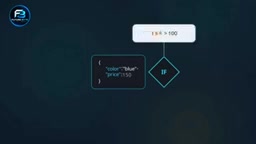
Master these rigid routing rules, and you gain complete control over how data behaves. This strict structure is exactly what allows complex automation systems to run smoothly without requiring constant human supervision.
Communicating with the Outside World: APIs and Webhooks
Once you can control data inside n8n, you need to communicate with the outside world. APIs act as universal translators, letting your workflows issue commands to almost any external software. By reading API documentation, you construct HTTP requests that push data to platforms without native integrations.
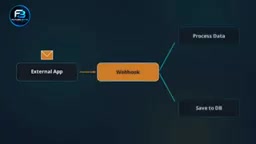
If APIs push instructions outward, Webhooks reverse that flow. A Webhook listens for real-world events — like a new email or a form submission — and uses that trigger to pull fresh data in.
Treating Failures as Diagnostic Data
Moving data between different external tools inevitably brings format mismatches, unexpected API updates, and execution interruptions. But these failures are actually extremely valuable diagnostic data: they pinpoint the weakest links in your system and tell you exactly where to build dedicated error-handling paths and guardrails.
The most resilient workflows are forged through deliberate stress testing. You keep pushing the system to its limits and design solutions for every edge case you discover — and that's where real stability comes from.
APIs (Application Programming Interfaces) and Webhooks represent two fundamentally different communication patterns, and understanding the distinction helps you choose the right tool for the right scenario. An API call is a "pull" (polling) pattern: your workflow actively initiates an HTTP request, asks an external service for data or issues a command, then waits for a response. This works well for scheduled batch data syncing, but polling too frequently wastes compute resources while polling too infrequently causes you to miss real-time events.
Webhooks are a "push" pattern: you generate a unique URL in n8n, register it with an external service (like GitHub, Stripe, or Typeform), and from that point on, whenever the target event occurs, the external service immediately sends an HTTP POST request to that URL — instantly waking up your workflow. This event-driven architecture has extremely low response latency and requires no continuous polling, making it far more resource-efficient. The two aren't mutually exclusive — complex workflows often mix both approaches: Webhooks handle real-time event capture at the entry point, while API calls handle writing processed results to other systems downstream.
Safely Deploying LLMs on a Deterministic Foundation
Once a reliable, deterministic framework is in place, you can safely deploy large language models. Unlike standard nodes, these models process information in a fluid way, generating responses based on whatever context you feed them.
It's important to distinguish two levels here:
- AI-assisted workflows: Using a model to make a single, isolated decision — like classifying a support ticket as high or low priority.
- True AI Agents: Equipped with memory and a full suite of tools, capable of taking independent action and deciding their own next steps.

Because agents decide their own next steps, they require constant maintenance and frequent evaluation. You only introduce this degree of autonomy when a task genuinely requires dynamic reasoning that fixed rules cannot handle.
For example, combining a deterministic web scraper with an AI summarization step creates a system that extracts and condenses targeted research material around the clock. A model's intelligence is ultimately bounded by the structure it's anchored to — when you ground fluid reasoning in a rigid workflow, you transform raw compute into measurable, high-leverage business output.
The architectural difference between "AI-assisted workflows" and "true AI Agents" runs far deeper than the terminology suggests. The former is essentially a standard node: the LLM receives fixed-format input, produces output, and immediately returns control to the deterministic process. The branching logic throughout the decision chain is still governed by rule engines like IF nodes. This pattern carries minimal risk — even if the model produces anomalous output, the hard rules downstream act as a safety net.
A true AI Agent introduces a "tool-use loop": the model doesn't just generate text — it autonomously decides which tools to call (such as searching the web, querying a database, or sending an email), and plans its next action based on what those tools return, continuing until it believes the task is complete. The core challenges with this architecture are hallucination and goal drift — the agent may confidently execute the wrong steps, and each step consumes real resources. Engineering practice therefore typically requires setting explicit tool permission whitelists for agents, a maximum step count, and "circuit breaker" nodes that require human review, preventing uncontrolled autonomous behavior from causing irreversible damage in production environments.
A 90-Day Execution Roadmap
Reaching this level of output requires actually getting your hands dirty. Watching videos without building, breaking, and debugging things yourself will keep you stuck in tutorial hell forever. The original tutorial lays out a clear three-phase path:
- Days 1–30: Focus on manual execution. Work through triggers and core nodes, and learn to read JSON.
- Days 31–60: Expand outward — integrate APIs and Webhooks, and establish rigorous error handling.
- Days 61–90: Build the cognitive layer and safely deploy your first integrated AI agent.
Following this progressive sequence is what separates two types of people: those who depend on software, and those who control it. You're either the worker who clicks buttons, or the architect who designs the system to click those buttons for you.
Related articles

@ai-sdk/workflow-harness 1.0.146 Release Notes
@ai-sdk/workflow-harness 1.0.146 is a patch-level update that syncs the @ai-sdk/harness dependency to 1.0.146. Auto-published via GitHub Actions with a verified signature.

Googlebook In-Depth Review: Can Google's New Laptop Replace the Chromebook?
In-depth Googlebook review: Google Book OS on Android 17, Pixel ecosystem integration, Gemini semantic search, and how it stacks up against Chromebook and MacBook Air on price and apps.

Python in Practice: Build an MCP Server from Scratch to Give LLMs Real-Time Web Data
Step-by-step guide to building an MCP server with Python and FastMCP, connecting it to Claude Code and Claude Desktop, and enabling LLMs to answer questions with live web data.