n8n + AI in Action: Auto-Generate Social Media Posts from a Single Keyword
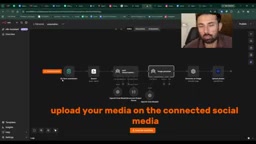
Enter one keyword, and this n8n workflow auto-generates copy, images, and publishes to Instagram.
This article presents an n8n-based social media automation workflow: the user inputs a keyword, and the system sequentially calls a web search tool (Tavily) for real content, a language model to generate post ideas and captions, an image generation model to produce matching visuals, and finally publishes to Instagram via API — all without human intervention. The four modules (search, text, image, publishing) are independently swappable. The author also notes key limitations: fully automated content risks homogenization and factual errors, and a human review step before publishing is recommended.
From a Single Keyword to a Complete Social Media Post
The most time-consuming part of social media management is rarely the creative idea itself — it's the repetitive work of turning that idea into copy, visuals, and a published post. This article walks through an n8n-based automation workflow with a clear goal: a user inputs a single keyword or short description, and the system automatically handles everything from topic ideation and copywriting to image generation and social media publishing.
This workflow was originally built as a real client project. Its value isn't in technical complexity, but in chaining together disparate AI capabilities into a reusable production pipeline. For content teams, this means compressing what used to take tens of minutes of manual work into a single click.
Core Steps of the Workflow
The trigger is simple: enter a topic in a form — for example, "the benefits of AI in daily life" — and hit submit. The automation kicks off immediately.
Step 1: Web Search and Content Collection
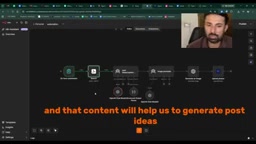
The workflow starts by calling a web search capability (the demo uses a tool like Tavily) to fetch content related to the keyword from the internet. This step is the foundation of the entire pipeline's quality — with real, relevant web material, the topic ideas and copy generated downstream won't be hollow or hallucinated.
Tavily is a search API designed specifically for AI applications. Unlike traditional search engines, it doesn't return a list of web links — it returns filtered, structured text summaries that can be fed directly as context to a language model. This design removes the complexity of having a model parse raw HTML and reduces information noise. In an n8n workflow, the Tavily node typically only requires an API key and a search query to inject real-time web information into subsequent text generation steps. Similar tools include Brave Search API and Serper, and can be swapped in depending on budget and access requirements.
Step 2: Generate Topic Ideas and Copy
The search results are fed to a language model to generate a specific post idea and corresponding caption. Based on the demo, the system first determines a clear content direction, then writes social-media-ready text based on that direction — including the main body and hashtags.
Automatically Turning Text into Images
Once a topic is established, the workflow converts it into an image prompt. This step is the critical bridge between text and visuals: the model automatically writes a descriptive image generation instruction based on the post topic, then passes it to the image generation node.
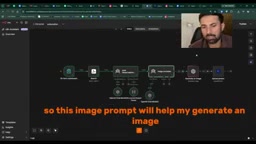
Image generation typically takes one to two minutes. In the demo, the generated image centers on the theme of "the benefits of AI," featuring elements like graphics and shopping — everyday life scenarios that align with the copy's subject matter. This chain design — where copy determines the prompt, and the prompt determines the image — ensures semantic consistency between text and visuals.
Auto-Publishing to Social Platforms
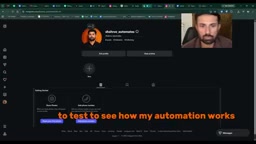
The final stage is publishing. The author uses a test account called "Shahrukh Automates" to validate the result. Once the image is generated, the workflow automatically uploads the image along with the caption and hashtags to the connected social platform (Instagram in the demo). Refreshing the page reveals the post — fully created by AI and published automatically.
From keyword input to post going live, no human intervention is required. This is the core value proposition of this type of automation workflow: integrating ideation, production, and distribution into a single operation.
Practical Value and Limitations
This workflow demonstrates a typical use case for n8n as an automation orchestration platform — it doesn't generate content itself, but assembles search, text generation, image generation, and publishing APIs like building blocks. For individual creators or small teams that need to produce social media content at high frequency, this kind of pipeline can significantly lower the operational barrier.
That said, it's important to stay clear-eyed about its limitations. Fully automated generation means content quality is heavily dependent on the quality of search results and model performance. Without human oversight, there's a real risk of homogenization or factual inaccuracies. Generated images may also not perfectly align with a brand's visual identity. A more reliable approach is to insert a human review step before the publishing node — let automation handle the "production," and let humans handle the "decision."
For readers who want to get started, think of this workflow as four independently swappable modules: search tool, copy model, image model, and publishing API. Any module can be replaced based on budget and platform requirements — which is the greatest strength of low-code automation platforms like n8n.
n8n is an open-source workflow automation platform, similar in positioning to Zapier or Make (formerly Integromat), but with support for self-hosting and a more developer-friendly experience. It uses a node-based visual editor where each node represents an action unit (e.g., HTTP request, database read/write, third-party API call), with nodes passing JSON data between them via connections. n8n's key advantages include: self-hosting for data privacy protection, native integrations with AI services (OpenAI, Anthropic, HuggingFace, etc.), and a large library of reusable workflow templates from the community. For users unfamiliar with coding, n8n has a gentler learning curve than pure-code solutions, though it's slightly steeper than Zapier — you'll need to understand basic data structures and conditional logic.
Related articles

@ai-sdk/workflow-harness 1.0.146 Release Notes
@ai-sdk/workflow-harness 1.0.146 is a patch-level update that syncs the @ai-sdk/harness dependency to 1.0.146. Auto-published via GitHub Actions with a verified signature.

Googlebook In-Depth Review: Can Google's New Laptop Replace the Chromebook?
In-depth Googlebook review: Google Book OS on Android 17, Pixel ecosystem integration, Gemini semantic search, and how it stacks up against Chromebook and MacBook Air on price and apps.

Python in Practice: Build an MCP Server from Scratch to Give LLMs Real-Time Web Data
Step-by-step guide to building an MCP server with Python and FastMCP, connecting it to Claude Code and Claude Desktop, and enabling LLMs to answer questions with live web data.