n8n in Action: Automatically Turn Hacker News Top Stories into Videos with AI
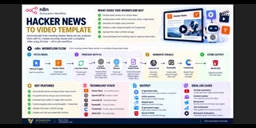
Build an automated tech-content pipeline using n8n: from Hacker News scraping to AI analysis, Leonardo visuals, video generation, and multi-platform distribution.
This article walks through an n8n-powered content automation workflow that scrapes top stories from Hacker News, uses AI to extract scripts and summaries, calls Leonardo AI for styled images, feeds into a video generation module, and archives everything to Google Drive for multi-platform distribution. The entire chain compresses topic selection, analysis, asset creation, storage, and publishing into a single automated pipeline. The article also addresses real-world challenges: quality-checking AI output, ensuring image relevance, meeting platform compliance requirements, and managing API costs. The core takeaway: the true competitive advantage in this kind of workflow lies in process design, not in any individual tool.
An Underrated Content Automation Use Case
Content creators face the same challenge every day: how to consistently produce valuable, visually compelling content without getting bogged down by repetitive tasks. A n8n workflow shared by a YouTube creator offers a genuinely useful approach — scraping top stories from Hacker News, feeding them to AI for analysis, automatically generating images and video, and running the entire pipeline within a single workflow.
The real value here isn't any single technology — it's the end-to-end pipeline that chains together topic selection, analysis, asset generation, storage, and distribution. For content creators, researchers, tech enthusiasts, and business educators alike, this kind of workflow delivers one immediate benefit: stripping repetitive operations out of your daily routine.
The Four Key Stages of the Workflow
According to the author's description, the overall n8n workflow structure is actually straightforward — but each node carries a well-defined responsibility.
1. Scraping Top Content from Hacker News
The pipeline starts by connecting to Hacker News and pulling the technical stories currently generating the most buzz. This step determines the timeliness and relevance of your content — Hacker News is itself a bellwether for the tech community, so topic quality is naturally filtered in.
2. AI Article Analysis and Content Preparation
After scraping, the workflow moves into article analysis. The author emphasizes that articles are "thoroughly analyzed" to extract core content and prepare structured material for downstream video scripting and image generation. This step essentially deconstructs a raw article into production-ready "semi-finished" components: summaries, related themes, key information points, and more.

3. Generating Visuals and Video with Leonardo AI
The image generation stage uses Leonardo AI. The author specifically notes that it was chosen to give the visuals "different stylistic qualities" rather than producing cookie-cutter AI imagery. A video generation step then follows, transforming the text content into a complete finished piece.
This reflects a practical tool selection philosophy: image generation tools are not interchangeable — choosing a model that matches your content's tone and style can significantly improve the distinctiveness of the final output.
4. Centralized Asset Storage in Google Drive
All generated assets — article summaries, related topics, AI images, and videos — are stored in Google Drive. The author's exact words: "so it never gets lost." The benefits of centralized archiving are obvious: assets can be retrieved at any time for distribution across YouTube, X (formerly Twitter), LinkedIn, and other platforms.

Why This Type of Workflow Deserves Attention
Setting aside the specific tools, what this case truly demonstrates is the leverage effect of combining n8n with AI in content production. In a traditional workflow, a creator has to find their own topics, read articles, write scripts, source images, edit video, and manually distribute everything — each step requiring a context switch in both tools and attention. Once these actions are orchestrated into an automated pipeline, the human only needs to make judgment calls at key checkpoints while the machine handles execution.
Vedanova Systems, the author's company, positions this type of service as helping clients "save a tremendous amount of time" so they can redirect that energy toward higher-value work. This gets at the essence of AI automation — it doesn't replace creativity; it frees creators from mechanical labor.
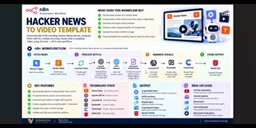
n8n is an open-source workflow automation tool, comparable in positioning to Zapier or Make (formerly Integromat), but with support for self-hosted deployment and fully programmable node logic. Its core concept is the "Node" — each node corresponds to a specific operation (HTTP requests, data transformation, calling AI models, etc.), with nodes connected by data flows so that the output of one node automatically becomes the input of the next. Compared to SaaS-based automation tools, n8n's advantages include keeping data off third-party servers (in self-hosted scenarios) and offering more flexible conditional branching and code nodes (supporting JavaScript/Python), enabling it to handle more complex business logic. For content creators, n8n's visual orchestration interface lowers the barrier to building multi-step automated workflows without requiring full backend development skills.
Practical Considerations for Real-World Implementation
While the demo is conceptually clean, creators should take a clear-eyed look at a few realities before deploying it:
- Quality control on AI output: AI-generated summaries and scripts still require human review. Hacker News topics tend to be technically demanding, and the risk of misinterpretation shouldn't be dismissed.
- Balancing visuals with authenticity: AI-generated images can boost visual appeal, but for serious technical content, the relevance of an image to its topic matters more than how attractive it looks.
- Distribution compliance: Automated bulk publishing to multiple platforms requires attention to each platform's content policies and originality requirements.
- Cost structure: Leonardo AI and video generation models both involve API usage fees. Before scaling up production, it's worth calculating your per-piece cost in advance.
Conclusion
This n8n workflow is essentially an automated production line for "turning tech news into video": sourcing material from Hacker News, refining it through AI analysis, generating styled visuals with Leonardo AI, producing a finished video, and archiving everything to Google Drive for multi-platform distribution. It doesn't showcase any cutting-edge technology — it demonstrates the efficiency gains that come from thoughtfully orchestrating mature tools. For creators looking to lower the barrier to content production, this kind of systems thinking delivers more long-term value than chasing any single tool. The real competitive advantage lies in workflow design, not in any individual node.
Background Notes
Hacker News is a tech community operated by venture capital firm Y Combinator, using a community voting system to rank content. Its Top Stories list is accessible via an official API that returns a list of currently highest-scoring post IDs, which can then be queried individually for fields like title, link, and comment count. In n8n, this API can be called directly via an HTTP Request node with no authentication required. Hacker News's core user base consists of founders, engineers, and researchers, which means trending content is naturally filtered for quality — low-signal topics rarely surface. This is the primary reason it's preferred over Reddit or Twitter trends as a topic source.
Leonardo AI is an image generation platform built for creative content, with underlying support for multiple open-source and self-trained models (such as Leonardo Diffusion and PhotoReal). It allows users to switch between different style presets within the same platform — one of its key differentiators from DALL·E or Midjourney. For content automation use cases, Leonardo provides a REST API that can be called in n8n via an HTTP Request node by passing a text prompt and receiving a URL for the generated image. Its Model Fine-tuning feature also supports training custom style models from a small set of samples, making it well-suited for channels that need to maintain visual consistency as part of their brand identity. It's worth noting that API calls are billed by token (generation credits), so batch production workflows should include usage caps planned in advance to keep costs under control.
Related articles

@ai-sdk/workflow-harness 1.0.146 Release Notes
@ai-sdk/workflow-harness 1.0.146 is a patch-level update that syncs the @ai-sdk/harness dependency to 1.0.146. Auto-published via GitHub Actions with a verified signature.

Googlebook In-Depth Review: Can Google's New Laptop Replace the Chromebook?
In-depth Googlebook review: Google Book OS on Android 17, Pixel ecosystem integration, Gemini semantic search, and how it stacks up against Chromebook and MacBook Air on price and apps.

Python in Practice: Build an MCP Server from Scratch to Give LLMs Real-Time Web Data
Step-by-step guide to building an MCP server with Python and FastMCP, connecting it to Claude Code and Claude Desktop, and enabling LLMs to answer questions with live web data.