n8n Open-Source Automation Mining: Mine Before You Automate

n8n open-sources Automation Mining Skill, letting AI Agents mine what to automate before building.
n8n Labs released the open-source Automation Mining Skill, which advocates finding what's worth automating before automating. It's a Markdown instruction file AI coding agents can read directly, built on 973,000 lines of workflow data with nearly 1 million automation patterns. The Agent analyzes team activity data and scores each repetitive task by "frequency × time cost," producing a dollar-ranked list of automation opportunities. n8n's own tests show recall rising from 28.2% to 51.7%, but the data is from 57 synthetic companies with no third-party validation, and the recall ceiling means nearly half the opportunities are still missed. The Skill uses a read-only design — it only observes, analyzes, and proposes without touching production systems. The article also notes that automation auditing itself can be packaged as a standalone product: deliver the receipt first, then talk about building.
Most companies get the order of automation wrong. They spend weeks building a fancy workflow that saves 40 minutes a week. Worthless. The core problem is this: before you automate, you need to know what to automate.
n8n Labs just dropped a bombshell on the open-source community called Automation Mining. It's not another workflow template — it's an intelligent skill that lets an AI Agent "survey" your team's daily work first, uncovering hidden automation goldmines.
What Is Automation Mining?

Automation Mining is essentially an Agent Skill — a Markdown-format instruction file that AI coding agents (like Claude Code, Codex, Cursor, etc.) can directly read and execute.
You point it at your team's activity data: support tickets, spreadsheets, chat logs, email threads, anything you can provide. Then it mines out repetitive work nobody noticed.
The clever part: n8n Labs built a taxonomy, extracting nearly 1 million automation patterns from 973,000 lines of workflow data. When the Agent analyzes your team's daily work, it's not guessing — it's matching what it sees against this massive dataset.
The difference is: one is "hmm, this looks pretty repetitive," the other is "this exact pattern has appeared in 12,000 known workflows." The former is intuition, the latter is evidence.
What is an Agent Skill? In the context of AI coding agents, a Skill is not a plugin or API in the traditional sense, but a structured instruction file written in natural language (usually Markdown). Once an agent reads it, it gains a specific set of working methods, judgment criteria, and output formats. The key difference from prompt engineering is: prompts are temporary and one-off, while Skills are reusable, version-controlled, shareable capability encapsulations. Claude Code's Skills, OpenAI's Codex, and Cursor's rules files all fall into this category. Because it's pure text, it's cross-platform, zero-dependency, and easy to audit — you can even track every change in Git.
How Does It Work? Four Steps
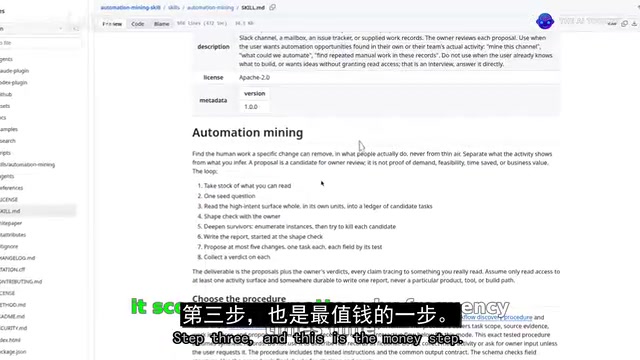
According to the skill.md file in the repository (Apache 2.0 open-source license), the entire process has four steps:
Step 1: Collect data. The Agent gathers raw work data your team produces daily.
Step 2: Taxonomy matching. Activities are classified against the taxonomy — is this data entry? An approval chain? Scheduling? Copy-pasting reports?
Step 3 (the key step): Score and rank. Each pattern is scored by frequency × time cost. How often does something happen? Multiply by how long it takes each time. This essentially puts a dollar tag on every repetitive task.
Step 4: Propose solutions. Sorted by impact, biggest financial gains first. No arguments, no office politics, just math.
Because it's just one file, any Skill-supporting Agent can use it directly. No new software, no subscription, no sales calls.
Why is frequency × time cost an effective ranking function? This is the classic priority matrix idea applied to automation. Looking at frequency alone overestimates high-frequency chores that only take seconds each time; looking at duration alone overestimates low-frequency but exhausting one-off tasks. Multiplying the two gives total time invested per week (or month), and plugging in an hourly labor rate converts it into a quantifiable dollar loss. The value of this approach isn't in how precise the formula is, but in transforming the subjective "this thing is annoying" into the objective "this thing burns $3,200 a month," turning resource allocation from debate into sorting.
Test Data: Structure Crushes Intuition
n8n Labs tested with 57 synthetic companies (fake businesses with realistic messy data), comparing "Agent with Skill" against "baseline Agent without Skill":
| Metric | Baseline Agent | With Skill | Improvement |
|---|---|---|---|
| Task recall rate | 28.2% | 51.7% | Nearly doubled |
| Proposal quality | 44.7% | 53% | +8.3 percentage points |
Recall rate refers to the proportion of real automation opportunities the Agent actually discovers. Going from 28.2% to 51.7% is nearly a doubling.
The structured taxonomy gives the Agent a clear judgment framework, performing significantly better than letting the Agent freestyle.
But to be fair: these numbers come from n8n's own synthetic data tests, with no third-party independent verification yet. The direction is right, but caution is warranted.
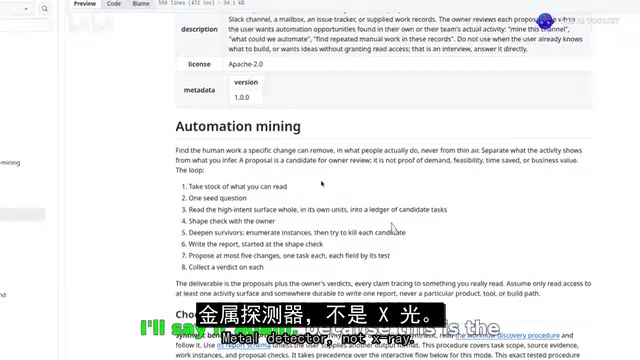
Moreover, a 51.7% recall rate means it misses nearly half the opportunities. This isn't an X-ray machine, it's a metal detector — very useful, but you still need someone who understands the business walking it through the field.
What does recall mean here? Recall is originally an evaluation metric in information retrieval and machine learning, referring to the proportion of relevant items a system correctly identifies out of all truly relevant items. In the automation mining context, "all automatable opportunities that actually exist in the team" is treated as the full set, and the portion the Agent successfully identifies divided by the full set is the recall rate. It pairs with "precision": recall cares about whether anything was missed, precision cares about whether what was found is correct. The article only reports recall doubling to 51.7% but doesn't give precision data, meaning we don't know how many of the identified opportunities are false positives — this is also something to probe further when evaluating such tools.
Why the Read-Only Design Deserves Respect
A design choice worthy of admiration: this Skill is read-only.
It doesn't publish anything, doesn't edit anything, doesn't touch your systems. It only observes, analyzes, proposes. That's it.
You don't want an experimental Skill to have write access to production data. Observe first, act later, human in the loop. More AI tools should be designed this way.
The Overlooked Business Value

The hardest part of selling automation has never been building the workflow — it's figuring out what to build.
Agencies charge $1,000 to $2,500 just to build one automation. But the discovery phase — process auditing — is a separate fee. Consultants charge heavily for audits that require weeks of interviews and spreadsheets.
Now think differently. You walk into a client meeting with a report generated this morning. Every repetitive process in their company, ranked by dollar impact. "Your team loses 40 hours a month on manual invoice matching. Here's the solution, here's the ROI timeline."
That's no longer a pitch — it's a receipt. Try saying no to a receipt.
The audit itself is a product. A 48-hour automation audit, every opportunity ranked by dollar impact. Building becomes the upsell, the audit is the door-opener.
Hand this receipt to yourself first. Most founders have 5 to 10 hours of repetitive work per week they've stopped seeing — because things you do every day become invisible.
Why is process auditing expensive? Traditional automation discovery phases typically rely on consultant interviews, on-site observation, and manually documenting processes. An audit for a mid-sized company often takes weeks and costs anywhere from thousands to tens of thousands of dollars. The high cost isn't due to technical difficulty but the friction cost of information gathering: processes are scattered across departments, and employees themselves can't clearly articulate how many repetitive actions they perform daily. Automation Mining's approach is to hand this collection and analysis work to an Agent, compressing weeks of interviews into hours of data analysis, transforming auditing from a bespoke service into a standardized, batch-deliverable product. This is the typical path of SaaS-ified consulting — converting labor-intensive expert services into software delivery with extremely low marginal costs.
Four Critical Limitations
First, synthetic data limitations. Real companies are messier — office politics, weird edge cases, "we do things differently on Tuesdays." Real-world recall will be lower, possibly much lower. Treat lab data as a ceiling, not a floor.
Second, recall ceiling. Even in n8n's own tests, recall topped out at 51.7%. On data specifically designed for it, it missed half the opportunities. Manage your expectations.
Third, read-only is both a feature and a limitation. It proposes, you build. If you can't build n8n workflows, a beautiful ranked list is just a wish list.
Fourth, too new. Released this week, expect rough edges, missing docs, weird behavior. Early adopters get the advantage and the bugs.
Action Items
Do one thing this week: write down every task your team does more than 3 times a week. Pen and paper is fine.
Then ask yourself: which ones could an Agent discover in five minutes? Congratulations, that's your automation to-do list, sorted by pain level.
The Automation Mining Skill is free, open-source (Apache 2.0), with the repository on GitHub (n8n-io-automation-mining-skill).
One last line worth remembering: before automating, find where the money is. That sentence itself is a business model.
One-line Summary
n8n open-sources the Automation Mining Skill, letting AI Agents mine what to automate before building.
Paragraph Summary
n8n Labs released the open-source Automation Mining Skill, advocating for finding what's worth automating before automating. It's a Markdown instruction file AI coding agents can directly read, built on 973,000 lines of workflow data forming a taxonomy with nearly 1 million automation patterns. The Agent analyzes team activity data and scores each repetitive task by "frequency × time cost," outputting a list of automation opportunities ranked by dollar impact. n8n's own testing shows task recall improving from 28.2% to 51.7%, but the data comes from 57 synthetic companies with no third-party verification, and the recall ceiling means it still misses nearly half the opportunities. The Skill uses a read-only design, only observing, analyzing, and proposing without touching production systems. The article also notes that automation auditing itself can be packaged as a standalone product — deliver the receipt first, then discuss building.
Related articles

Chain of Thought Isn't Just for AI: How Humans Can Use CoT to Improve Thinking Quality
Chain of Thought isn't just a prompt trick for large models. Starting from a Hacker News discussion, this article analyzes why CoT works for human thinking too, breaks down actionable ways to transfer it, and highlights the key differences between human CoT and machine CoT.
Cloudflare Teams Up with OpenAI: Closi…
Cloudflare Teams Up with OpenAI: Closing the Loop from Vulnerability Discovery to Defense with AI
Cloudflare uses OpenAI Daybreak to investigate security vulnerabilities and generate reviewable remediation plans, while developers use Codex to boost coding efficiency and quality.

Orca Multi-Agent Orchestration in Practice: A Guide to Parallel Collaboration with Claude and Codex
Orca is Stable AI's free open-source agent workbench supporting 34 agents like Claude Code and Codex in parallel. Learn its Git worktree isolation, multi-model orchestration, and mobile management.