n8n Workshop in Practice: How to Build Truly Functional AI Agents with Low-Code

A hands-on two-day n8n workshop on building real-world AI agents, covering new features and automation decision frameworks.
This two-day online workshop, led by Avenir Technology CEO Ashley Nicholson, focuses on building AI agents for real business workflows using n8n. Designed for all skill levels, it covers live workflow demos, n8n's latest features (AI Assistant and Skills), and a practical framework for deciding when automation is worth building. With a background serving Fortune 100 and government clients, the presenter brings enterprise-grade, real-world experience rather than classroom theory.
A Hands-On n8n Automation Workshop Focused on Real-World Deployment
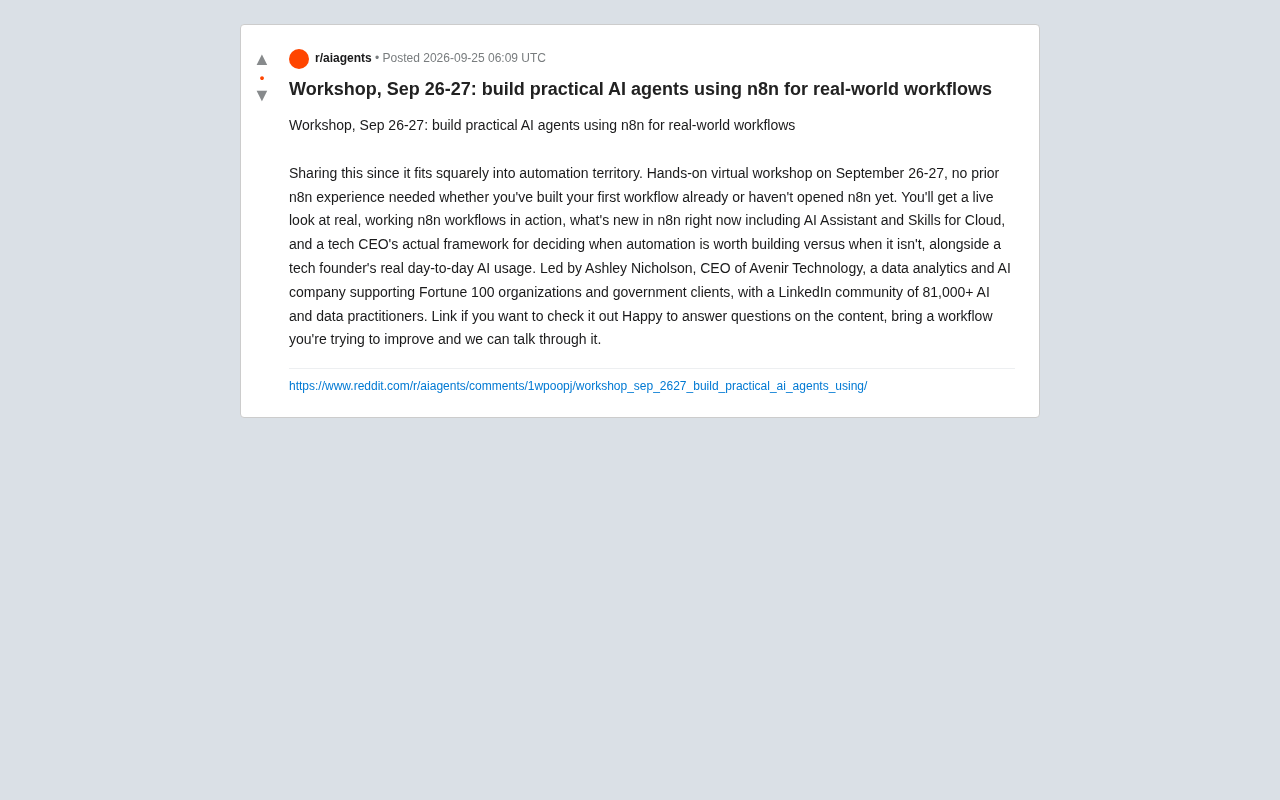
With AI Agent concepts being endlessly discussed, real-world cases where they actually run and integrate into everyday business processes remain surprisingly rare. A post recently circulating in Reddit's automation community announced a two-day online hands-on workshop centered on building AI agents for real workflows using n8n.
The workshop is designed as a hands-on, practical experience and explicitly states that no prior n8n experience is required — whether you've already built your first workflow or have never opened n8n, you're welcome to join. This low-barrier approach reflects the broader trend of low-code automation tools reaching a wider audience.
What's Inside: From Tool Updates to Decision Frameworks
Based on the public description, the workshop goes well beyond conceptual discussion and is organized around several concrete modules.
Real, Working Workflow Demonstrations
Participants will see actual, functioning n8n workflows in action within real-world scenarios. Compared to abstract architecture diagrams or slide decks, watching an automation pipeline actively running is far more effective at helping newcomers understand how nodes connect, how data flows, and what role an AI agent plays within the system.
n8n's Latest Capabilities
The workshop will cover n8n's newest features, with particular emphasis on AI Assistant and the Skills feature for Cloud users. These updates reflect n8n's evolution from a pure workflow orchestration tool into a platform that incorporates AI assistance and reusable skill modules. Readers who follow the open-source automation ecosystem will want to pay attention to these developments.
n8n is an open-source workflow automation platform that uses a visual, node-based orchestration approach, allowing users to connect APIs, databases, and services into automated pipelines without extensive programming knowledge. Compared to SaaS competitors like Zapier and Make (formerly Integromat), n8n supports self-hosted deployment so data never passes through third-party servers — a significant advantage in enterprise environments where data security is a priority. AI Assistant is a recently introduced built-in AI feature that suggests node configurations or debugs errors based on natural language descriptions, lowering the barrier for building complex workflows. Skills (currently available for Cloud users) are reusable, pre-built capability units — similar to encapsulated modules in a function library — that let users package common AI task logic into a Skill and invoke it across multiple workflows, eliminating redundant builds and making it easier for teams to share standardized automation components.
When to Automate — and When Not To
One easily overlooked but highly valuable segment is the presenter's framework for deciding when it's worth building an automation and when it isn't. Over-engineering is a common trap in automation — spending significant time building a complex pipeline for a task that happens only a few times a month rarely pays off. A practical decision framework from a tech company CEO provides far more actionable guidance than pure technical instruction when it comes to developing the right cost-benefit instincts.
The workshop will also offer a look at how a tech founder actually uses AI in their day-to-day work, grounding the content in real application rather than theoretical demonstration.
Automation decision frameworks are often harder to develop than the technical implementation itself. A common evaluation dimension is "frequency × time cost" — automation only pays for itself within a reasonable timeframe when a task repeats often enough and takes long enough each time. Beyond that, factors such as the degree of standardization (how many exceptions require human judgment), error tolerance (how costly a failure would be), and maintenance overhead (how frequently APIs or business rules change) all need to be weighed. For early-stage teams or small operations, chasing "end-to-end automation" too soon often locks limited engineering resources into maintaining fragile pipelines, ultimately slowing overall momentum. This is why the perspective of a CEO who has actually managed enterprise-level projects tends to carry more practical weight on this topic than that of a purely technical instructor.
About the Presenter
The workshop is led by Ashley Nicholson, CEO of Avenir Technology — a company specializing in data analytics and AI, with clients that include Fortune 100 organizations and government agencies. The presenter also runs a LinkedIn community of over 81,000 AI and data professionals.
This background suggests the content is more likely to draw from enterprise-level, real-client experience than from classroom-style demonstrations. For readers interested in how automation plays out inside large organizations, this context is worth noting.
What This Means for You
The real value of workshops like this isn't that they're "yet another AI tool tutorial" — it's that they try to answer a more practical question: In real business environments, how should AI agents and automation actually be used, and when?
Different audiences can take away different things:
- n8n newcomers: The beginner-friendly design offers a fast, intuitive introduction to workflow orchestration.
- Experienced users: The bigger draws are the AI Assistant and Skills updates, along with the automation decision framework.
- Team decision-makers: The presenter's enterprise perspective and the "should we automate this?" decision criteria may be more valuable than the technical walkthroughs.
The presenter has also mentioned that participants are welcome to bring their own workflows they're trying to optimize for group discussion. This interactive, problem-driven format is typically more effective than one-way instruction.
Takeaway
As an event that surfaced from the Reddit automation community, this n8n workshop stands out for its emphasis on practicality and real-world application — live workflow demonstrations, the latest tool features, and a decision-making framework for evaluating automation trade-offs. For readers exploring how to integrate AI agents into their daily business workflows, it offers a window into enterprise-level practice. Of course, how much you take away will depend on your background and level of engagement, so approach it with realistic expectations.
Related articles

After GPT-6 Ignites Generative UI, the Next Gap Is Generative Workflow
After GPT-6's Intelligent UI brings Generative UI mainstream, the execution layer beneath the interface matters just as much. This article unpacks Generative Workflow and how FlowX makes agent skills runnable, editable, and evolvable.

I Gave Four AI Coding Agents a $100 Budget Each: Who Could Build a PDF Editor?
A developer gave four AI coding agents a $100 budget each to build a PDF editor. This analysis examines what the experiment reveals about real-world AI coding tool capabilities.

Anthropic's New Policy: Abusing Claude Could Get You Banned
Anthropic reportedly plans a November 2026 policy banning users who "abuse" Claude. We analyze the motivations behind it — from abuse prevention to AI welfare — and what it means for users.