Nano Banana 2.1 Launches, Mistral Large 4 Scores 38 on AI Benchmark

Nano Banana 2.1 launches, Mistral Large 4 tops benchmarks outside China/US, and OpenAI math manuscripts spark controversy.
This edition covers major AI developments: Google's Nano Banana 2.1 signals a shift in image generation toward production-ready workflows; Mistral Large 4 scores 38 on third-party benchmarks with a 1-trillion-parameter MoE architecture, becoming the top model outside China and the US; a Chinese AI company closes in on 100 billion RMB in funding; and OpenAI's release of 722 math manuscripts draws pushback from a panel including 3 Fields Medal winners, exposing the gap between AI output speed and academic verification capacity. Google also released EmbeddingGemma 2 and embedded AI deeper into Workspace.
The pace of AI industry updates continues to accelerate. This edition covers developments ranging from image generation model upgrades and open-source benchmark breakthroughs, to record-breaking funding rounds for Chinese AI companies and controversy over OpenAI's math manuscripts — with a look at the trends behind each.
Google Launches Nano Banana 2.1: Image Generation Shifts Toward "Production-Ready Assets"
Google has officially released the Gemini Nano Banana 2.1 model, designed for efficient image generation and conversational editing. As an upgrade to Nano Banana 2, it maintains Flash-level speed while significantly improving real-world output quality. The model is now integrated across 7 Google products, including the Gemini API, AI Studio, Gemini App, Google Flow, and Stitch.
With the new model live, the previous generation Gemini Flash Image will be officially deprecated on the 29th of this month. The key signal here: the competitive focus in image generation is shifting from "visually impressive" to "delivering production-ready design assets." In other words, the evaluation standard is moving from aesthetic quality toward seamless integration into real design and production workflows.
Mistral Large 4: The First Model Outside China and the US to Post Hard Numbers
French AI company Mistral has released Mistral Large 4, scoring 38 points on a third-party intelligence index benchmark — placing it in the same tier as top GPT-series models. The evaluation body described it as "the most intelligent model outside China and the US."
Architecturally, it uses a MoE design with 1 trillion total parameters and 49 billion active parameters, with native multimodality, a 512K-token context window expandable up to 256K tokens. Mistral plans to open-source the weights by the end of October, and the model is currently available for public testing on open platforms. Pricing is highly competitive: $0.68 per million input tokens and $2.09 per million output tokens for the first two weeks.
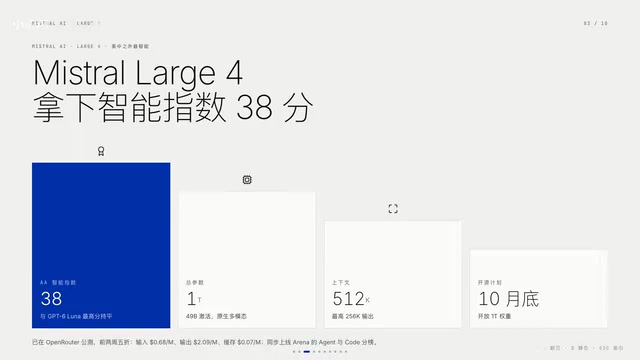
This marks the first time a non-Chinese, non-US player has delivered quantifiable, hard benchmark results. For a long time, the frontier model narrative has been almost entirely dominated by American and Chinese players. Mistral's performance provides a rare reference point for the European AI ecosystem, and demonstrates that the open-source path can still compete with closed-source leaders.
What is MoE? MoE (Mixture of Experts) is a model architecture paradigm that divides a neural network into multiple "expert" sub-networks, activating only a small subset during each inference pass rather than all parameters. Of Mistral Large 4's 1 trillion total parameters, only about 49 billion are activated per inference. This means the model retains the expressive power of a large model while dramatically reducing per-inference compute costs — which explains its competitive pricing. MoE naturally balances "model scale" with "inference overhead" and is one of the most popular approaches for reducing operational costs among frontier models. GPT-4 and the Gemini series are also widely believed to use similar designs.
Chinese AI Funding Breaks Records
According to Bloomberg, a major Chinese AI company is close to finalizing a new funding round of at least 80 billion RMB (approximately $12 billion USD) — far exceeding its original target of around 50 billion RMB, with the final figure potentially reaching 100 billion RMB. Sources say CATL and Tencent are the largest contributors, and the deal is expected to close soon.
The round will pave the way for a planned IPO in early 2027. Notably, the company had only completed its first external funding round of approximately $7.4 billion just one month prior — yet again setting a new record for single-round fundraising in Chinese AI. Capital's conviction in compute infrastructure and large models continues to intensify.
OpenAI Releases 722 Math Manuscripts, Sparking Academic Controversy
OpenAI has released 722 math manuscripts all at once, produced by an unreleased internal model and organized into 372 sets of results touching on several frontier mathematical conjectures. Source code and partial proofs have been uploaded to GitHub. The company says the model attempted approximately 4,000 research problems, with each result consuming compute roughly equivalent to ChatGPT thinking for 3 hours.

However, an independent advisory panel of 9 scholars — including 3 Fields Medal winners — promptly issued a statement clarifying that this did not represent their endorsement of the results or the process. The disconnect is telling: when AI produces mathematical results faster than humans can read and verify them, the academic validation system faces unprecedented pressure. Quality and credibility, not output volume, are the real bottleneck.
What is the Fields Medal? The Fields Medal is the highest honor in mathematics, often called the "Nobel Prize of mathematics." It is awarded every four years and only to mathematicians under 40. The fact that 3 medal recipients participated in the review panel represents an extraordinarily high level of academic authority. Their choice to publicly state they did "not endorse the results or the process" — rather than staying silent — signals that the academic community holds a cautious, even skeptical view of AI-generated mathematical conclusions. The core debate: do proof steps that look formally correct constitute genuine mathematical proofs? Human mathematicians don't just check symbolic derivations — they exercise deep judgment about lines of reasoning, conceptual boundaries, and counterexamples. These are precisely the aspects of AI outputs that are hardest to verify quickly from the outside.
EmbeddingGemma 2: Lightweight Multimodal Embedding Model Lowers the Bar for On-Device RAG
Google has released a lightweight multimodal embedding model with 740 million parameters, built on the Gemma architecture and open-sourced under the Apache 2.0 commercial-friendly license. For the first time, it maps text, code, images, video, and audio into a unified embedding space, sharing a text tokenizer and audio encoder with the main model — allowing them to run together in the same inference pipeline.
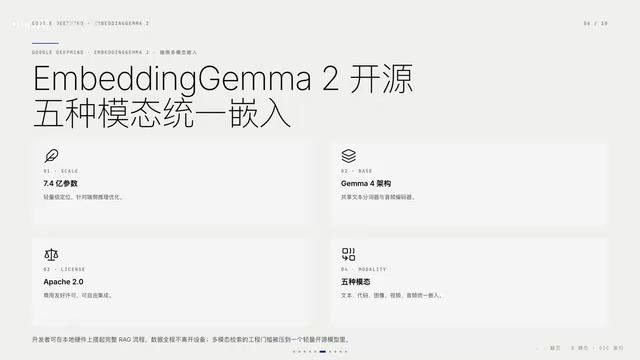
The model is optimized for on-device use, enabling developers to build a complete RAG pipeline on local hardware with data never leaving the device. This compresses the engineering complexity of multimodal retrieval into a single lightweight open-source model — a practical step forward for use cases that prioritize data privacy and local deployment.
What is RAG? RAG (Retrieval-Augmented Generation) is a framework that enables large language models to retrieve from an external knowledge base before answering questions. Documents, images, and other content are converted into vectors ("embeddings") and stored in a vector database. At query time, the most relevant fragments are retrieved and passed to the generative model along with the original question. Embedding model quality directly determines retrieval accuracy. EmbeddingGemma 2's value lies in mapping text, images, audio, and other modalities into a single shared vector space — previously, multimodal RAG often required deploying separate encoders for each modality, adding significant engineering complexity. Compressing the entire pipeline into a 740M-parameter model that runs on local hardware dramatically reduces dependence on compute and network connectivity, making it especially useful for privacy-sensitive domains like healthcare and legal services.
AI Assistant Moves Into Documents: Workspace Embedded Capabilities Enter Public Beta
Google also announced that AI capabilities for Workspace have entered public beta, covering Docs, Sheets, and Slides. The AI appears as a sidebar panel alongside the document, reads the currently open file, and edits it directly — with all changes tracked in version history.

In Sheets, it can write formulas and build pivot tables; in Slides, it can create new pages matching existing layouts and check for issues like overlapping elements or text that's too small. This capability is available to all paid plans. The AI assistant is clearly moving from a standalone chat window into the document itself, deeply embedded in everyday office workflows.
Closing Notes
Beyond the above, one vendor has launched an expanded cybersecurity verification program offering tiered access to frontier models for qualified security professionals — as frontier models grow more capable of dual-use applications, tiered security access is becoming standard practice among leading players. A prospectus also revealed that one AI infrastructure company plans to spend at least $518 billion over the next decade, with roughly 80% as take-or-pay commitments — trading certainty of expenditure for guaranteed compute capacity. Taken together, these developments point to a clear conclusion: model capability, compute supply, and safety governance are becoming the three defining competitive threads of this AI cycle.
Related articles

Gaussian Process Bandit Optimization: Exploration Strategies and Inference Regret Guarantees
Cumulative regret guarantees in Bayesian optimization fail to reflect final recommendation quality. This article examines a new study that provides inference regret guarantees for Gaussian process bandit optimization through exploration query strategies and fill distance analysis, validated on hyperparameter optimization and control tasks.

The Most Detailed Codex Guide on Bilibili: From Installation to Real-World Practice
The most detailed Codex guide on Bilibili: from app store installation to daily work mode configuration, with a real coffee shop project demonstrating file organization, data extraction, dashboard creation, and other practical tasks. Learn to use Plan Mode and desktop pets to leverage Codex efficiently.

Appearance Compensation in Volume Rendering: Why RGB Accuracy Cannot Guarantee Density Correctness
Volume rendering research reveals that volumetric data perfectly reproducing external RGB views may still contain density errors: appearance compensation can double central density and keep external rays unchanged even when L2 error exceeds 14.52%. Density recovery depends on appearance capacity, spatial resolution, and measurement design.