Nanocodex: Building High-Performance AI Agent Foundation Components with Rust

Nanocodex leverages Rust to build modular, high-performance foundation components for OpenAI AI Agents.
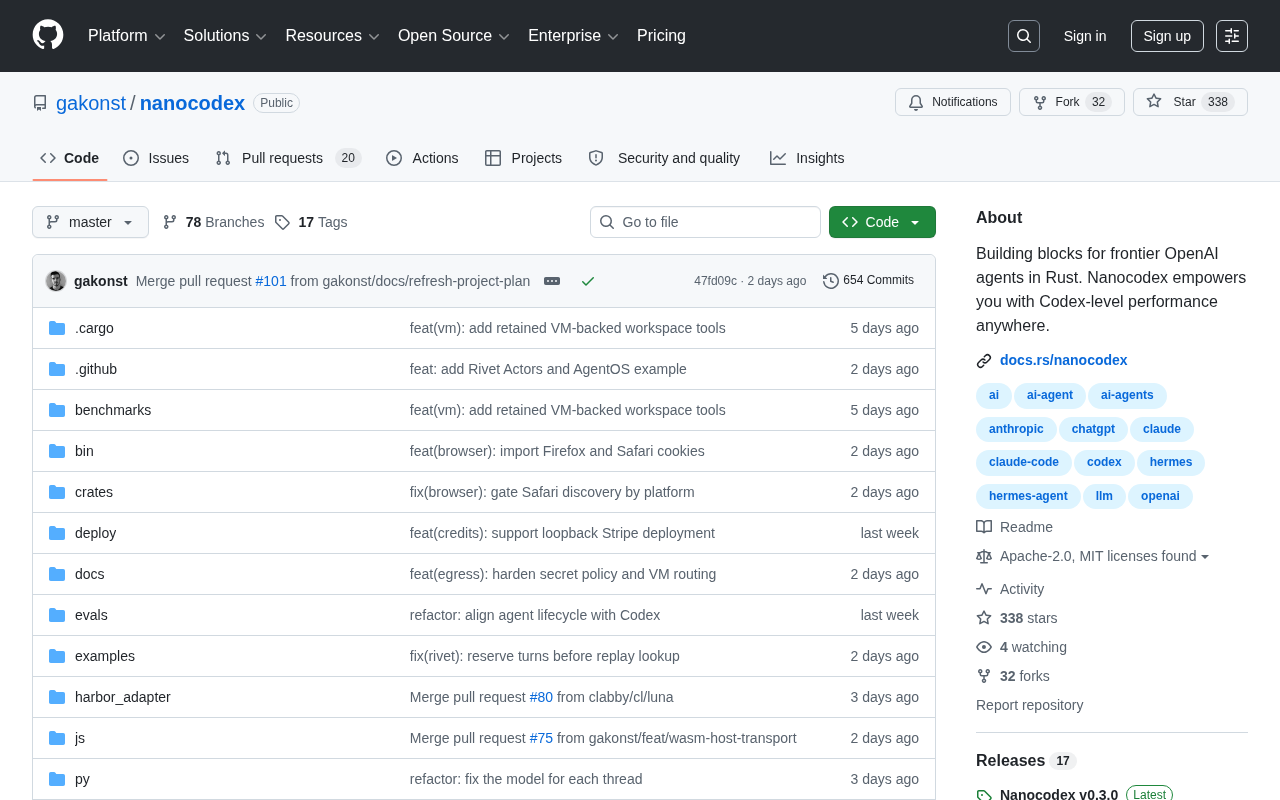
Nanocodex is an early-stage project that uses Rust to build modular, high-performance building blocks for OpenAI Agents. By leveraging Rust's zero-cost abstractions, ownership-based memory safety, and powerful async concurrency model, it addresses Python's limitations in production AI Agent deployments. The project reflects a broader industry trend toward language diversity in AI infrastructure, where Rust handles performance-critical runtimes while Python remains dominant for experimentation.
The Infrastructure Revolution in AI Agent Development: Why Rust?
As large language models advance rapidly, building autonomous AI Agents has become an industry focal point. A typical AI Agent operates in an Observe-Think-Act Loop—during a single task execution, the Agent may need to invoke an LLM for reasoning multiple times, execute several tools in parallel (such as search engines, code executors, and database queries), and maintain complex dialogue states and memory systems. However, most Agent frameworks are built on the Python ecosystem. While convenient for development, Python has inherent bottlenecks in performance, memory safety, and concurrent processing. Python's GIL (Global Interpreter Lock) becomes a serious bottleneck in high-concurrency scenarios, and its dynamic type system makes complex state management prone to runtime errors. The emergence of the Nanocodex project represents an entirely new technical approach—using Rust to build high-performance foundation components for cutting-edge OpenAI Agents.
This project appeared on Hacker News and, while still in its early stages of attention, its technical positioning deserves in-depth discussion: it aims to provide more reliable and efficient underlying support for next-generation AI Agent systems.
Why Choose Rust for Building AI Agents
The Dual Advantages of Performance and Safety
Rust has risen rapidly in the systems programming domain in recent years, with its core advantages being zero-cost abstractions and memory safety guarantees. Zero-Cost Abstractions originate from a design principle proposed by C++ creator Bjarne Stroustrup: high-level abstractions should not incur additional runtime overhead. In Rust, advanced features like generics, traits, and iterators are expanded into efficient machine code at compile time, so developers don't need to trade off between code expressiveness and execution efficiency. Rust's innovative Ownership System statically verifies memory allocation and deallocation at compile time through three concepts—ownership, borrowing, and lifetimes—fundamentally eliminating dangling pointers, double frees, and data races without relying on a garbage collector or manual memory management.
For AI Agents—systems that need to run for extended periods with frequent network requests and state management—Rust's features are particularly well-suited:
- High performance without garbage collection: When Agents handle massive concurrent tool calls and API requests, Rust delivers execution efficiency close to C/C++, avoiding latency jitter caused by GC. In scenarios requiring WebSocket long connections and stateful session context management, deterministic memory management means more predictable latency behavior.
- Compile-time memory safety: The ownership system eliminates null pointers, data races, and other common errors at the compilation stage—critical for autonomous agents that need to run stably. For an Agent running 24/7 in production, any memory leak or segfault could lead to catastrophic consequences.
- Powerful concurrency model: Modern Agents often need to handle multiple task streams simultaneously. Rust's async/await model makes high-concurrency orchestration more reliable. Rust's async tasks are compiled into state machines rather than runtime objects requiring extra threads or coroutine stacks. Combined with multi-threaded work-stealing schedulers in async runtimes like Tokio, hundreds or even thousands of concurrent API calls can be efficiently distributed across a small number of OS threads, with memory footprint and context-switching overhead far lower than traditional thread pool models.
The Paradigm Shift from Python to Rust
Currently, mainstream Agent development frameworks like LangChain and AutoGPT are primarily Python-based. Python's advantages lie in its rich ecosystem and low learning curve, but in production deployments, its performance overhead and runtime errors often become pain points. By choosing Rust, Nanocodex is essentially an attempt to push AI Agents from the "rapid prototyping" phase to "production-grade infrastructure." This transition is similar to the evolution in web development from Ruby/Python prototypes to Go/Rust high-performance services—when system complexity and reliability requirements exceed a certain threshold, the value of static typing and compile-time guarantees becomes apparent.
Nanocodex's Technical Positioning and Design Philosophy
The Modular Building Blocks Approach
The term "Building blocks" in the project name reveals that Nanocodex isn't trying to be an all-encompassing framework, but rather provides modular foundation components. This design philosophy aligns with the software engineering community's preference for the "small and beautiful" approach—developers can assemble customized Agent systems like building blocks based on their specific needs. In the Rust ecosystem, this philosophy naturally aligns with the design of crates (Rust's package management units): each crate has a single responsibility, clean interfaces, and can be independently compiled and tested.
The value of this modular approach lies in:
- Reducing framework coupling, avoiding the common "all or nothing" dilemma of large frameworks;
- Making it easier for developers to understand each component's responsibilities, improving code maintainability;
- Providing flexible low-level support for building complex, cutting-edge Agent systems.
Deep Integration with the OpenAI Ecosystem
The project explicitly positions itself for "OpenAI agents," meaning it provides deep adaptation for OpenAI's APIs and Agent patterns. OpenAI's Assistants API, launched in late 2023, is a stateful Agent interface with built-in thread management, file retrieval, and code interpreter capabilities, allowing developers to build intelligent assistants with persistent memory. Function Calling is one of the core capabilities of OpenAI models—the model can output structured function call requests (including function names and parameters) based on user intent. Developers execute these functions locally and feed the results back to the model for continued reasoning. This pattern evolves LLMs from pure text generators into the intelligent core capable of manipulating external tools.
How to efficiently manage the lifecycle of these API calls—error retries, rate limiting, and streaming response parsing—is precisely the engineering problem that the underlying runtime needs to solve. In Rust, the strong type system can precisely model API responses, catching parameter type mismatches at compile time; the ownership system ensures that streaming data won't be accidentally dropped or consumed multiple times in async processing chains. Nanocodex aims to fill this gap in the Rust ecosystem.
The Trend Toward Language Diversity in AI Infrastructure
Rust's Rise in AI Engineering
While Python remains the dominant language in AI, an increasing number of projects are adopting Rust for critical scenarios like inference engines, model serving, and Agent runtimes. Candle, developed by Hugging Face, is a lightweight ML inference framework written entirely in Rust that supports running mainstream models on CPU and GPU. Qdrant is a high-performance vector database built with Rust, optimized specifically for large-scale semantic search. Additionally, some low-level components of vLLM, MistralAI's inference server mistral.rs, and Mozilla's llamafile project all demonstrate Rust's penetration into the AI inference stack.
These projects collectively indicate that AI engineering is forming a layered architecture: Python handles model training and rapid experimentation, Rust handles inference engines and production-grade runtimes, and the two collaborate through FFI (Foreign Function Interface) or gRPC interfaces. Nanocodex is a continuation of this trend at the Agent layer—it's not about replacing Python's role in AI exploration, but providing a more solid foundation for production deployment of Agent systems.
The Exploratory Value of Early-Stage Projects
It should be objectively noted that Nanocodex currently has limited discussion on Hacker News, indicating it's still in a very early exploratory stage. For such projects, we should focus more on the foresight of their technical direction rather than their current community size. Many important tools in the open-source community grew from obscure beginnings—Tokio was initially just an experimental project for a few Rust developers and has since become the cornerstone of Rust's async ecosystem; similarly, LangChain was just a simple collection of Python scripts when it launched in late 2022.
Practical Insights for Developers
For developers building AI Agents, Nanocodex's emergence offers several directions worth considering:
- Consider Rust for performance-sensitive scenarios: If your Agent needs to handle high concurrency, low latency, or long-running tasks, the Rust ecosystem is worth including in your technology evaluation. Especially in scenarios requiring thousands of concurrent sessions or strict P99 latency requirements, Rust's deterministic performance advantage is significant.
- Modularity over monolithic frameworks: Rather than being locked into large frameworks, choose composable foundation components to maintain system flexibility. This also means developers need clear architectural awareness of each layer of an Agent system—prompt management, tool orchestration, state persistence, and error recovery.
- Focus on production-grade reliability: From prototype to production, memory safety and operational stability are unavoidable concerns. An Agent that occasionally crashes in a development environment might be acceptable, but when deployed as a customer-facing automated service, every abnormal interruption can lead to task loss and eroded user trust.
- Pay attention to cross-language collaboration patterns: Future AI Agent systems will likely not be built in a single language, but rather a multi-language collaboration involving Python (experimentation and training), Rust (core runtime), TypeScript (frontend interaction), and others. Understanding how to perform cross-language integration through FFI, WebAssembly, or RPC will become an essential skill for AI engineers.
Conclusion
Although Nanocodex is still an early-stage project, it reflects the deep changes occurring in AI Agent development—a shift from pursuing rapid experimentation to building reliable, high-performance production-grade infrastructure. Using Rust to build components for OpenAI Agents is a technical approach that may still need time to validate, but the pursuit of performance and safety behind it undoubtedly represents an important direction in AI engineering. As Agent systems evolve from simple chatbots to digital workers capable of autonomously executing complex workflows, the reliability requirements for underlying runtimes will only increase. For developers following the evolution of AI infrastructure technology, explorations like this are worth continued attention.
Related articles

The Scaling Dilemma of Vertical AI Engine MLOps: Engineering Practices from Prototype to Scale
Exploring MLOps scaling challenges for vertical AI engines moving from prototype to production, covering model iteration pipelines, data drift detection, and inference cost optimization.

The Boy Who Cried Wolf Effect in AI Safety Warnings: Why the Public No Longer Believes "Dangerous"
The AI industry's repeated claims that new models are "too dangerous" have severely depleted public trust. This article analyzes how AI safety warnings became marketing tactics and how to rebuild credible risk communication.

Samsung Support Agent Accidentally Pastes ChatGPT Prompt, Exposing How AI Customer Service Really Works Behind the Scenes
A Samsung support agent accidentally pasted a ChatGPT prompt into a customer chat, revealing how enterprise AI customer service really operates behind the scenes.