National Geographic Glow-in-the-Dark Marble Run: Building a Mega Machine with Three Sets

Three Nat Geo glow marble run sets assembled into a mega build, testing glow effect and minimalist racing.
This article follows a YouTube video in which creators combine three National Geographic glow-in-the-dark marble run sets—240 pieces total—into one giant track with multiple loops and spirals, insisting on using every piece in the first build. The video also features a 15-piece speed challenge, where vertical stacking for near free-fall wins by minimizing curve resistance. The glow effect is verified with the lights off: marbles and track pieces glow clearly in darkness, no gimmick. Key takeaways: structural stability is the main challenge in multi-set builds and needs extra reinforcement; minimalist constraints spark creative solutions; and multiplayer collaboration is a natural social scenario for this toy.
Marble run toys have long been a popular category for introducing kids to engineering, and National Geographic's glow-in-the-dark version upgrades "build it and play" to "turn off the lights and watch it glow." This YouTube video uses three Nat Geo marble run sets to assemble one giant track and puts the glow-in-the-dark effect to the test.
A Mega Project: Three Sets, 80 Pieces Each
At the start of the video, the creators unbox all three National Geographic marble run sets. Each set contains 80 pieces, meaning that combined, there are over two hundred connectable modules. They set a hard goal for themselves: use every single piece on the very first build.
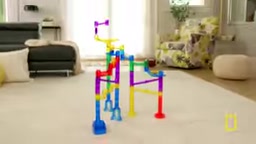
That decision immediately raised the difficulty. The more pieces there are, the more prone the track structure is to destabilizing under gravity—especially from the lateral impact forces generated when marbles whip through curves at high speed. In the video, the finished track is impressively long, with multiple loops and spiral sections—what the creators call "swifty, spirally stuff," designed to build drama toward the finish. After a three-count, the marble is released from the start and clears every obstacle in sequence.
The Physics of Marble Runs: Potential Energy, Kinetic Energy, and Lateral Impact
On the surface, marble runs are a building game, but underneath they're a system of energy conversion and force analysis. A marble released from height gradually converts gravitational potential energy mgh into kinetic energy ½mv². In theory, the steeper the track and the greater the drop, the faster the marble's exit speed. But curves introduce new variables: a marble needs centripetal force to turn, provided by the track's side walls. The higher the speed and the smaller the radius of curvature, the greater the lateral impact force—roughly mv²/r. This means that within any given section, the force on a curve is proportional to the square of the velocity, making curves the most destabilization-prone spots. Friction at piece joints, gaps between track segments, and slight unevenness in the floor all chip away at theoretical speed. So when building a large track, you need enough drop to guarantee speed, but also reinforced connections at curves and appropriately enlarged turning radii to strike a balance between speed and stability.
The 15-Piece Speed Challenge: Thinking in Minimal Structures
After the mega build, the video shifts to a small competition: each person can use only 15 pieces, and whoever makes the marble go fastest wins.

The first creator to go offers an intuitive solution—build a tower, stacking pieces vertically one after another, so the marble plunges almost in free fall. The essence of this approach is reducing track length and the number of curves, converting gravitational potential energy as directly as possible into falling speed. The 15-piece limit actually forces a minimalist engineering mindset: rather than chasing spectacle, spend every piece on reducing resistance.
Friction and Energy Loss: Why Simple Structures Are Actually Faster
In a marble run, the marble's final speed depends not only on the drop height but also on energy losses along the way. Every roll incurs rolling friction, every bump against a track seam loses kinetic energy, and wall friction on curves drains energy too. The more energy lost, the lower the actual speed at the finish. The vertically stacked tower wins the speed challenge because it compresses track length to the minimum—the marble falls in near free-fall, with minimal contact surface, a straight path, and few curves, keeping energy loss close to the theoretical minimum. This also shows that long, complex tracks excel in spectacle but are often a disadvantage in speed: more pieces, more joints, more turns mean greater friction and collision losses. Understanding this is valuable when evaluating the performance of any marble run design.
Glow-in-the-Dark Test: From Sand to Glass to Shining in the Dark
The video weaves in a bit of science about glass marbles. The narration notes that the humble glass marble originally comes from sand—most glass is made by melting sand at extremely high temperatures and then cooling it. National Geographic's selling point here is that the marbles and some track pieces glow in the dark.

The creators head into a room and turn off the lights to verify. The instant the lights go out, the marbles and track parts take on a fluorescent quality, like "someone poured some kind of potion" on them.

The core principle behind glow-in-the-dark toys is usually fluorescent or phosphorescent materials: they absorb ambient light and slowly release energy in darkness. From the video footage, this product's glow is bright enough to clearly make out the track's path in a fully dark room—key for the "lights-off viewing" experience after a build is complete.
Fluorescence vs. Phosphorescence: Two Different Glow Mechanisms
Glow materials fall into two main engineering categories. The first is fluorescent materials, which emit visible light almost simultaneously after absorbing UV or visible light. They're bright instantly and vividly, but once the light source is removed, the glow decays within milliseconds to seconds—so pure fluorescence can't keep a toy visible in the dark. The second is phosphorescent materials, also called long-persistence materials, typically strontium aluminate doped with europium (SrAl₂O₄:Eu²⁺, Dy³⁺). When exposed to light, they store energy in electron traps within the material; after the light source is removed, electrons in those traps slowly release energy, sustaining a glow for minutes to tens of minutes with a decay curve that's roughly exponential. Whether a toy's glow is a gimmick or genuinely useful comes down to glow duration and initial brightness—long-persistence materials are typically an order of magnitude brighter than ordinary phosphors right after the lights go out, enough for the human eye to discern track outlines after dark adaptation.
A Few Things Worth Noting About This Toy Experience
Combining three marble run sets into one build exposes some issues that aren't obvious with a single set, while also showcasing the product's strengths:
Structural stability is the biggest challenge. The more pieces there are, the more prone the whole thing is to loosening at key joints. In the video, the creators repeatedly check "finishing touches" before the final launch, showing that large-scale builds require extra reinforcement and debugging time.
The glow effect genuinely works. After lights-out, the marbles and track pieces are visibly luminous to the naked eye—not a gimmicky faint fluorescence. This creates a complete experience loop from daytime building to nighttime viewing.
Minimal constraints spark creative solutions. The 15-piece challenge is simple, yet it unexpectedly reveals another way to play with marble runs—not chasing length and complexity, but efficiency and speed.
Multiplayer collaboration is a natural fit. In the video, the creators mention "you could have a sleepover party and play together." The sheer volume of three sets is well-suited for two or three people building in parallel, giving it much stronger social appeal than a single-player toy.
By the video's end, the final marble's run on the giant track delivers some suspense—the creators at one point think it'll be a "tie." That uncertainty at the moment of launch is precisely the core fun of marble run toys: you never know whether the marble will get stuck on some curve.
One-line Summary
Three Nat Geo glow-in-the-dark marble run sets assembled into a mega build, testing the glow effect and a minimalist speed challenge.
Paragraph Summary
This article covers a YouTube video in which creators merge three National Geographic glow-in-the-dark marble run sets—240 pieces total—into one giant track. The course includes multiple loops and spiral sections, and the creators insist on using every piece in the first build. The video also features a 15-piece speed challenge, where the simplest solution is vertical stacking for near free-fall to cut curve resistance. The glow-in-the-dark portion is verified with the lights off: marbles and track pieces glow clearly in darkness, and it's no gimmick. The article then summarizes a few takeaways: structural stability is the main difficulty when combining multiple sets and requires extra reinforcement and debugging; minimalist constraints spark creative solutions; and multiplayer collaboration is a natural social scenario for this toy.
Related articles

Amphibious Transforming Drone: Beyond 100x Power Savings, What Are the Real Needs?
Is the amphibious transforming drone just a gimmick? Starting from the 100x power difference of the M4 Morphobot, explore real application scenarios and thesis topic ideas, analyzing boundary conditions where pure drones and pure ground robots both fail.

Warhound Raises $200 Million: Genetically Engineered "War Dogs" Paired with Anduril Gear
Warhound raises $200M, backed by Ben Lamm and Palmer Luckey, to genetically engineer dogs for military and law enforcement use and equip them with Anduril gear. This article analyzes its technology direction, funding logic, and ethical controversy.

Claude API Comes to Google Cloud: IAM Integration and SDK Access Guide
Anthropic hosts the full Claude API on Google Cloud with IAM-controlled permissions and unified billing. This guide covers the Vertex AI and Anthropic-hosted entry points, IAM role configuration, and SDK access.