National Geographic Glow-in-the-Dark Marble Run: Creative Building and Racing Experience
Building a giant track and racing with three National Geographic glow-in-the-dark marble run kits, showcasing hands-on fun and STEM value.
This article covers a YouTube video project where creators used three National Geographic glow-in-the-dark marble run kits to build a giant track and race on it. It discusses the product's glow-in-the-dark features, spiral and rotating structures during building, the tie result in the race, and the STEM educational significance of marble runs. Phosphorescent materials add visual fun in low light; building involves centripetal force and gravitational potential energy conversion; racing tests track stability and symmetry. This project blends crafting, physics, and entertainment, suitable for DIY enthusiasts and parent-child activities.
At the intersection of technology and creative crafting, the Marble Run has always been a fascinating concept. It blends basic physics, structural engineering, and pure playfulness. Recently, a YouTube video demonstrated how to use three National Geographic glow-in-the-dark marble run kits to build a giant track and race on it. This article takes you through the product features, building process, racing experience, and educational significance of this project.
Product Overview: National Geographic Glow-in-the-Dark Marble Run
National Geographic's glow-in-the-dark marble run kit features parts that glow in the dark, designed to combine the fun of marble games with visual surprise. Each set includes various track pieces, connectors, and marbles. According to the video description, this project used three such kits, aiming to combine them into a "giant" track whose length and complexity far exceed a single set.
The glow-in-the-dark feature is typically achieved through phosphorescent materials, which emit a soft glow in the dark after being exposed to light, adding visual tracking fun to the marble's rolling path. This design not only appeals to children but is also loved by many adult makers.

Phosphorescent materials (also known as glow-in-the-dark materials) are a special class of materials that can absorb external light energy (such as sunlight or lamplight) and slowly release it in dark environments. The most common types are rare-earth aluminate or zinc sulfide phosphors, which store and release light energy through electron energy level transitions. When used in toy tracks, the phosphor is typically mixed into plastic or paint, causing the entire component to produce afterglow after exposure to light. The duration and brightness of the afterglow depend on the material type and lighting conditions, generally lasting from tens of minutes to several hours. This property requires no batteries, is environmentally friendly and safe, and is therefore widely used in children's toys, safety signage, and decorative items. In marble runs, phosphorescent components provide clear visual tracking of marble movement in low-light environments, enhancing the immersion and fun of the game.
Building Process: From Scratch to Giant Track
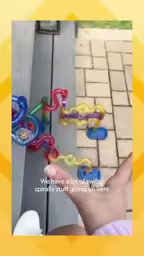
Building a multi-kit marble run is no easy task. In the video, the creators first planned the overall layout of the track, then assembled it step by step. From the screenshots, we can see they were "putting the finishing touches," indicating that a significant amount of time had already been invested. The track includes "a lot of swifty, spirally stuff" — these spiral and rotating structures are the parts of a marble run that best demonstrate physical principles (such as centripetal force and gravitational potential energy conversion).
Moreover, according to the description, this track is "so long," meaning it takes quite a while for the marble to complete the entire course, placing higher demands on the track's stability and connection precision.

In marble runs, spiral and rotating structures are typical designs that showcase physical principles. Centripetal force keeps the marble in circular motion along curved or looped tracks, with the direction pointing toward the center; when the marble descends through a spiral, gravitational potential energy converts to kinetic energy, gradually increasing speed while friction continuously dissipates mechanical energy. Building these structures requires consideration of track slope, radius of curvature, and smoothness at connections to prevent the marble from derailing or getting stuck. For a giant track combining multiple kits, the connection angle and height difference of each spiral component affect overall smoothness. By adjusting these variables, players can intuitively observe energy conversion and conservation — a practical approach to "understanding science through design iteration" emphasized in STEM learning.
Racing Time: Anticipation and Results
After building was complete, the team conducted a race test. In the video, after counting down "3, 2, 1" and releasing the marbles, the creator said, "I think it's going to be a tie." This suggests they may have released multiple marbles simultaneously, or the track design was such that marbles on different paths arrived at the finish almost at the same time.
Racing is not just entertainment — it's also a way to test whether the track design is reasonable. If marbles frequently derail or get stuck, it indicates structural flaws; a tie may mean the track has excellent symmetry, or the starting conditions of the marbles were well controlled.
Educational Significance and Inspiration
Marble run toys are often used in STEM education to help understand concepts such as gravity, kinetic energy, potential energy, and friction. As a well-known science popularization brand, National Geographic products typically come with learning guides. Through building and debugging, players can exercise spatial imagination and problem-solving skills.
Additionally, the glow-in-the-dark element adds fun and visual feedback, making it especially suitable for observing marble trajectories in low-light environments. The three-kit combination approach in the video also inspires how expanding kits can enhance challenge and creativity.
STEM education is an interdisciplinary integration of Science, Technology, Engineering, and Mathematics, emphasizing hands-on practice to solve real-world problems. Marble run toys naturally align with this philosophy: building requires geometric spatial planning, structural mechanics, and material connection knowledge; debugging requires observing the conversion of gravity and kinetic energy, the effects of friction, and recording data to optimize design. Brands like National Geographic often include experiment guides to lead children through forming hypotheses, testing, and improving. Moreover, multi-kit combination play encourages teamwork and creative expansion, while the glow-in-the-dark element introduces topics in optics and materials science, letting learning happen naturally through play.
Summary
This YouTube video demonstrates the complete process of building a giant track with National Geographic glow-in-the-dark marble run kits and racing on it. From product features to building techniques, to the tension of the race, it embodies the joy of hands-on creation. For those who enjoy DIY and physics experiments, this type of project is an excellent weekend activity. If you'd like to try it too, consider starting with one set and gradually expanding, enjoying every moment of marbles speeding along the track.
One-line Summary
Building a giant track and racing with three National Geographic glow-in-the-dark marble run kits, showcasing hands-on fun and STEM educational value.
Paragraph Summary
This article introduces a YouTube video project: creators used three National Geographic glow-in-the-dark marble run kits to build a giant track and race on it. The article covers the product's glow-in-the-dark features, the spiral and rotating structures during building, the tie result in the race test, and the significance of marble runs for STEM education. Phosphorescent materials add visual fun in low light through light storage and emission; the building process involves physical principles such as centripetal force and gravitational potential energy conversion; racing tests the track's stability and symmetry. Overall, this project combines crafting, physics, and entertainment, suitable for DIY enthusiasts and parent-child activities, and also inspires enhancing challenge through kit expansion.
Related articles

Linux Kernel's AI Civil War: Anti-AI Activist Elected to TAB, Torvalds Scraps AI Disclosure
Anti-AI activist Laurent Pinchart elected to the Linux kernel TAB as Linus Torvalds scraps AI code disclosure. A rundown of the kernel community's AI civil war, both sides' positions, and the impact on open source.

When Did Paid Childcare Become the Norm? Working Mothers and the Evolution of Childcare
When did paid childcare become the norm? This article traces the evolution from the rise of childcare centers in the 1970s–80s and the 1990s linking of federal subsidies to work requirements, to declining stigma and rising costs, and explores advocates' 25-year effort to catch up with other countries on childcare and paid parental leave.

Red Flags for Product-Market Fit: A Practical Guide from Top VCs and the Superhuman Founder
Investors from Iconiq and Sapphire Ventures and Superhuman founder Rahul Vohra share PMF red flags and practical methods, including the 40% disappointment rule, retention curves, and acquisition costs.