Natural Policy Gradient Achieves Minimax-Optimal Sample Complexity: Theory and Lower Bound Match for the First Time
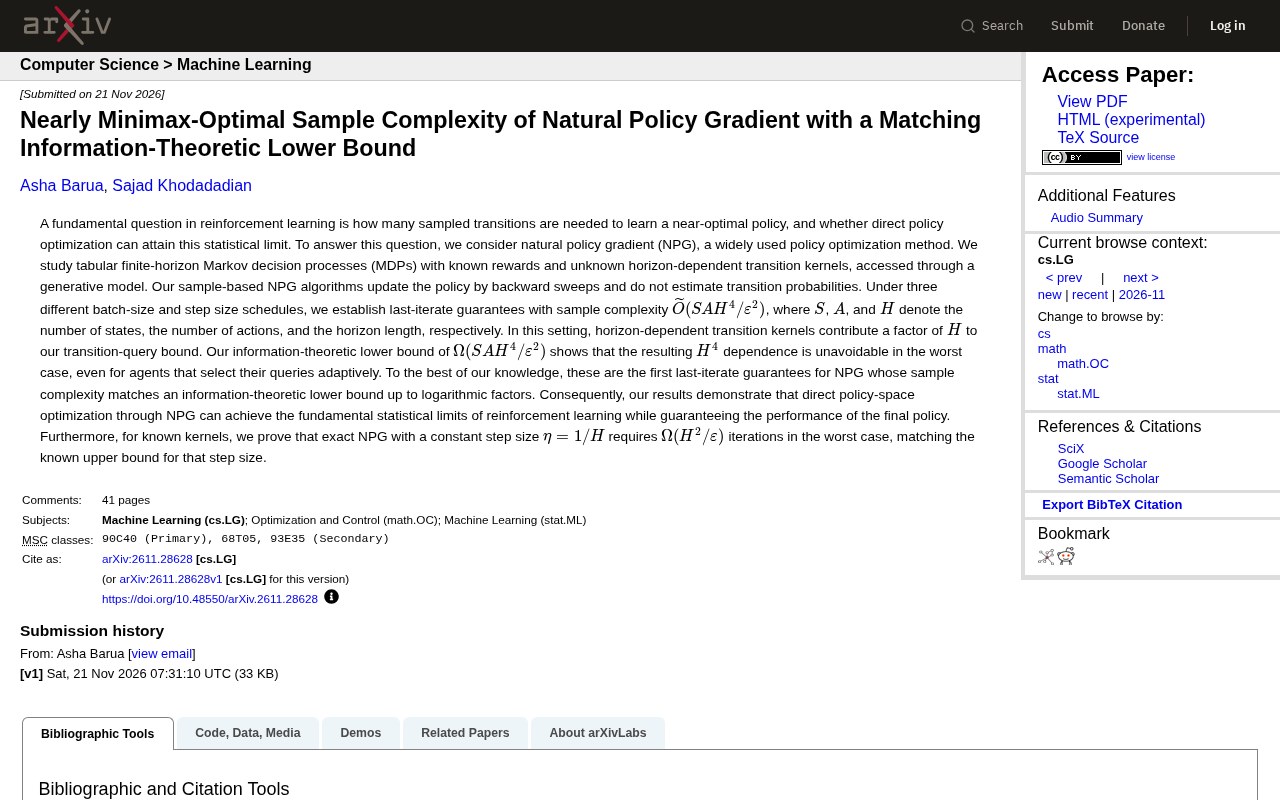
NPG achieves Õ(SAH⁴/ε²) sample complexity in tabular MDPs, matching the information-theoretic lower bound—the first proof of last-iterate optimality.
This study focuses on tabular finite-horizon MDPs and proves for the first time that the last-iterate sample complexity of Natural Policy Gradient (NPG) is Õ(SAH⁴/ε²), matching the information-theoretic lower bound Ω(SAH⁴/ε²) up to logarithmic factors, thereby establishing the minimax optimality of NPG. The proposed algorithm updates the policy via backward scanning without explicitly estimating transition probabilities, and holds under three batch size and step size scheduling schemes. The authors also prove the inevitability of the H⁴ horizon dependence via a matching lower bound construction, and analyze the iteration complexity of exact NPG with known transition kernels, proving that a constant step size η=1/H requires Ω(H²/ε) iterations, matching the known upper bound. This work provides a rigorous theoretical foundation for the statistical efficiency of direct policy optimization.
Title
Natural Policy Gradient Achieves Minimax-Optimal Sample Complexity: Theory and Lower Bound Match for the First Time
Meta Description
A new theoretical study proves that Natural Policy Gradient (NPG) achieves minimax-optimal sample complexity Õ(SAH⁴/ε²) in tabular MDPs and establishes a matching information-theoretic lower bound Ω(SAH⁴/ε²), achieving for the first time a last-iterate guarantee that matches the theoretical limit.
Article Content
A fundamental question in reinforcement learning is: how many sampled transitions are needed to learn a near-optimal policy? Can direct policy optimization attain this statistical limit? A theoretical study on Natural Policy Gradient (NPG) provides an affirmative answer. In tabular finite-horizon MDPs, the study proves for the first time that the last-iterate sample complexity of NPG matches the information-theoretic lower bound up to logarithmic factors.
Background: Sample Complexity and Direct Policy Optimization
In reinforcement learning, sample complexity measures the minimum number of transition samples required to learn an ε-optimal policy. Traditionally, value-based methods (such as Q-learning) have well-established sample complexity analyses in tabular MDPs, whereas the statistical efficiency of direct policy optimization methods (such as policy gradient) has long lacked tight theoretical characterization.
Natural Policy Gradient (NPG) introduces Fisher information matrix preconditioning and empirically exhibits faster convergence than vanilla policy gradient. However, whether its sample complexity has reached the information-theoretic limit has remained undetermined. This study focuses on tabular finite-horizon MDPs, assuming known rewards, unknown and horizon-dependent transition kernels, and an agent that obtains sampled transitions through a generative model.
Natural Policy Gradient (NPG) is a variant of policy gradient methods whose core idea is to precondition the gradient using the Fisher Information Matrix in the policy parameter space. Vanilla policy gradient updates parameters directly along the direction of the policy gradient, whereas NPG adjusts the update direction via the inverse of the Fisher information matrix, giving parameter updates better geometric properties in the sense of KL divergence over policy distributions. In tabular MDPs, the NPG update can be equivalently expressed as mirror descent over the policy space, where the Fisher information matrix corresponds to the entropy-regularized geometry on the policy simplex. This preconditioning mechanism makes NPG empirically converge faster than vanilla policy gradient and more robust to the choice of step size. However, the statistical efficiency of NPG—i.e., the sample size required to achieve an ε-optimal policy—has long lacked a tight theoretical characterization, and this paper fills that gap.
Algorithm Design and Theoretical Guarantees
The sampling-based NPG algorithm proposed in the study updates the policy via backward scanning and does not explicitly estimate transition probabilities. This design avoids additional error from transition probability estimation, allowing policy updates to act directly in the policy space.
Under three different batch size and step size scheduling schemes, the authors establish last-iterate guarantees with sample complexity Õ(SAH⁴/ε²), where S, A, and H denote the number of states, number of actions, and horizon length, respectively. It is worth emphasizing that this guarantee concerns the performance of the final policy, rather than the average iterate or the minimum over the policy sequence.
Under horizon-dependent transition kernel settings, the contribution of the horizon length H to the upper bound on transition queries is an H⁴ factor. This dependence may appear high, but the authors prove via an information-theoretic lower bound that it is unavoidable.
Last-iterate guarantees and average-iterate guarantees are two different paradigms in convergence analysis of optimization algorithms. An average-iterate guarantee means that the average policy (or average parameters) of the algorithm's iteration sequence satisfies the error bound, whereas a last-iterate guarantee requires that the policy ultimately output by the algorithm (i.e., the policy obtained at the last iteration) directly satisfies the error bound. In reinforcement learning, last-iterate guarantees are usually stronger and more aligned with practical applications—since deployment uses the final policy, not the average policy. However, last-iterate analysis is often much more difficult than average-iterate analysis, especially in policy gradient methods, because policy updates may oscillate. This paper establishes the first last-iterate sample complexity guarantee for NPG, and this guarantee matches the information-theoretic lower bound, significantly strengthening the theoretical strength of the previously only available average-iterate guarantees.
Information-Theoretic Lower Bound: The Necessity of the H⁴ Dependence
A core contribution of the study is the establishment of an information-theoretic lower bound Ω(SAH⁴/ε²). This lower bound shows that even if the agent can adaptively choose queries, the H⁴ dependence is unavoidable in the worst case. This means that the sample complexity of NPG is minimax optimal up to logarithmic factors.
To the authors' knowledge, this is the first NPG sample complexity result whose last-iterate guarantee matches the information-theoretic lower bound. Prior work either provided only average-iterate guarantees or had a polynomial gap between sample complexity and the lower bound. This matching theoretically confirms that direct policy space optimization can achieve the fundamental statistical limit of reinforcement learning.
An information-theoretic lower bound refers to the minimum sample size required by any algorithm (regardless of computational feasibility) to achieve a certain accuracy within a given class of statistical models. It characterizes the fundamental statistical limit of the problem, independent of any specific algorithm. In reinforcement learning, information-theoretic lower bounds are usually proved by constructing two hard-to-distinguish MDP instances: these two MDPs differ only slightly in transition kernels but have significantly different optimal policies, so any algorithm needs enough samples to distinguish them and output an ε-optimal policy. The lower bound Ω(SAH⁴/ε²) constructed in this paper shows that even if the agent can adaptively choose queries (i.e., active learning), the H⁴ horizon dependence cannot be avoided in the worst case. This fully matches the upper bound Õ(SAH⁴/ε²) of NPG up to logarithmic factors, thereby proving that NPG is minimax optimal.
Iteration Complexity with Known Transition Kernels
In addition to sample complexity, the authors also analyze the iteration complexity of exact NPG in the known transition kernel setting. They prove that exact NPG with a constant step size η=1/H requires Ω(H²/ε) iterations in the worst case, matching the known upper bound for this step size. This result completes the complexity picture of NPG in the exact setting.
Significance and Outlook
The theoretical significance of this study is that it aligns the sample complexity of NPG with the information-theoretic lower bound for the first time, providing a rigorous foundation for the statistical efficiency of direct policy optimization methods. On the practical side, although the analysis targets tabular MDPs, its methodology—combining last-iterate analysis with matching lower bound construction—may inform policy optimization analysis under more complex function approximation settings.
Future directions include extending the analysis to linear MDPs or general function approximation, and exploring adaptive step size scheduling to further improve constant factors. Regardless, this work is an important step toward understanding the statistical limits of policy gradient methods.
One-line Summary
NPG achieves Õ(SAH⁴/ε²) sample complexity in tabular MDPs, matching the information-theoretic lower bound, the first proof of last-iterate optimality.
Paragraph Summary
This study focuses on tabular finite-horizon MDPs and proves for the first time that the last-iterate sample complexity of Natural Policy Gradient (NPG) is Õ(SAH⁴/ε²), matching the information-theoretic lower bound Ω(SAH⁴/ε²) up to logarithmic factors, thereby establishing the minimax optimality of NPG. The proposed algorithm updates the policy via backward scanning without explicitly estimating transition probabilities, and holds under three batch size and step size scheduling schemes. The authors also prove the inevitability of the H⁴ horizon dependence via a matching lower bound construction, and analyze the iteration complexity of exact NPG with known transition kernels, proving that a constant step size η=1/H requires Ω(H²/ε) iterations, matching the known upper bound. This work provides a rigorous theoretical foundation for the statistical efficiency of direct policy optimization.
Related articles

HN Warning: Don't Use AI to Write Comments, or They'll Be Auto-Deleted
Hacker News warns that AI-written comments will be automatically deleted. This article analyzes HN's automated enforcement mechanism, the community's attitude toward AI-generated content, and what it means for creators using AI tools responsibly.

AI Product Manager Systematic Course for Beginners: Three Modules Explained with Pitfall Avoidance Guide
Breakdown of Bilibili's 100-episode AI product manager course: Foundation builds large model and Prompt cognition, Advanced tackles Agent workflows and RAG knowledge bases, Practice completes projects like personal knowledge bases and intelligent customer service. Includes learning roadmap and pitfall avoidance tips.

YOLO Object Detection for Absolute Beginners: Environment Setup and Core Concepts
Learn YOLO object detection from scratch: Python basics, VS Code, Miniconda environment setup. A Bilibili tutorial guides you step by step, with a desktop icon recognition project as your hands-on goal.