NautilusTrader: A Production-Grade Quantitative Trading Engine Built with Rust

NautilusTrader uses Rust and deterministic event-driven architecture to bridge the gap between backtest and live trading.
NautilusTrader is a rising open-source quantitative trading engine that combines a Rust-native core with Python interfaces. Its deterministic event-driven architecture ensures backtest code runs identically in live trading, eliminating the traditional research-production gap. With 25K+ GitHub stars, it represents a structural shift in quant infrastructure from scripted backtesting to production-grade engineering.
A Rising Open-Source Quantitative Infrastructure
In the world of algorithmic trading, there has always been a difficult-to-reconcile contradiction: the research phase demands flexible and rapid iteration, while live trading requires extreme performance, stability, and determinism. Traditional approaches often adopt a dual-track model — Python for research, C++ for production — at the cost of maintaining two codebases, two sets of logic, and an almost impossible-to-eliminate gap between backtest and live trading results.
This Python+C++ dual-track model has existed in the quantitative industry for over a decade. The research phase uses Python (with libraries like NumPy, Pandas, and Zipline) for rapid strategy prototyping and backtesting, while the production phase rewrites core logic in C++ to meet microsecond-level latency requirements. The core problem with this model is what the industry calls "Backtest Delusion" — due to subtle differences between the two codebases in floating-point precision, event processing order, and order matching logic, strategies that perform brilliantly in backtests often degrade significantly in live trading. Industry estimates suggest the code rewrite from research to production typically takes 2-6 months, with an extremely high probability of introducing new bugs.
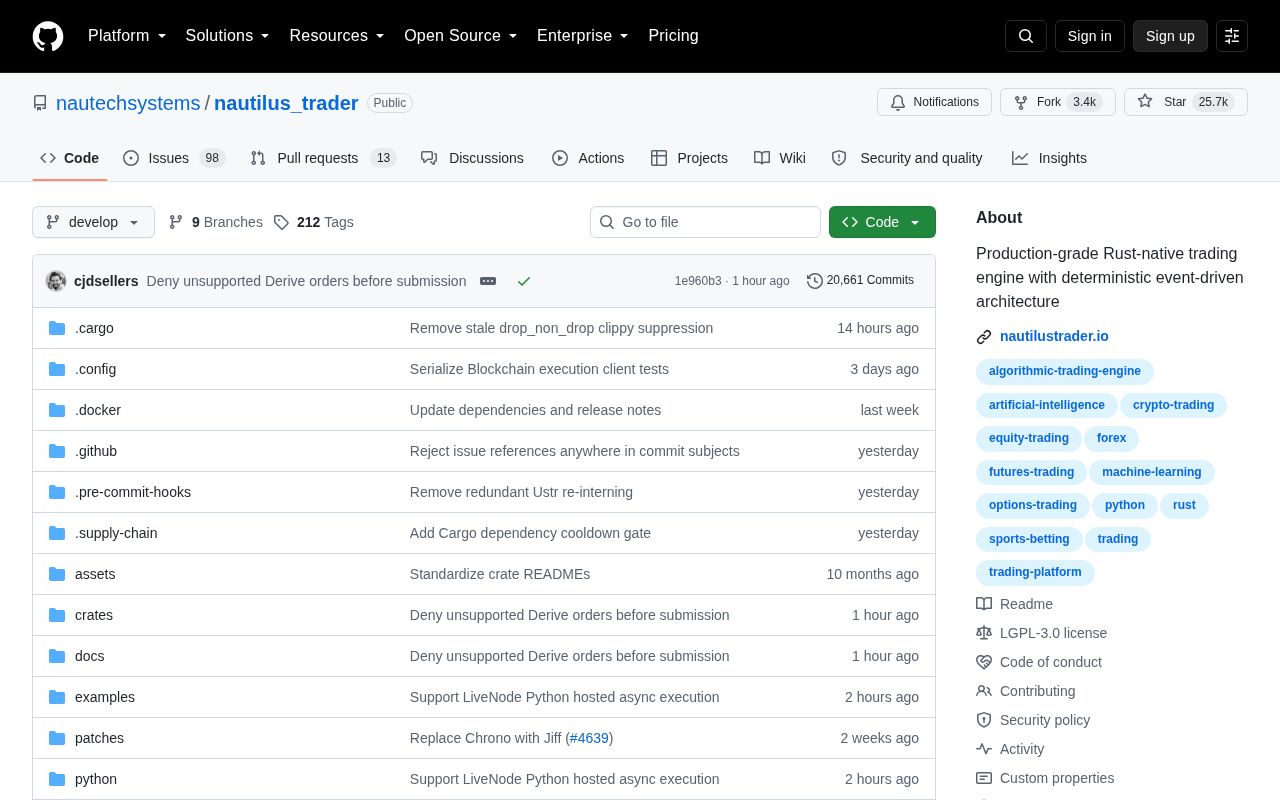
NautilusTrader is an open-source project that targets precisely this pain point. As a "Rust-native, production-grade, event-driven" trading engine, it has been performing impressively on GitHub — accumulating 25,659 Stars and 3,357 Forks, while maintaining a pace of 58 new stars per day. For a specialized vertical domain like quantitative trading, these numbers are remarkably impressive.
Core Design: Deterministic Event-Driven Architecture
Why "Determinism" Is the Key
NautilusTrader's most noteworthy design philosophy is its deterministic event-driven architecture. Determinism means that given the same input data and strategy logic, the system produces completely identical results every time it runs.
From a computer science perspective, determinism means that given the same initial state and input sequence, a program undergoes exactly the same state transitions and produces the same output on every execution. Achieving determinism in a trading system faces numerous challenges: platform differences in floating-point arithmetic, non-deterministic multi-thread scheduling, system clock precision issues, and more. NautilusTrader addresses this by encapsulating all external interactions (market data, order feedback, timer triggers, etc.) as immutable event objects and processing them in strict timestamp order within a single ordered queue, eliminating sources of non-determinism at the architectural level. This design draws from the Event Sourcing pattern — the system's complete state can be fully reconstructed by replaying the event sequence, which also makes debugging, auditing, and compliance tracing possible.
This is critically important for quantitative trading. The value of backtesting lies in predicting how a strategy will perform in real markets. If the backtest engine and live engine exhibit behavioral differences, then even the most beautiful backtest curve may be nothing more than an illusion. Through its unified event-driven kernel, NautilusTrader allows backtest code to be deployed to live trading without any modifications, fundamentally eliminating the "research-production" gap.
The Engineering Significance of Event-Driven Design
Event-driven architecture abstracts all activities — market data, orders, fills, risk management — into a series of ordered event streams. The engine processes these events in chronological order, naturally fitting the time-sensitive requirements of trading scenarios.
In quantitative trading systems, there are three common architectural paradigms: Polling, Batch, and Event-Driven. Polling systems check market state at fixed intervals — simple but introducing latency and resource waste. Batch systems (like traditional vectorized backtesting frameworks such as Backtrader and Zipline) load historical data all at once for matrix operations — fast but unable to accurately simulate order book dynamics and real-time interactions. Event-driven systems simulate the asynchronous nature of information arrival in real markets — every tick, every order status change is an independent event, processed by the engine in arrival order. While this approach may not match vectorized solutions in pure backtesting speed, it can precisely simulate slippage, partial fills, market impact, and other real-market microstructure effects, dramatically improving the credibility of backtest results.
Performance and Safety Dividends from Rust
The "Rust-native" positioning is another major highlight. Choosing Rust over traditional C++ or pure Python reflects the team's dual pursuit of performance and safety.
Rust's advantages are particularly well-suited to quantitative trading scenarios:
-
Near-C++ runtime performance: Low latency is the lifeline of high-frequency and medium-frequency strategies. Rust's zero-cost abstractions meet the stringent requirements for throughput and latency. Zero-Cost Abstraction means that the high-level abstractions developers use (generics, traits, iterators, etc.) generate machine code after compilation that is identical in performance to manually written low-level code, with no runtime overhead. In quantitative contexts specifically, this means developers can write trading logic using elegant strategy abstraction layers, while the compiler optimizes it into highly efficient instructions approaching hand-written assembly. By comparison, Python's function call overhead is approximately 50-100x that of C/Rust, and even with acceleration tools like Cython or Numba, it's difficult to compete with natively compiled languages on latency-sensitive paths.
-
Memory safety without GC: Rust's Ownership system is its most revolutionary language feature. Every value has exactly one owner at any given time, and the lifetime of values is strictly tracked at compile time by the Borrow Checker. This means null pointer dereferences, Use-After-Free, Data Races, and other memory safety issues notorious in C/C++ simply cannot pass compilation in Rust. According to statistics from Microsoft and Google, approximately 70% of security vulnerabilities and system crashes originate from memory safety issues. Furthermore, Rust has no garbage collector (GC), avoiding the latency spikes caused by GC pauses (Stop-The-World Pauses) in languages like Java/C# — in high-frequency trading, a single GC pause of tens of milliseconds could mean losses of tens of thousands of dollars.
-
Concurrency-friendly: Trading engines need to simultaneously handle multiple market data feeds and multiple strategies. Rust's concurrency model makes such high-concurrency logic safer and easier to implement.
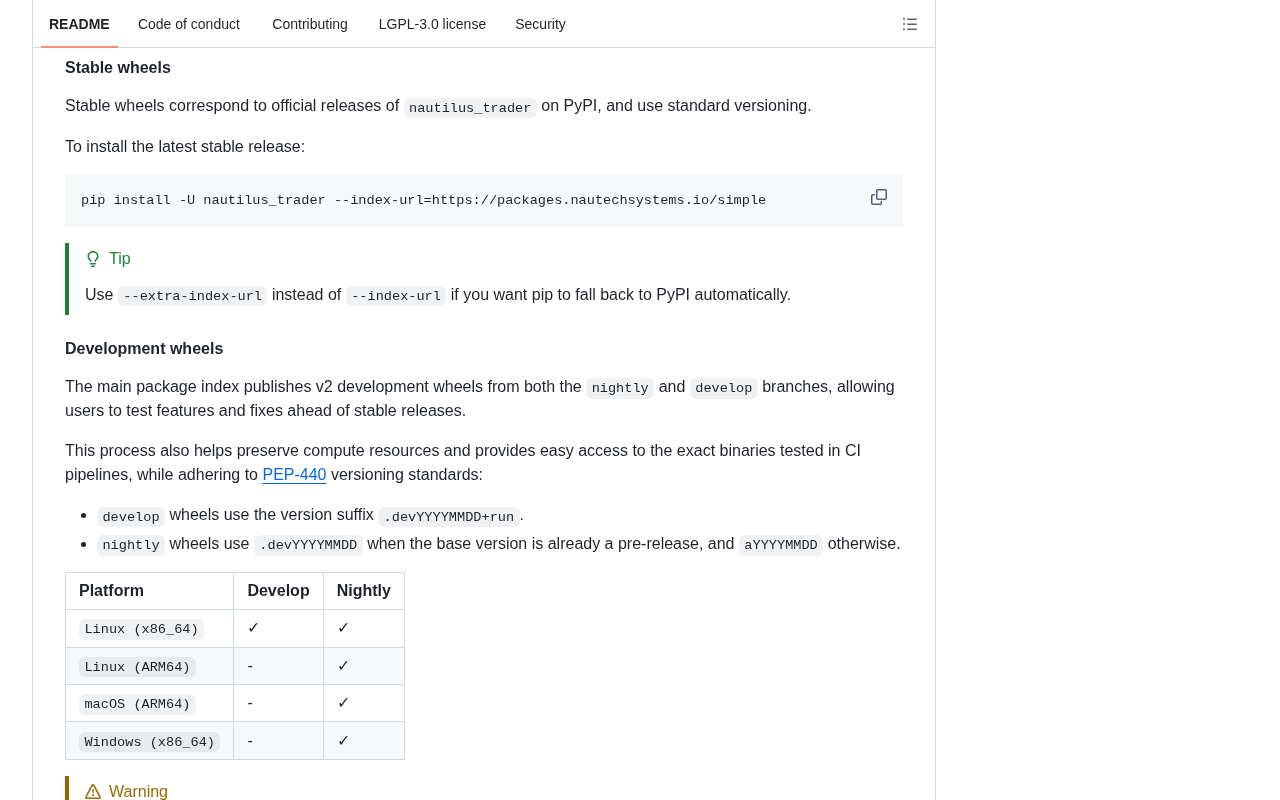
It's worth noting that despite the core being implemented in Rust, NautilusTrader still provides Python interfaces for strategy developers. This "Rust kernel + Python upper layer" combination preserves development efficiency for strategy research while delegating performance-critical paths to Rust — an architectural paradigm that has become highly favored in the quantitative and data infrastructure space in recent years.
This paradigm has become a mainstream trend in data and quantitative infrastructure. Notable examples include: Polars (a Rust-core DataFrame library as a high-performance alternative to Pandas), Ruff (a Rust-implemented Python linter, 10-100x faster than Flake8), Pydantic V2 (core validation logic rewritten in Rust with 5-50x performance improvement), and DataFusion in the database space. This pattern achieves seamless interoperability between the two languages through PyO3 (an FFI bridging library between Rust and Python): performance-critical event loops, order matching, and risk calculations are handled by Rust, while strategy logic, data analysis, and visualization — user-facing components — retain Python's ecosystem advantages and development efficiency. Developers can use most framework features without learning Rust, but can dive into the Rust layer when deep customization is needed.
What "Production-Grade" Really Means
Open-source quantitative frameworks are not uncommon, but few truly dare to claim production-grade status. Most open-source backtesting tools stop at the research stage, lacking the complete capabilities for connecting to real exchanges, handling exceptions, and managing risk.
NautilusTrader's production-grade positioning is reflected in several key dimensions:
- Live trading connectivity: Supports connections to multiple exchanges and data sources, with complete pipelines for real order submission, cancellation, and position management.
- Robust fault tolerance: Clear handling strategies for real-world complexities such as network interruptions, data anomalies, and order rejections.
- Backtest-live consistency: The same strategy code can seamlessly switch between both modes — this is the core competitive advantage of a production-grade framework.
The complexity of real trading environments far exceeds backtest scenarios, and this point deserves elaboration. Common exceptional situations include: reconnection and state synchronization after exchange API disconnections, timeout handling when orders receive no response for extended periods, filtering and alerting when market data contains gaps or anomalous values, automatic reconciliation when account funds or positions are inconsistent with the exchange, and resource isolation and risk exposure aggregation when running multiple strategies in parallel. Production-grade frameworks typically also need to support graceful shutdown — ensuring that all pending order states are known, positions are reconciled, and incomplete operations are properly handled when the system needs to restart or upgrade, rather than brutally terminating processes and risking capital. These seemingly trivial engineering details are often the critical watershed that separates "toy projects" from "production systems."
Who Should Pay Attention to NautilusTrader
For individual quantitative enthusiasts, NautilusTrader provides a free, industrial-grade engine, avoiding the high cost of building infrastructure from scratch. For small quantitative teams and proprietary trading firms, it can serve as a unified platform for strategy development and deployment, significantly reducing engineering burden. For Rust developers, it's also an excellent example for learning high-performance system design and event-driven architecture.
Of course, barriers still exist. To fully leverage its capabilities, users need a certain level of quantitative trading knowledge and programming ability. Deep customization of the Rust kernel requires corresponding language proficiency.
Conclusion
NautilusTrader's rising popularity reflects a structural upgrade in the quantitative trading open-source ecosystem — from "able to backtest" to "able to produce," from scripted assembly to engineered architecture.
This upgrade follows a clear historical trajectory. The quantitative trading open-source ecosystem has gone through several distinct phases: 2012-2016 saw the rise of first-generation Python backtesting frameworks represented by Zipline (open-sourced by Quantopian), which lowered the barrier to strategy research but stopped at backtesting; 2016-2020 saw the emergence of second-generation frameworks like Backtrader and VNPY that focused on live trading connectivity, but remained constrained by Python's performance bottlenecks and architectural limitations; from 2020 to present, as the Rust ecosystem matures and the quantitative industry demands higher engineering quality, third-generation frameworks represented by NautilusTrader have begun to emerge, characterized by compiled-language kernels, industrial-grade architectural design, and research-production integration. This trend is also closely related to cryptocurrency market development — 24/7 uninterrupted trading, fragmented liquidity across dozens of exchanges, and new trading paradigms brought by DeFi all place higher demands on trading infrastructure.
NautilusTrader uses Rust's performance and safety as its foundation and deterministic event-driven design as its methodology, attempting to bridge the long-standing gap between research and live trading.
For any developer who is serious about strategy deployment, an open-source engine that continuously gains community recognition and approaches industrial standards is well worth placing on their technology radar.
Related articles

Chain of Thought Isn't Just for AI: How Humans Can Use CoT to Improve Thinking Quality
Chain of Thought isn't just a prompt trick for large models. Starting from a Hacker News discussion, this article analyzes why CoT works for human thinking too, breaks down actionable ways to transfer it, and highlights the key differences between human CoT and machine CoT.
Cloudflare Teams Up with OpenAI: Closi…
Cloudflare Teams Up with OpenAI: Closing the Loop from Vulnerability Discovery to Defense with AI
Cloudflare uses OpenAI Daybreak to investigate security vulnerabilities and generate reviewable remediation plans, while developers use Codex to boost coding efficiency and quality.

Orca Multi-Agent Orchestration in Practice: A Guide to Parallel Collaboration with Claude and Codex
Orca is Stable AI's free open-source agent workbench supporting 34 agents like Claude Code and Codex in parallel. Learn its Git worktree isolation, multi-model orchestration, and mobile management.